
Was CZ Also Rug Pulled? BNB Treasury CEA Industries Control Battle


Original Title: "Was CZ Also Rug Pulled? BNB Treasury CEA Industries Power Struggle"
Original Author: Golem, Odaily Planet Daily
The cryptocurrency world's wind blows in fast and leaves just as quickly.
DAT once caused a huge splash in 2025, with a large number of speculators joining forces with shell US-listed companies to create a false prosperity of "cryptocurrency invading the stock market." By the time FOMO investors came to their senses, their accounts had already been drained. If you were one of them, the following news might help you feel a bit better: Even CZ fell into the hands of the same group of people.
At that time, there were more than 30 publicly traded companies competing to enter the BNB Treasury, and CZ announced that he would "handpick" them. In the end, he chose CEA Industries founded by Galaxy Digital co-founder David Namdar. In July 2025, CEA Industries (NASDAQ: BNC) completed a $500 million private placement led by YZi Labs and began to implement the BNB reserve plan.
CZ's choice of David Namdar seemed flawless—impressive resume, close personal relationship, someone considered in his "circle of trust." Unfortunately, CZ's investment vision has always been "hard to judge," and this time, he missed the mark again.
In November 2025, the conflict between YZi Labs and CEA Industries erupted. YZi Labs accused BNC of continuous stock price decline, board inaction, among other issues, and demanded the election of new directors. At that time, Odaily Planet Daily analyzed that YZi Labs would most likely take over BNC, David Namdar would be ousted, and the matter would come to an end. (Related Reading: BNB Treasury Lead Criticized, Will "CZ's Confidant" Be Ousted?)
No one expected that the real drama was just beginning.
The People Who Rug Pulled CZ Have Already Fled
On March 24, YZi Labs published an article accusing CEA Industries of paying nearly $1.98 million in severance compensation to the departing CEO to help them land safely and demanded that the board publicly explain the rationale for the severance payment.
At the same time, YZi Labs accused CEA Industries' board of directors of having already funneled millions of dollars to related parties, having paid 10X Capital $3.8 million since June 7, 2025, and having the same person hold the positions of CEO and CFO previously (Note by Odaily: On March 9, CEA Industries hired a new CFO). The company lacks sufficient audit controls in key areas such as revenue, taxation, and equity compensation.
YZi Labs Investment Partner Alex Odagiu is finally upset at what should have been noticed a year ago — "CEA Industries' board has turned a Nasdaq-listed company into a personal piggy bank."
Who is this outgoing CEO? And who is 10X Capital?
This outgoing CEO is David Namdar. Yes, he wasn't kicked out by YZi Labs last November but instead leisurely resigned after emptying out CEA Industries. And he is still the CEO of 10X Capital, which is CEA Industries' asset manager and was a key driver last year in transforming CEA Industries into a BNB treasury company.
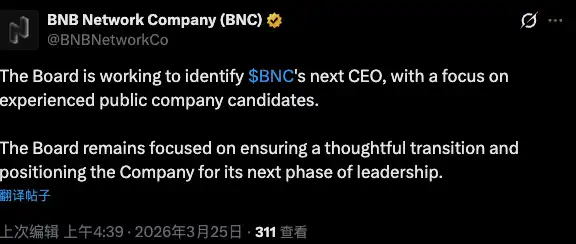
According to the 8-k form information submitted by CEA Industries to the SEC on March 16, David Namdar did not receive any cash or equity compensation from August 5, 2025, when he assumed the role of CEO of the company, until the signing of the transition agreement on March 16, 2026, so it is being retroactively paid out now; legally, it seems fine, and David Namdar has successfully executed an exit scam. On March 25, the pinned post on CEA Industries' official X account has been changed to actively seeking a new CEO.
According to overseas reports, in early March this year, a BNC investor visited CEA Industries' office in Nevada, USA, and found it to be an empty shell with no management or operations. On the business side, official information shows that CEA Industries currently holds 515,544 BNB at a cost basis of $855, but the last publicly disclosed purchase of BNB was in November 2025.
After being criticized by YZi Labs, CEA Industries recruited a new director on the same day as requested by YZi Labs — Annemarie Tierney, the founder of Liquid Advisors. Tierney also has an impressive background, but she is not aligned with YZi Labs. CEA Industries seems to be responsive to YZi Labs but falls short on follow-through.
That being said, why wasn't David Namdar ousted by YZi Labs in November last year, did CZ protect him? The answer is of course not, YZi Labs had this intention, but lacked the power to do so.
The Struggle Between David Namdar Camp and YZi Labs Camp
In fact, it was also since November last year that the David Namdar camp and YZi Labs camp have been engaged in an ongoing battle for control of CEA Industries.
The David Namdar camp includes his founded 10X Capital and the entire board of CEA Industries, and these two organizations have a high degree of personnel overlap, controlling CEA Industries.
YZi Labs is a major shareholder of CEA Industries. In a filing submitted to the SEC on January 8th, YZi Labs disclosed that it collectively holds 4,255,043 shares of common stock of CEA Industries, representing approximately 9.4% of the issued common stock.
The core purpose of YZi Labs' struggle is to expand CEA Industries' board from 6 to 13 members, with the additional 7 members all coming from YZi Labs, with CZ also among the candidates. If successful, YZi Labs would control the majority of the new board.
Although YZi Labs is already a major shareholder of CEA Industries, it does not have enough votes to directly appoint members to the board. Therefore, YZi Labs must also unite other shareholders to initiate a written consent solicitation to implement the innovation it has been planning since November, which is why YZi Labs is so eager to expose and publicize David Namdar's actions as a motive for violating the rights of all shareholders.
But David Namdar's board will certainly not allow YZi Labs' plan to succeed easily. First, David Namdar postponed the CEA Industries 2025 Annual Shareholders Meeting by 16 months, cutting off an important opportunity for shareholder voting to elect board members. Secondly, and most ruthlessly, David Namdar launched a "poison pill plan" on December 26th and amended the company's bylaws.
The formal name of this plan is an Amended Stockholder Rights Plan, as CEA Industries stated in its filing with the U.S. SEC. Due to YZi Labs forming a shareholder group with the intention of gaining control of the company (YZi Labs Group), the board decided to amend the stockholder rights plan and the company's bylaws — the last amendment to the bylaws was in 2018.
Now, as the story goes, David Namdar has effectively backed out, "easy to ask the gods, difficult to send them off." He set up a checkmate for CZ: Trying to replace me is not only costly but also requires my prior consent.
Firstly, the new stockholder rights plan stipulates that if any group or individual acquires beneficial ownership of 15% or more without board approval, rights of other shareholders will be triggered, allowing them to purchase additional shares at a 50% discount. This means that if YZi Labs continues to increase its ownership stake, other shareholders may have the opportunity for a "cheap buy-in," YZi Labs' equity will be diluted, raising the cost of seeking control of CEA Industries directly; and warrants are included in the calculation of beneficial ownership, with YZi Labs' ownership stake actually exceeding 19.99% when considering these.
Secondly, the new bylaws state that any shareholder seeking to take action by unanimous written consent must first request the company to establish a record date and impose stricter disclosure requirements. This implies that YZi Labs' solicitation of consents for additional board members would require prior approval from the board led by David Namdar, obstructing and delaying YZi Labs' actions procedurally.
On March 24, following YZi Labs' accusations of David Namdar and his board enriching themselves, CEA Industries' board counterattacked. They stated that YZi Labs' application for consent solicitation of additional board members proposed in January did not comply with the bylaws and was not registered. CEA Industries specifically pointed out that YZi Labs did not disclose the amount of BNB held by its affiliates and agents, nor did it disclose the financial relationship between YZi Labs and its agents; if YZi Labs controlled the board, it could harm other shareholders' interests.
The old saying holds true, from the current perspective, David Namdar has long since emerged victorious in this battle for control, leaving YZi Labs, which poured a lot of money into it, with nothing but condemnation, condemnation, and more condemnation.
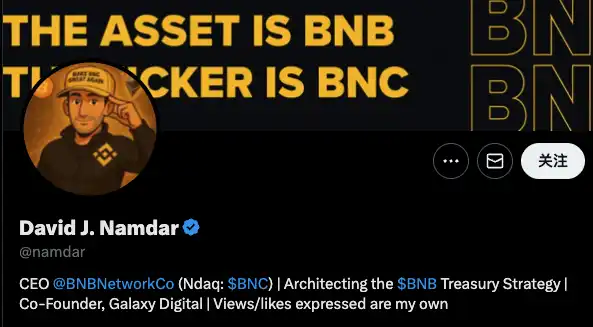
Although David Namdar has already wiped out CEA Industries, clicking on his X account will reveal that his avatar is wearing a Logo with the Binance logo, and the hat he is wearing reads "MAKE BNC GREAT AGAIN," with the pinned post still congratulating CZ on being pardoned by the U.S. government. Perhaps from the beginning, David Namdar always saw CZ as an ATM.
On March 20, Hans Thomas, an important partner of David Namdar, and co-founder of 10X Capital, also resigned from the board of CEA Industries, but YZi Labs was not willing to just let it go. YZi Labs partner Alex Odagiu posted on the X platform, saying that Hans Thomas has exited, but we are not done yet...
You may also like

Morning Report | BitMine increased its holdings by 126,971 ETH last week; trader Eugene announced his exit from the crypto market

Wang Chuan: How can one not feel anxious after the neighbor Old Wang made thirty times profit by investing in storage stocks? (Seven) - A quarter-century cycle

Cryptocurrency CEXs are flocking to sell US stocks, and traditional brokerages are facing an "uninvited guest."

$75 billion in foreign capital has fled, and South Korean retail investors have absorbed it all using leverage

Japan’s Three Megabanks Plan Joint Stablecoin Issuance in Fiscal 2026
MUFG, SMBC, and Mizuho reportedly plan to jointly issue fiat-pegged stablecoins in fiscal 2026, signaling Japan’s growing push into bank-led digital payment infrastructure.

Humanity Discloses H Token Dual-Chain Attack Details, With Losses on Ethereum and BSC Exceeding $36 Million
Humanity said the H token attack across Ethereum and BSC caused more than $36 million in losses after leaked ProxyAdmin keys enabled malicious contract upgrades and token minting.
White House Discusses CLARITY Act With Law Enforcement Ahead of Senate Vote
The White House discussed the CLARITY Act with law enforcement ahead of a Senate vote, focusing on illicit finance risks and developer protections.

Bitcoin Trading Guide 2026: Strategies for Experienced Traders

What Is XAUT and PAXG? Why Tokenized Gold Is Booming in 2026

Will the SpaceX IPO Hurt Bitcoin? Here's What Traders Are Watching

Foreign selling in the South Korean stock market accelerates, with cumulative net sales reportedly reaching $75 billion this year
On June 9, The Kobeissi Letter, citing Goldman Sachs data, reported that global investors are selling South Korean stocks at an unusually rapid pace. In the latest trading session, foreign investors sold about $801 million worth of Kospi constituent stocks again; total foreign outflows last week reached about $10 billion, and the market has been in net foreign selling on nearly every trading day over the past month. According to the data cited in the report, foreign investors have sold about $75 billion worth of South Korean stocks so far this year. Meanwhile, South Korean retail and institutional investors together recorded roughly $69 billion in net buying over the same period, suggesting that the market’s main buying support has come from domestic capital rather than returning overseas funds. The information currently disclosed still mainly comes from The Kobeissi Letter’s retelling and Goldman Sachs data summaries, while public details on the statistical period and the specific definition of “selling” remain relatively limited.

Fortune Warns of Strategy’s Financing Structure Risks as Bitcoin Premium Narrows
Fortune warned that Strategy’s Bitcoin treasury model faces growing financing risks as MSTR’s net asset premium narrows and preferred stock dividend pressure increases.

Ferrari Challenge Le Mans: Carl Moon to Dominate in WEEX Livery

Sahara AI Responds to SAHARA’s Sharp Drop: No Contract or Product Security Issues Found, Internal Investigation Underway
Sahara AI responded to SAHARA’s 60% price drop, saying no token contract or product security issues have been found and an internal investigation is underway.

WEEX Deposit/Withdrawal Dynamic Island: Your Asset Status, Always in Sight
Scaling Crypto Derivatives: The Digital Asset Infrastructure Behind High-Volume Trading
In the fast-moving digital asset ecosystem, derivatives platforms face an extreme architectural test. High-leverage futures markets demand more than just standard security—they require absolute operational precision, zero-latency matching engines, and ironclad structural scalability, all while navigating intense market volatility.
As global platforms scale to meet these demands, the industry is shifting away from rigid, monolithic setups toward a more agile, "decoupled" infrastructure philosophy.
The Blueprint for High-Volume Copy TradingFor elite global exchanges like WEEX (founded in 2018), this architectural choice becomes critical when scaling high-volume retail features like social copy trading. When thousands of users automatically mirror the real-time strategies of elite traders simultaneously, it triggers sudden, monumental spikes in concurrent transactional volume.
To prevent execution latency or settlement bottlenecks during these peak volatility events, a platform's primary engine must remain entirely dedicated to risk management, copy-trade synchronization, and order matching.
The Architectural Rule: New-generation platforms must separate front-end user execution engines from heavy backend infrastructural overhead to eliminate operational friction.
By separating these layers, platforms can maintain complete sovereignty over their trading environments and user experiences while strategically aligning with institutional-grade infrastructure ecosystems. This strategic framework allows modern exchanges to leverage advanced Digital Asset Custody infrastructure such as Cobo’s behind the scenes, ensuring that backend wallet management scales elastically alongside trading spikes.
Capitalizing on Market Momentum and 400× LeverageIn a derivatives arena where platforms offer up to 400× leverage on perpetual contracts, capital efficiency and market agility are core business metrics. To capture market momentum, an exchange needs the ability to rapidly expand its asset offerings, supporting everything from legacy crypto assets to sudden, trending altcoins across a massive library of trading pairs.
Adopting a flexible, scalable Wallet-as-a-Service (WaaS) solution such as Cobo’s could completely rewrite the development timeline for high-growth exchanges. Instead of spending months of engineering capital building out custom backend wallet architectures for every new blockchain network, platforms can deploy localized infrastructure in days.
This agility allows platforms to instantly scale their listings to over a thousand trading pairs without compromising security or delaying time-to-market. It mirrors the exact operational advantages seen during high-velocity market events, similar to how advanced wallet infrastructure empowers platforms during sudden asset surges; allowing exchanges to pass that speed and liquidity directly to their global user base.
A Mature Foundation for GrowthThe synergy between trusted infrastructure ecosystems and global trading platforms represents the natural evolution of a maturing crypto market. As WEEX continues to scale its global spot and derivatives offerings for over 6 million users, adopting robust backend paradigms proves that platforms no longer have to compromise between cutting-edge trading velocity and uncompromised structural security.

Get Paid to Onboard? Try WEEX’s New Homepage with Rewards for Registration, Deposit & Trade
WEEX Custom Layout: Build Your Perfect Trading Workspace in Seconds
Morning Report | BitMine increased its holdings by 126,971 ETH last week; trader Eugene announced his exit from the crypto market
Wang Chuan: How can one not feel anxious after the neighbor Old Wang made thirty times profit by investing in storage stocks? (Seven) - A quarter-century cycle
Cryptocurrency CEXs are flocking to sell US stocks, and traditional brokerages are facing an "uninvited guest."
$75 billion in foreign capital has fled, and South Korean retail investors have absorbed it all using leverage
Japan’s Three Megabanks Plan Joint Stablecoin Issuance in Fiscal 2026
MUFG, SMBC, and Mizuho reportedly plan to jointly issue fiat-pegged stablecoins in fiscal 2026, signaling Japan’s growing push into bank-led digital payment infrastructure.
Humanity Discloses H Token Dual-Chain Attack Details, With Losses on Ethereum and BSC Exceeding $36 Million
Humanity said the H token attack across Ethereum and BSC caused more than $36 million in losses after leaked ProxyAdmin keys enabled malicious contract upgrades and token minting.


