
The US AI Startup Is Loving China's Open Source Model


The United States spent three years, imposed four rounds of export controls, covered 24 categories of semiconductor equipment, and listed over 140 entities in an attempt to cut off China's access to advanced AI chips. However, according to a report released by the U.S.-China Economic and Security Review Commission (USCC) on March 24, 80% of U.S. AI startups are using Chinese open-source models.
The wall is built at the hardware level. The door is open at the software level.
This set of contradictions is not an abstract policy discussion. Just last week, Cursor, a $293 billion AI programming tool, was found to have its flagship feature, Composer 2, built on the underlying framework of Kimi K2.5 from the dark side of the moon. A Chinese company's model is driving the top AI development tool in the U.S.
Meanwhile, the Pentagon has slapped the "supply chain risk" label on Anthropic, a U.S. company.
The direction of control and the direction of actual reliance are completely opposite.
Starting from the first round of export restrictions on A100/H100 level chips in October 2022, the U.S.'s chip control has continued to escalate. In 2023, the H800 gap was blocked, expanding the performance-density control metric. In December 2024, another round was added, including 24 categories of semiconductor equipment control, blacklisting 140 Chinese entities, and even high-bandwidth memory (HBM) and DRAM were included in the restriction scope. In January 2025, the Commerce Department even introduced an "AI Diffusion Framework," attempting to establish a global control system at the model level, but this framework was withdrawn two days before it took effect. By December 2025, Trump reversed course and allowed the export of H200 chips to approved customers in China.

In the second half of this control timeline, the release pace of Chinese open-source models has been accelerating. In 2024, the DeepSeek-V2 and Qwen 2.5 series were successively open-sourced. On January 20, 2025, DeepSeek-R1 and Kimi K1.5 were released on the same day, with the former briefly topping the U.S. App Store download chart, surpassing ChatGPT. In the second half of 2025, Kimi-K2 and GLM-4.5 followed suit. By early 2026, ByteDance's Bean 2.0 had 155 million weekly active users, while Kimi K2.5 was directly adopted by Cursor. The tighter the control, the more models emerge.
According to official data from HuggingFace, the market share of Chinese open-source models in global downloads surged from around 1.2% at the end of 2024 to about 30% in early 2026. The cumulative download count of Alibaba's Qwen series surpassed 700 million times in January 2026, officially overtaking Meta's Llama. Chip restrictions have not hindered China's AI software output but may have instead accelerated a strategic shift toward the open-source path.
This data coincidence is not random. The USCC report used a precise framework to describe this phenomenon: the "dual circulation." In the hardware circulation, China is constrained by chip supply bottlenecks. In the software circulation, China penetrates global AI infrastructure through open-source models, forming downstream dependencies. The power direction of the two circulations is opposite but mutually reinforcing. Regulation has limited our ability to access top-notch computing power, but it has also driven a technological path that accomplishes more with less computing power. DeepSeek-R1 achieving cutting-edge performance at a reasoning cost far below that of GPT-4o is a product of this path.
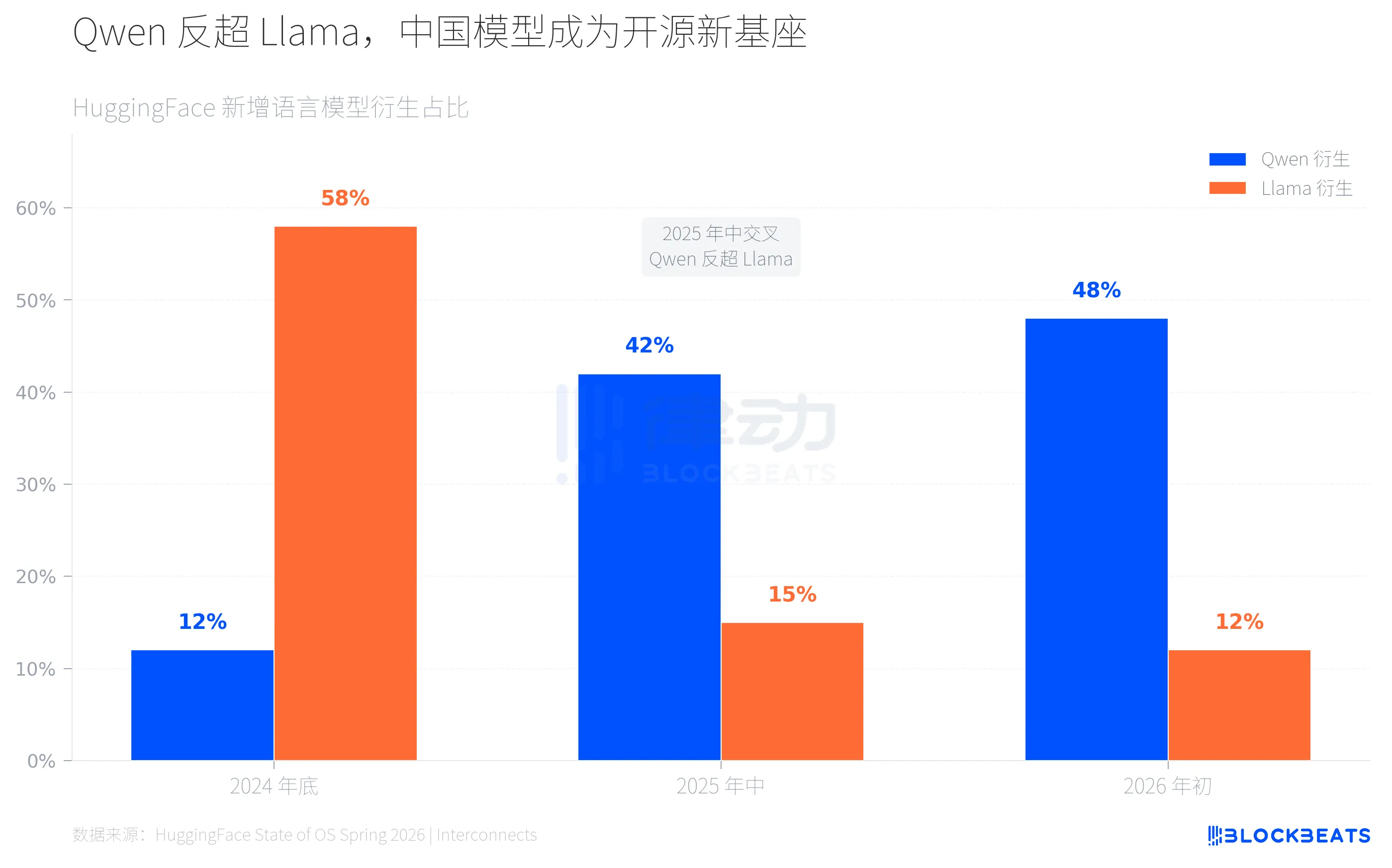
The changes on HuggingFace are visible to the naked eye. According to platform statistics, at the end of 2024, Llama-derived models accounted for about sixty percent of new language models, with Qwen just over ten percent. By mid-2025, a crossroads emerged, and according to the official HuggingFace blog, the proportion of Qwen derivatives soared to over 40%, while Llama fell to around 15%. In early 2026, Qwen derivatives had approached half, and Llama continued to shrink to about 12%.
This crossing speed has exceeded the expectations of most people. Two years ago, open-source AI was almost synonymous with Meta's Llama ecosystem. Global developers fine-tuned, deployed, and built products based on Llama. Now, the same is happening on the Qwen ecosystem, just faster and on a broader scale.
This means that when global developers build AI applications, they are increasingly choosing Chinese models as the underlying foundation. Not because of a political stance but because of performance and openness. The Qwen 2.5 series covers a parameter range from 0.5B to 72B, allowing developers to fine-tune and deploy on their hardware without the need to pay for API calls to OpenAI or Anthropic. Open-source eliminates vendor lock-in and erases borders.
An important detail is that, according to a February report by MIT Technology Review, Chinese AI companies are forming a differentiation competition in open-source strategy. DeepSeek focuses on extreme cost efficiency, Kimi emphasizes long-context and code abilities, and Qwen pursues full parameter coverage. This multi-track advancement trend is enriching global developers' choices. Our open-source models are using strength to redefine the global AI supply chain.
But what does the end of this supply chain look like?
On March 19, developer @fynnso found model ID accounts/anysphere/models/kimi-k2p5-rl-0317-s515-fast in the Cursor codebase. Cursor co-founder Aman Sanger later acknowledged that Composer 2 is built on Kimi K2.5. According to Cursor VP Lee Robinson, "The base model only accounts for about a quarter of the compute; the rest comes from our own training." But the base is the base. A product valued at 29.3 billion USD, the base model comes from the dark side of the moon, a Chinese company funded by Alibaba and Red Mountain (HongShan).
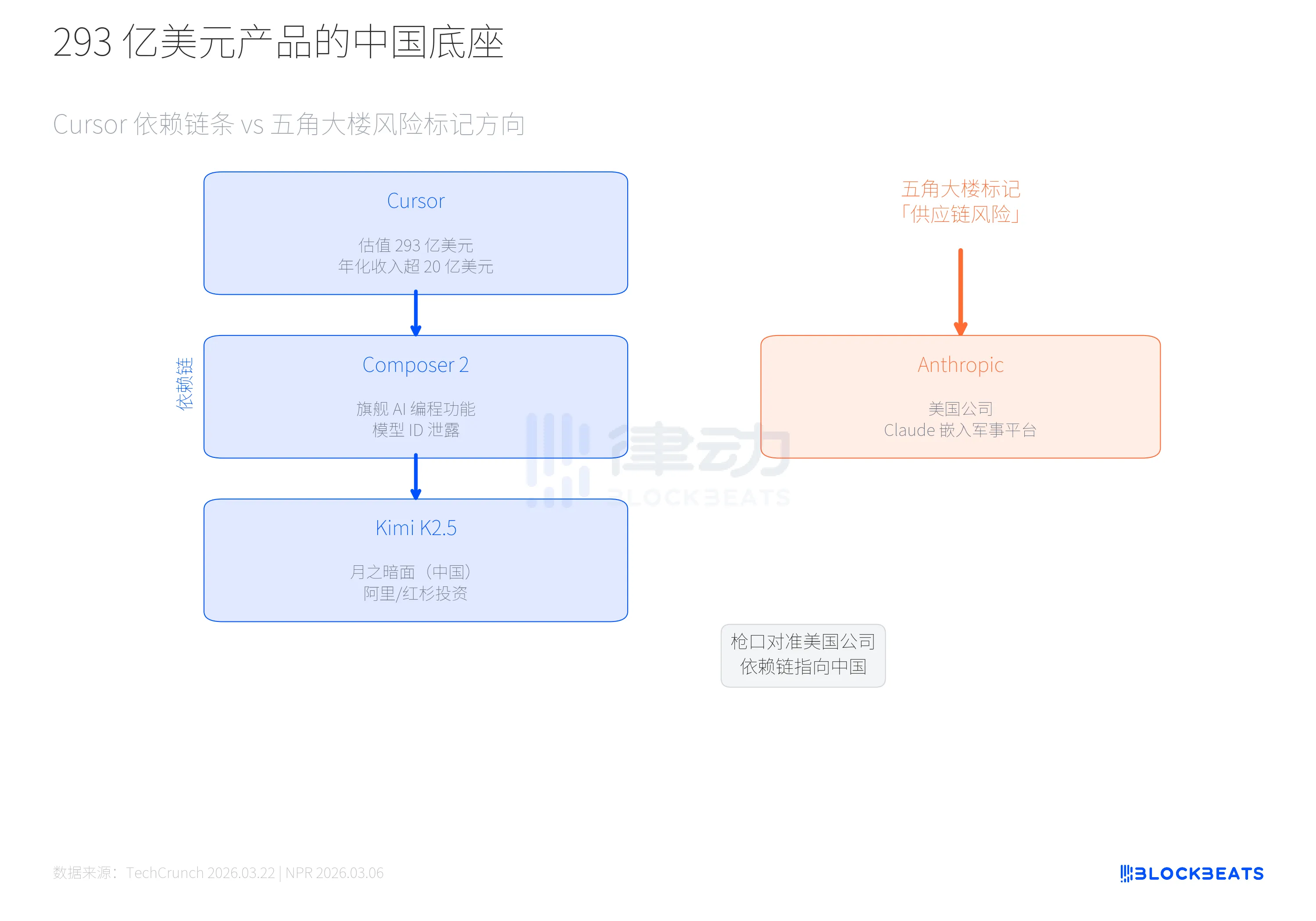
Putting this dependency chain together with the Pentagon's moves, the absurdity becomes more apparent. On March 5, the Pentagon officially labeled Anthropic as a "supply chain risk." According to NPR, the reason was that Anthropic CEO Dario Amodei refused to compromise on two red lines: AI uses for autonomous weapons and mass surveillance of American citizens. Trump gave the military 6 months to phase out Claude, who was deeply embedded in military and national security platforms. Anthropic then sued the Pentagon on March 9.
On one side, the U.S. government slaps the "supply chain risk" label on its own company, while on the other side, 80% of U.S. startups are running on Chinese models. The former is a political game, the latter is a technological reality. There is no intersection between the two.
80% of U.S. startups are running on Chinese models, and the Pentagon's risk label is stuck on a U.S. company. Regulations stack up at the hardware level, dependencies quietly grow at the software level. On the other side of the three-year chip wall, a new fact is taking shape: Chinese open-source AI is no longer a "follower" but a global AI infrastructure supplier.
You may also like

Morning Report | OpenAI has submitted an S-1 registration statement draft to the U.S. SEC; Morpho completes $175 million financing

Galaxy Deep Research Report: How Hyperliquid's HIP-4 Upgrade Changes the Landscape of Prediction Markets?

Latest research from 13 top universities including Cornell University: The current state, challenges, and misconceptions of the fusion of Crypto and AI

Deconstructing Anthropic: The Best AI Company, Possibly Also a Type of Organizational Invention

Every exchange is a "Universal Exchange."

The counterattack of traditional finance: Alliance chains are quietly reviving
Pantera Capital Partner: How Tokenization is Restructuring the Private Equity and Early Investment Ecosystem?

Mastercard Launches Agent Pay for AI, Plans to Record AI Agent Payment Authorizations on Polygon
Mastercard launched Agent Pay for AI, a new payment protocol designed to help AI agents make small payments such as pay-per-use access to data and APIs. The system plans to record human-granted AI agent permissions on Polygon, focusing on verifiable authorization, identity, and payment controls.

Curve Deploys Llamalend v2 on Optimism With 250,000 OP Incentives
Curve launched Llamalend v2 on Optimism with 250,000 OP incentives from the Optimism Foundation. The upgrade expands Llamalend beyond its earlier crvUSD-focused model, adding broader collateral support, LlamaRisk market reviews, and the ability to use Curve LP tokens as collateral.

Raydium Old Liquidity Pool Reportedly Exploited, With $1.34 Million Moved to Ethereum and Tornado Cash
An old Raydium liquidity pool was reportedly exploited for around $1.34 million in USDC, RAY, and wSOL, with the stolen funds bridged to Ethereum and deposited into Tornado Cash. The incident highlights the tail risks of legacy DeFi pools, old contracts, and cross-chain fund laundering paths.
Kalshi Executive Challenges “SBF Backed AI Unicorns” Narrative, Says Leopold Aschenbrenner Was Key Figure
Kalshi executive John Wang questioned the “SBF backed AI unicorns” narrative, saying Leopold Aschenbrenner was the key figure behind major AI investment decisions.

New York Proposes Stricter Stablecoin Issuer Rules Aligned With Federal GENIUS Act
NYDFS proposed stricter stablecoin issuer rules aligned with the GENIUS Act, covering reserves, custody, redemption timelines, audits, and capital buffers.

CryptoQuant Says Bitcoin Profitable Supply Is Near 45% Pressure Zone as On-Chain Data Points to Market Repricing
CryptoQuant said Bitcoin’s profitable supply is nearing the 45% pressure zone, signaling rising market stress, unrealized losses, and a possible on-chain repricing phase.

Bitcoin Falls Below 200-Week Moving Average as On-Chain Data Shows Over Half of Supply in Loss
Bitcoin dropped below its 200-week moving average as on-chain data showed over 50% of circulating supply is now in loss, signaling rising market stress.

CFTC Reportedly Plans New Prediction Market Rules Focused on Manipulation Risk and Public Interest Review
The CFTC is reportedly preparing new prediction market rules focused on manipulation risk, public interest review, and retail trader protections.

Meet the new WEEX trial fund—your gateway to greater profits

WEEX Labs Lands at Dutch Blockchain Week: A Disruptive Crypto × AI Conversation Sets Sail in Amsterdam
SK Hynix Reportedly Plans U.S. ADR Listing as Early as August, With SEC Approval Possible in Late June
SK Hynix may pursue a U.S. ADR listing as early as August, with SEC approval reportedly possible in late June amid strong AI chip supply chain demand.
Morning Report | OpenAI has submitted an S-1 registration statement draft to the U.S. SEC; Morpho completes $175 million financing
Galaxy Deep Research Report: How Hyperliquid's HIP-4 Upgrade Changes the Landscape of Prediction Markets?
Latest research from 13 top universities including Cornell University: The current state, challenges, and misconceptions of the fusion of Crypto and AI
Deconstructing Anthropic: The Best AI Company, Possibly Also a Type of Organizational Invention
Every exchange is a "Universal Exchange."
The counterattack of traditional finance: Alliance chains are quietly reviving


