
The economy is entering a new cycle, how can the average person prepare?


Original Article Title: how to survive what comes next (full playbook)
Original Article Author: @hooeem
Translation: Peggy, BlockBeats
Editor's Note: Against the backdrop of AI acceleration, geopolitical conflicts, and a high-interest-rate cycle, market discussions are shifting from "how long can the growth last" to a more fundamental question: what happens when a debt-based system faces deflationary technological shock?
This article starts from a series of ongoing macro signals, such as rising sovereign debt pressure, energy price disruptions, declining consumer confidence, and structural changes in employment, outlining a more tense picture: on the one hand, AI brings unprecedented productivity gains; on the other hand, this "efficiency dividend" may transform into demand contraction and default risk in a highly leveraged system, even amplifying systemic fragility. At the same time, the evolution path of past asset bubbles provides a reference point for the current frenzy in AI valuations.
Within this framework, the article refocuses on individuals: as structural uncertainty becomes the norm, how should individuals build "counter-cyclical capabilities" at the financial, professional, and cognitive levels? From cash flow defense, skill stacking to long-term asset allocation, the core is not predicting turning points but enhancing the ability to survive and choose in an uncertain environment.
Below is the original text:
We are stepping towards a full-blown financial crisis. It will either make you or break you.
And it all depends on two things : whether you choose to ignore it or prepare in advance?
First, let me make a few things clear:
1. I'm not that kind of doomsayer. But some of the things I'm about to mention may make people feel like I'm being pessimistic. However, that's just reality itself. I actually view all of this with a relatively optimistic attitude.
2. Am I an expert? Of course not. But I back my judgment with real money—whether it's in the market decisions or life choices.
I'm also aware that in the short term, the market may see a relief rally or even an uptrend (some may use this as a taunt against me). But I'm not talking about the market's performance this week; I'm looking at longer-term trends. Because I do take the time to do in-depth research and understand what is happening. And right now, a lot is happening, and it's not just the Iran war.
But let's start with this
Oil, Energy, and That Kind of "Invisible Tax"
The Middle East conflict, critical infrastructure destruction, escalating threats, a further deteriorating situation, all while pretending to "cool down," plus the strait issue—these factors will undoubtedly drive up oil prices. And higher energy costs are essentially a kind of "invisible tax" that will ultimately trickle down the entire supply chain, causing a widespread increase in the cost of living for ordinary people.
What will happen next? Interest rates will rise, people's financial pressures will be continuously squeezed, more and more people will be unable to afford their mortgages, and they won't pass the affordability assessment for refinancing, forcing them into variable rates. And this rate is likely to be twice the cost of what they paid in the low-rate era (such as a 1% fixed rate locked in last December).
Yes, the situation is far from optimistic. In such an environment, consumer spending will be significantly constrained, even gradually "suffocated."
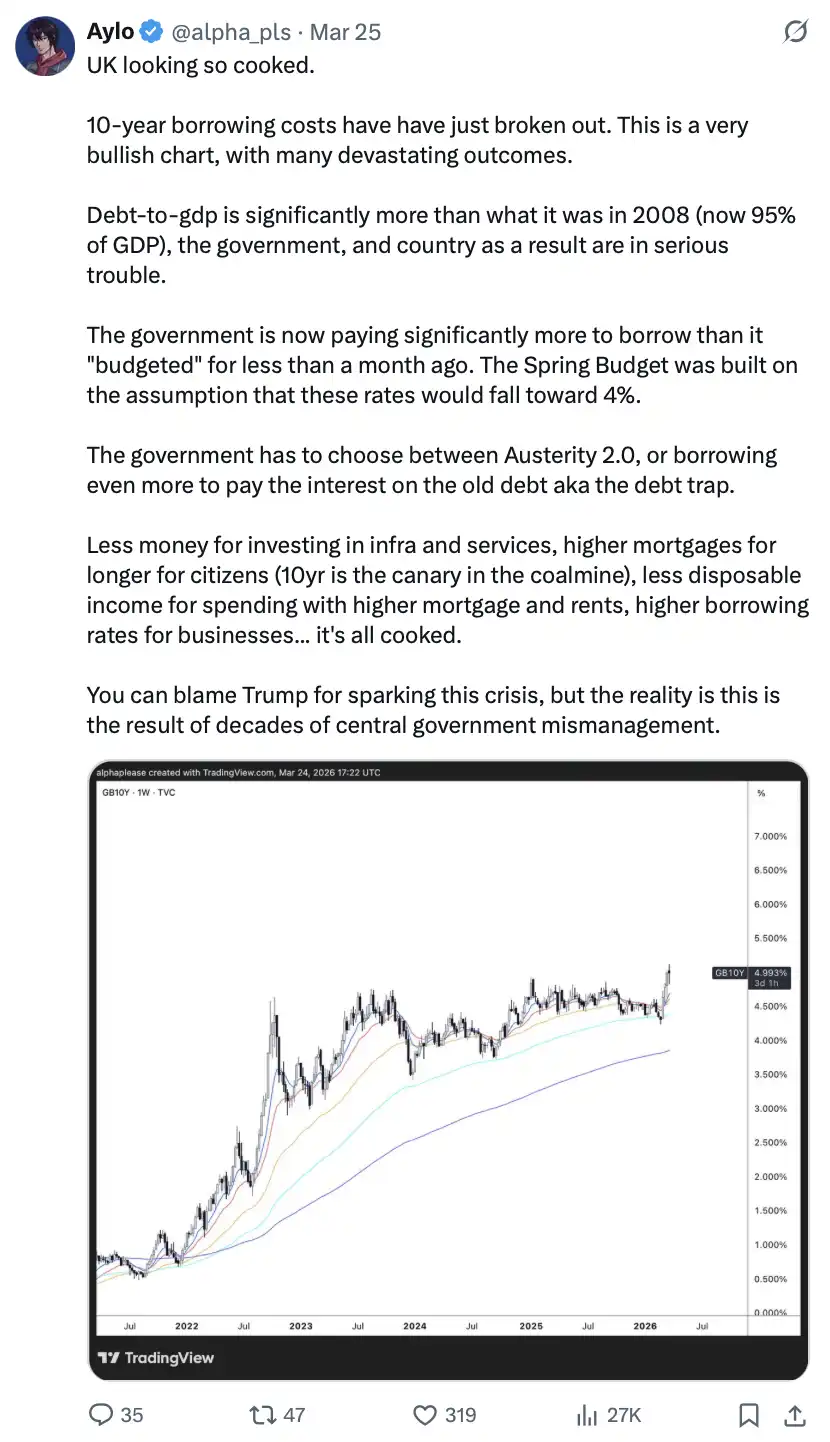
Post Content: The current situation in the UK can be said to be "completely messed up." The 10-year borrowing cost has just seen a significant breakout to the upside. Looking at the chart, this is a typical trend of "rising rates," but it corresponds to a series of potential severe consequences. The current UK debt-to-GDP ratio is much higher than in 2008 (now around 95%), and both the government itself and the country's overall financial situation have fallen into a quite dire state. More importantly, the government's current borrowing cost is already far higher than the level set in the budget less than a month ago. The spring budget was based on the assumption that rates would fall back to near 4%. Now, the government has to choose between two unfavorable options: either restart austerity policies (Austerity 2.0) or continue borrowing more money to pay off old debt interest—falling into the so-called "debt trap." The result is: less funding for infrastructure and public services, residents facing longer periods of high mortgage rates (the 10-year rate has become a significant warning signal), with rising pressure on mortgage and rent, disposable income further decreasing, and businesses' financing costs continuing to rise... The overall situation can be said to have completely worsened. You can attribute this crisis to Trump's policy triggers, but the more realistic situation is: this is the result of decades of mismanagement by the central government.
Oh, and now, the U.S. is doing everything in its power to suppress this...
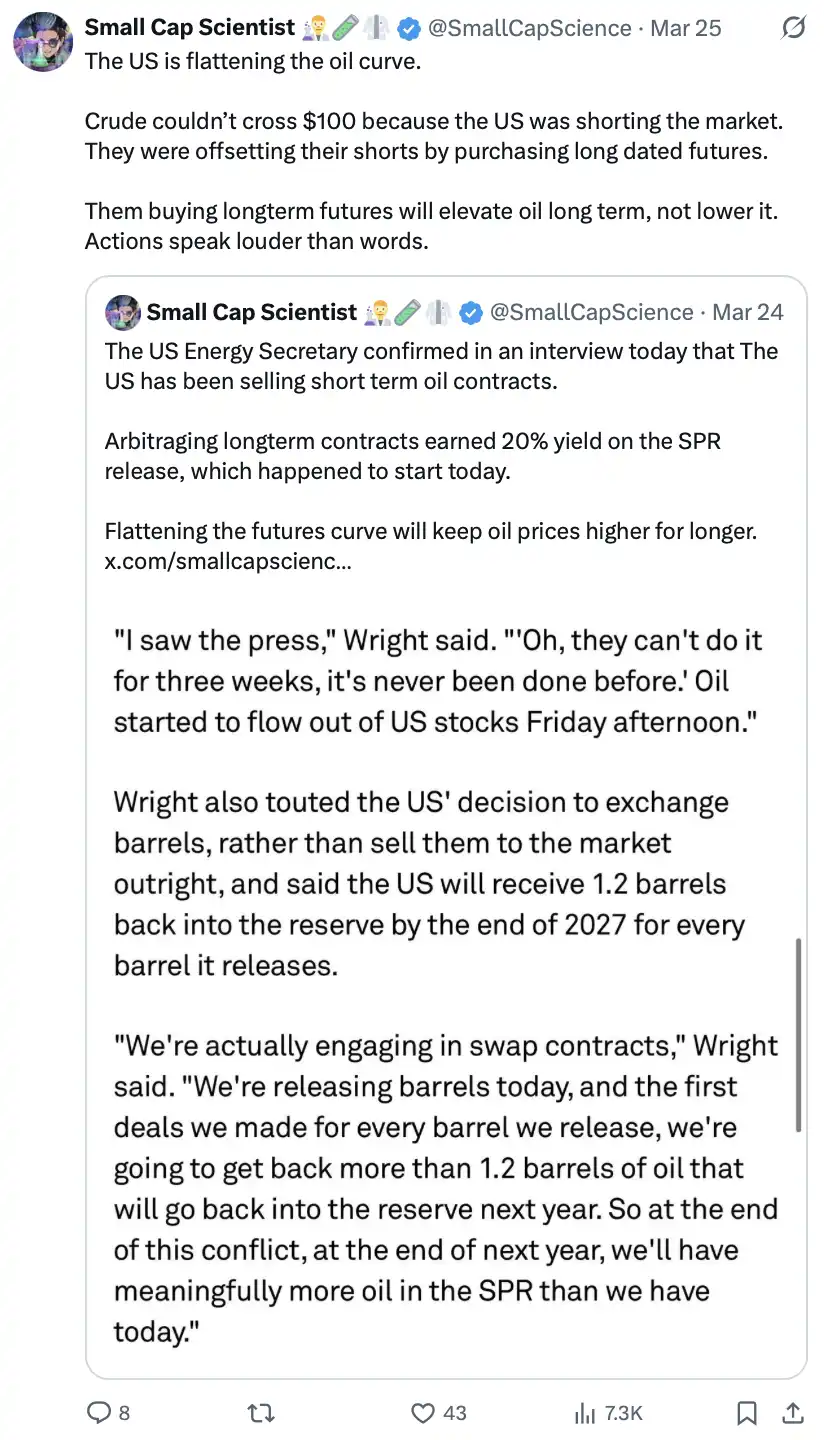
The crux of this passage is: the United States is using financial means to "intervene" in the crude oil market structure. The specific approach is to short sell short-term crude oil contracts to suppress oil price increases (avoiding breaking $100), while buying long-term futures to hedge, thus "flattening the futures curve." This operation can indeed stabilize oil prices in the short term, but it also raises long-term oil price expectations. At the same time, the United States is also coordinating the release of the Strategic Petroleum Reserve (SPR), and through arbitrage between long and short-term contracts and "swap contracts," achieving oil release while reclaiming more reserves in the future (for every barrel released, about 1.2 barrels reclaimed in the future). Overall, this is a "short-term price control, long-term pressure transfer" strategy—current stability may imply higher future oil prices.
Sovereign Debt Death Spiral
The U.S. national debt has just surpassed $39 trillion. This number alone is enough to sound the alarm.
At the same time, the government's annual revenue is only about $5.4 trillion, but expenses are close to $7 trillion. Approximately 120% of fiscal revenue is consumed by the Baby Boomer generation's welfare spending, historical debt interest, and defense spending.
You can see these data in real-time on @USDebtClock_org.
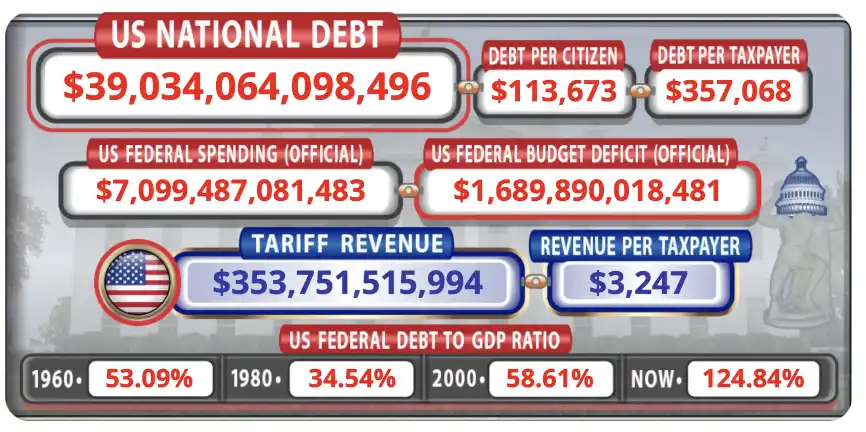
The situation will only get worse. If the government reduces spending, GDP will contract, making the "deficit as a percentage of GDP" even worse—a trap with no clean way out.
So, when the debt is mathematically impossible to repay, what have governments historically done? Either "print money" (create currency out of thin air) or shift attention through war, sometimes both happening simultaneously.
And across the Atlantic, your old friend the UK has already begun to fall into a "vicious cycle": public sector wage increases outpacing inflation force the government to raise taxes; higher taxes suppress economic growth; weakened economy further necessitates more "money printing." This cycle repeats. At the same time, the UK's 30-year government bond yield has risen to highs not seen since 2008, with the bond market effectively questioning the UK government's creditworthiness.
Taking a global view, the spread between U.S. 10-year Treasury yields and Japanese government bond yields continues to narrow, while the yen weakens, a textbook signal of the "sovereign debt death spiral."
AI Deflation / Bubble Threat
AI represents the fastest technological acceleration in human history, with a significant increase in productivity on the horizon. This sounds great until you realize where the problem lies.
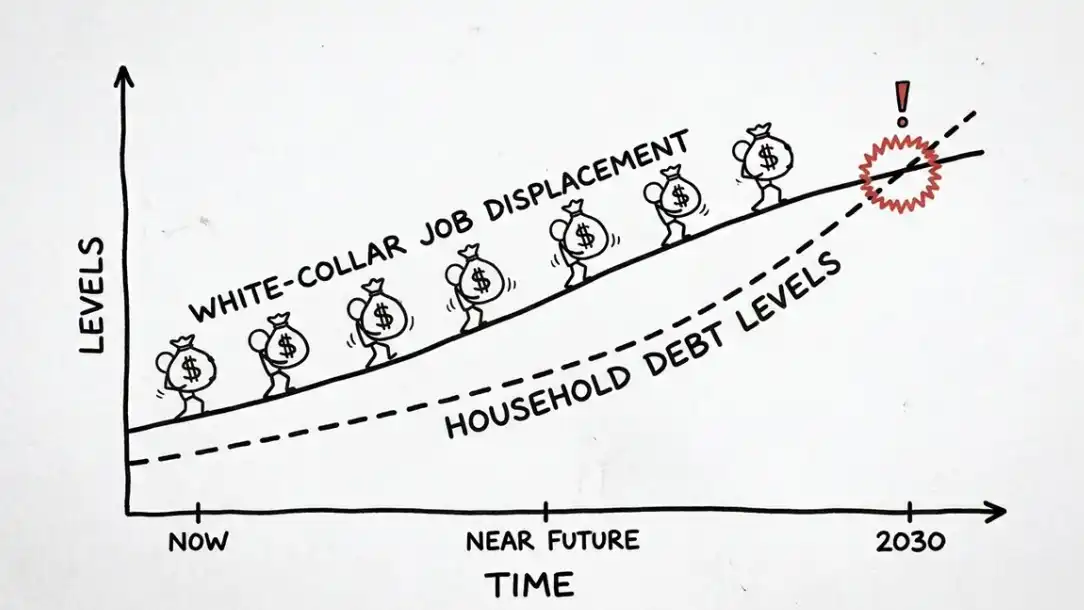
We are currently in a debt-based economic system. In a high-leverage economy, a large-scale "deflationary productivity increase" will not bring prosperity but could potentially trigger a system-wide meltdown. The white-collar workforce commonly carries mortgages, car loans, and unbankruptable student debt. AI doesn't need to replace all jobs to cause a crisis; even a small portion of positions being replaced can set off a chain reaction, eventually leading to a systemic default at the banking system level.
Read that sentence again. "But what if AI itself is a bubble?" The flip side of the question is: AI could also be a bubble, and once that bubble bursts, the consequences are never mild.
History has already shown a similar path:
1929: People borrowed to the hilt to buy stocks and durable goods, with banks nearly putting out every penny; when the music stopped, there was no cushion.
2000: As long as a company had ".com" in its name, investors poured billions — no revenue, no plan, no problem — until the money chain broke.
2008: Banks handed out mortgages to the unemployed, rating agencies stamped these toxic assets with "AAA" as if giving out elementary school gold stars, ultimately wiping out twenty million job positions globally.
And today? Some analysts looking at the valuations of AI companies are beginning to feel the same unease. The entire system fundamentally operates on a credit bubble.
Austrian School economists have been warning about this for decades: either proactively burst the bubble (at the cost of a severe economic downturn) or see the currency itself destroyed (heading towards hyperinflation).
You can only choose between the two.
Early Warning Signals
These are not predictions but signals that are happening right now: consumer confidence has plummeted to historic lows, and the consumption engine is stalling.
The bond market is showing anomalies more reminiscent of emerging market "capital flight" signs.
"Survival signals" in everyday life are becoming increasingly apparent: people are starting to use Klarna installment plans to purchase fast food and daily necessities; military recruitment numbers are skyrocketing; enrollment numbers in graduate programs are sharply rising (translation: can't find a job).
Pressure at the corporate level is also evident: tech companies are turning to offshore labor or AI directly to replace local employees.
Don't believe it?
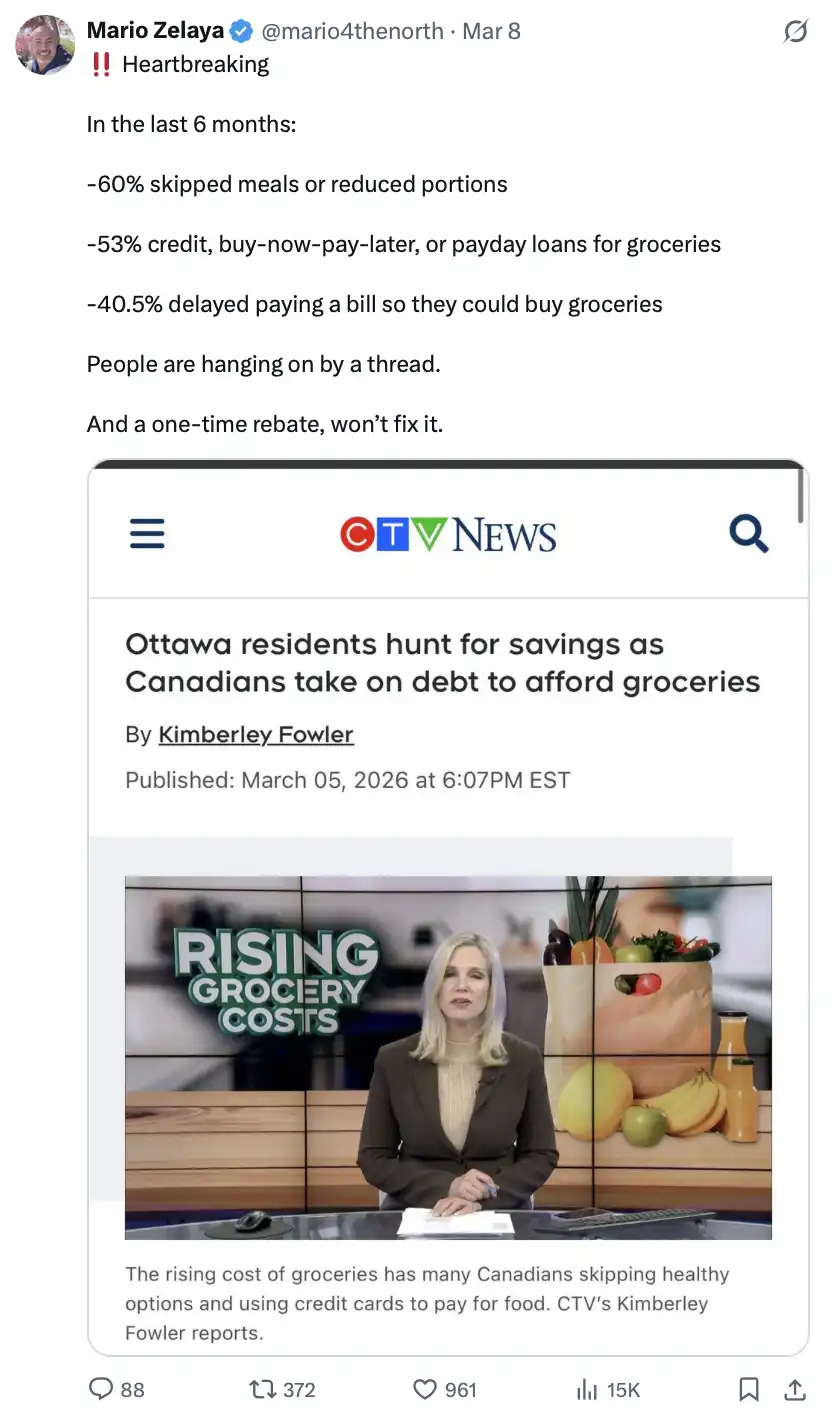
Data shows that in the past 6 months, 60% of people have reduced their food intake or portion size; 53% of people have relied on credit, installment, or high-interest loans to buy food; 40.5% of people have delayed bill payments to buy food. Overall, it points to a conclusion that many people are already "barely getting by," living on the edge of collapse, and one-time subsidies cannot fundamentally solve the problem.
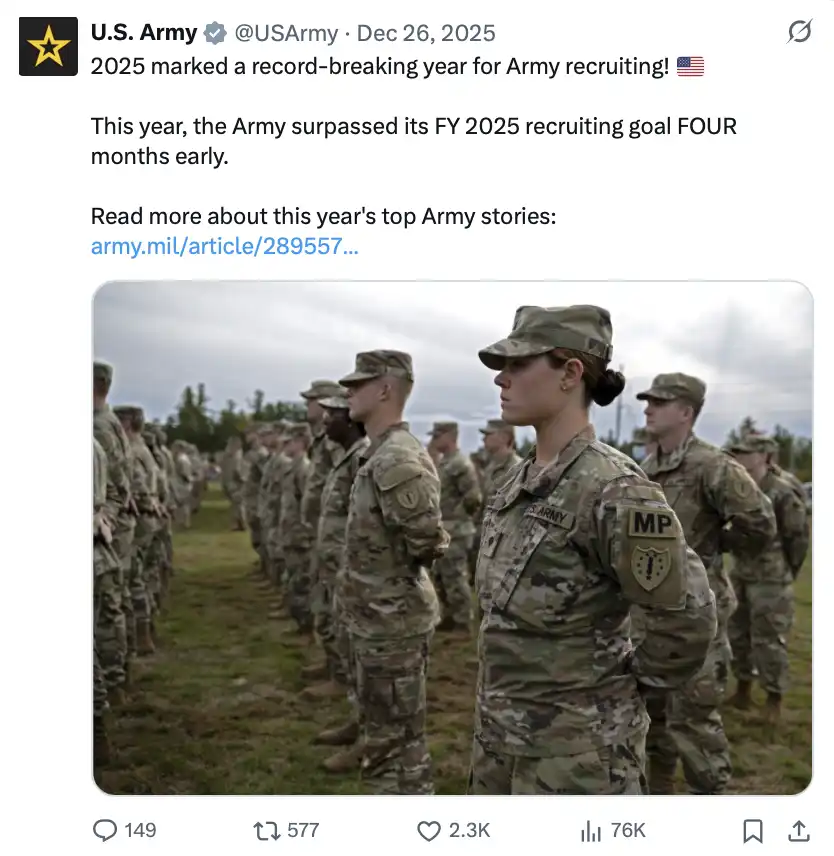
In 2025, the U.S. Army exceeded its recruiting target and achieved the full-year goal 4 months ahead of schedule, setting a record number of recruits. In a macro context, this is usually interpreted as: when economic opportunities decrease and the job market tightens, more people choose to enter the military as a stable option.
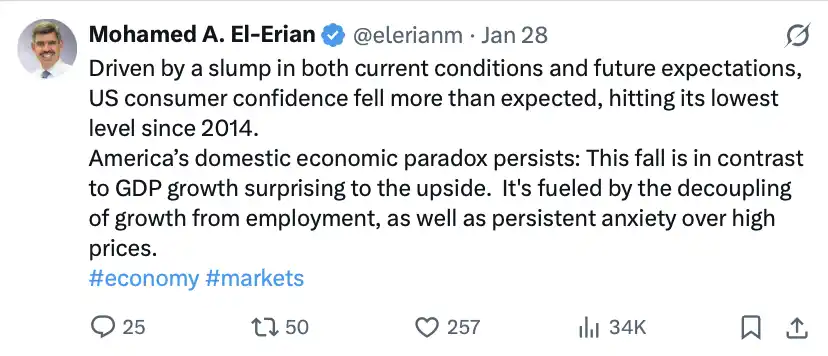
The crux of this content is: the U.S. economy is showing a contradictory signal of "data vs. the felt experience." On the one hand, consumer confidence has plummeted to the lowest level since 2014; on the other hand, GDP growth has exceeded expectations. Behind this "economic paradox" is the gradual decoupling of growth and employment, as well as the ongoing anxiety caused by high prices—meaning, while the macro data may look good, the actual experience of ordinary people is deteriorating.
Well, there is enough evidence, so what should we do? Sit there and complain about the unfairness of fate, sighing in despair? Of course not.
What we need to do is first realize the existence of this situation, prepare for it, and survive.
How to Respond (Action Plan)
The following content can serve as an actionable checklist.
We need to approach it with a "glass half full" mindset. Take action with a practical, can-do attitude, while also believing that things will eventually improve. This is not the end of the world. It is precisely because we are clear about this that we can take risks when necessary.

Immediate Financial Defense
Establish an emergency fund that can cover 3 to 6 months of "basic living expenses." This should be your top priority, above all but minimum payments. If you have no savings right now, start by saving your first $1,000 immediately.
This is not optional. Do not borrow money for consumption. If a large necessary expense must be incurred, try to lock in a fixed rate now. In a recessionary period, a variable rate will drag you down.
Pay off your credit card debt as soon as possible. In an economic downturn, variable rates usually rise. Be proactive in repaying, and if necessary, you can call the bank to negotiate a lower rate — there is no cost to asking, and data shows that about 70% of people do succeed in negotiating. Alternatively, you can consider transferring to a 0% interest rate balance transfer credit card, but make sure to calculate whether you can pay it off before the rate increases.
Do not cosign for anyone. Close to 40% of cosigners end up repaying the borrower's debt. If you want to help someone, give money directly or provide a personal loan. In any case, protect your credit record. These may sound basic, but they are crucial.
Career and Income Protection
Do you hate your boss? Understandable. But if you don't have an alternative and job opportunities are at a low point, in an environment where positions are being replaced, quitting impulsively just because you "dislike the boss" is risky.
Continuously upgrade your skills, especially learn to use AI. Of course, it can also be in other areas. YouTube, Udemy, Khan Academy, coding bootcamps — mostly free or very low cost. Learn to code, learn SEO, stack skills that make you harder to replace, or equip you to start a side business.
Start a side business. Freelancing, online services, handmade products are all options. On average, a side business can bring in about $500 per month, and this money will build a safety net for you while you sleep.
Investment and Wealth Strategy
Ignore media-induced panic. Economists predict a recession almost every year, and "consuming panic-inducing information" will only lead you to make emotional decisions and ruin your investment portfolio.
In the long run, the S&P 500 index continues to rise — after all, it represents the top 500 companies in the U.S. If you are ready, this stage is actually a good time to increase exposure to risky assets. I would do this while also allocating as much as possible to Bitcoin at the right time, and continue dollar-cost averaging and gradually building positions before that.
The market will eventually recover. If you miss the best 10 days of market performance, you have almost missed most of the gains. So, when the market has already fallen by 25%–35% (using the S&P as an example), and there are still people telling you it will get worse, it may actually be the time when you should take on the risk.
Believe in the power of time. A study by Schroders covering 148 years of data shows: investing for 1 month, the probability of loss is about 40%; investing for 1 year, it drops to 30%; investing for 20 years, it is nearly zero.
Extend your time horizon. You may not necessarily have to wait for 20 years, but at least think in terms of one cycle. Or, you can be a "cockroach that doesn't die."
Do you know who this person is?

Well, this guy was one of the richest people in human history. When he passed away in 1525, he controlled nearly 2% of Europe's GDP... and the reason he was able to do that, essentially, was by "living like a cockroach."
Today, to "be a cockroach that doesn't die" probably means: cash + commodities + stocks, in a balanced allocation.
This kind of combination can allow your assets to continuously compound over different periods. However, this is more suitable for those with a larger capital base. It may not make you rich overnight, but it can help you stay steady.
If you have cash on hand, I personally would consider making some allocations at the riskiest end of the curve, such as adding to positions when Bitcoin drops around 70%. Of course, this is just my opinion and not advice.
Remember: when everyone is panicking and selling off, those willing to take on risk are the ones with the opportunity for massive wealth returns.
Next, an often overlooked but crucial investment direction —
Personal Preparedness
1) Invest in Your Health
Make yourself "harder to knock down." Start investing time and energy now to improve your physical condition, striving to reach your peak fitness level in life as much as possible.
A sudden illness, a surgery, or a short period of being unable to work could directly ruin your financial situation. Therefore, this is the highest ROI investment you can make.
2) Asset and Tax Planning
Do proper tax planning, maximize the use of tax-free accounts and retirement allowances. Complete estate and inheritance arrangements before the end of the tax year, especially in situations where policies may change (such as abolishing the 7-year tax-free rule or imposing capital gains tax on inheritance). Seek professional assistance if necessary.
3) Invest in Your Cognition and Knowledge
Don't be ridiculed for paying attention to things "outside your field." Maybe algorithms won't immediately reward you, but those who are truly curious and continuously learning will eventually benefit. Keep outputting, keep learning, and your abilities and influence will slowly accumulate; the algorithms will "see you" sooner or later.
The 2008 financial crisis destroyed millions of jobs, but it also gave rise to a whole generation of developers, digital marketers, and internet entrepreneurs. They used the downturn to learn skills at a low cost and then leapfrogged into wealth during the subsequent bull market.
So, where should you invest your time?
Layer One: Skills that directly create income
Copywriting, sales, programming, SEO. These skills can be monetized immediately, whether freelancing or creating value within a company. A copywriter who understands conversion can make money in any environment; a developer who can deliver products is the most indispensable person to a company.
Layer Two: Skills that protect and amplify income
Financial knowledge, tax planning, negotiation skills, basic legal knowledge. Many people hand their money over to advisors for things they could have learned over a weekend, and this "cost of ignorance" will compound like interest.
Layer Three: Abilities to build long-term advantages
Macro analysis, understanding technological cycles, early identification of capital flows. These abilities allow you to see trends before the masses catch on.
But ultimately, the most important thing is to invest time in what you are truly interested in and willing to cultivate in the long term. Everything you do is not just for yourself but for your family—to give them a little less uncertainty and a bit more peace of mind in the future.
It is precisely because of this that we choose to prepare in advance. We are not children, nor are we blindly optimistic. We are sober, rational, and yet still believe that things will get better.
This article is so well written. Whatever happens next in the world, we are already prepared to face it.
P.S. This information is not scarce; it is just selectively ignored by most people. The real difference is never in "knowing" but in "taking action."
You may also like

Morning Report | BitMine increased its holdings by 126,971 ETH last week; trader Eugene announced his exit from the crypto market

Wang Chuan: How can one not feel anxious after the neighbor Old Wang made thirty times profit by investing in storage stocks? (Seven) - A quarter-century cycle

Cryptocurrency CEXs are flocking to sell US stocks, and traditional brokerages are facing an "uninvited guest."

$75 billion in foreign capital has fled, and South Korean retail investors have absorbed it all using leverage

Japan’s Three Megabanks Plan Joint Stablecoin Issuance in Fiscal 2026
MUFG, SMBC, and Mizuho reportedly plan to jointly issue fiat-pegged stablecoins in fiscal 2026, signaling Japan’s growing push into bank-led digital payment infrastructure.

Humanity Discloses H Token Dual-Chain Attack Details, With Losses on Ethereum and BSC Exceeding $36 Million
Humanity said the H token attack across Ethereum and BSC caused more than $36 million in losses after leaked ProxyAdmin keys enabled malicious contract upgrades and token minting.
White House Discusses CLARITY Act With Law Enforcement Ahead of Senate Vote
The White House discussed the CLARITY Act with law enforcement ahead of a Senate vote, focusing on illicit finance risks and developer protections.

Bitcoin Trading Guide 2026: Strategies for Experienced Traders

What Is XAUT and PAXG? Why Tokenized Gold Is Booming in 2026

Will the SpaceX IPO Hurt Bitcoin? Here's What Traders Are Watching

Foreign selling in the South Korean stock market accelerates, with cumulative net sales reportedly reaching $75 billion this year
On June 9, The Kobeissi Letter, citing Goldman Sachs data, reported that global investors are selling South Korean stocks at an unusually rapid pace. In the latest trading session, foreign investors sold about $801 million worth of Kospi constituent stocks again; total foreign outflows last week reached about $10 billion, and the market has been in net foreign selling on nearly every trading day over the past month. According to the data cited in the report, foreign investors have sold about $75 billion worth of South Korean stocks so far this year. Meanwhile, South Korean retail and institutional investors together recorded roughly $69 billion in net buying over the same period, suggesting that the market’s main buying support has come from domestic capital rather than returning overseas funds. The information currently disclosed still mainly comes from The Kobeissi Letter’s retelling and Goldman Sachs data summaries, while public details on the statistical period and the specific definition of “selling” remain relatively limited.

Fortune Warns of Strategy’s Financing Structure Risks as Bitcoin Premium Narrows
Fortune warned that Strategy’s Bitcoin treasury model faces growing financing risks as MSTR’s net asset premium narrows and preferred stock dividend pressure increases.

Ferrari Challenge Le Mans: Carl Moon to Dominate in WEEX Livery

Sahara AI Responds to SAHARA’s Sharp Drop: No Contract or Product Security Issues Found, Internal Investigation Underway
Sahara AI responded to SAHARA’s 60% price drop, saying no token contract or product security issues have been found and an internal investigation is underway.

WEEX Deposit/Withdrawal Dynamic Island: Your Asset Status, Always in Sight
Scaling Crypto Derivatives: The Digital Asset Infrastructure Behind High-Volume Trading
In the fast-moving digital asset ecosystem, derivatives platforms face an extreme architectural test. High-leverage futures markets demand more than just standard security—they require absolute operational precision, zero-latency matching engines, and ironclad structural scalability, all while navigating intense market volatility.
As global platforms scale to meet these demands, the industry is shifting away from rigid, monolithic setups toward a more agile, "decoupled" infrastructure philosophy.
The Blueprint for High-Volume Copy TradingFor elite global exchanges like WEEX (founded in 2018), this architectural choice becomes critical when scaling high-volume retail features like social copy trading. When thousands of users automatically mirror the real-time strategies of elite traders simultaneously, it triggers sudden, monumental spikes in concurrent transactional volume.
To prevent execution latency or settlement bottlenecks during these peak volatility events, a platform's primary engine must remain entirely dedicated to risk management, copy-trade synchronization, and order matching.
The Architectural Rule: New-generation platforms must separate front-end user execution engines from heavy backend infrastructural overhead to eliminate operational friction.
By separating these layers, platforms can maintain complete sovereignty over their trading environments and user experiences while strategically aligning with institutional-grade infrastructure ecosystems. This strategic framework allows modern exchanges to leverage advanced Digital Asset Custody infrastructure such as Cobo’s behind the scenes, ensuring that backend wallet management scales elastically alongside trading spikes.
Capitalizing on Market Momentum and 400× LeverageIn a derivatives arena where platforms offer up to 400× leverage on perpetual contracts, capital efficiency and market agility are core business metrics. To capture market momentum, an exchange needs the ability to rapidly expand its asset offerings, supporting everything from legacy crypto assets to sudden, trending altcoins across a massive library of trading pairs.
Adopting a flexible, scalable Wallet-as-a-Service (WaaS) solution such as Cobo’s could completely rewrite the development timeline for high-growth exchanges. Instead of spending months of engineering capital building out custom backend wallet architectures for every new blockchain network, platforms can deploy localized infrastructure in days.
This agility allows platforms to instantly scale their listings to over a thousand trading pairs without compromising security or delaying time-to-market. It mirrors the exact operational advantages seen during high-velocity market events, similar to how advanced wallet infrastructure empowers platforms during sudden asset surges; allowing exchanges to pass that speed and liquidity directly to their global user base.
A Mature Foundation for GrowthThe synergy between trusted infrastructure ecosystems and global trading platforms represents the natural evolution of a maturing crypto market. As WEEX continues to scale its global spot and derivatives offerings for over 6 million users, adopting robust backend paradigms proves that platforms no longer have to compromise between cutting-edge trading velocity and uncompromised structural security.

Get Paid to Onboard? Try WEEX’s New Homepage with Rewards for Registration, Deposit & Trade
WEEX Custom Layout: Build Your Perfect Trading Workspace in Seconds
Morning Report | BitMine increased its holdings by 126,971 ETH last week; trader Eugene announced his exit from the crypto market
Wang Chuan: How can one not feel anxious after the neighbor Old Wang made thirty times profit by investing in storage stocks? (Seven) - A quarter-century cycle
Cryptocurrency CEXs are flocking to sell US stocks, and traditional brokerages are facing an "uninvited guest."
$75 billion in foreign capital has fled, and South Korean retail investors have absorbed it all using leverage
Japan’s Three Megabanks Plan Joint Stablecoin Issuance in Fiscal 2026
MUFG, SMBC, and Mizuho reportedly plan to jointly issue fiat-pegged stablecoins in fiscal 2026, signaling Japan’s growing push into bank-led digital payment infrastructure.
Humanity Discloses H Token Dual-Chain Attack Details, With Losses on Ethereum and BSC Exceeding $36 Million
Humanity said the H token attack across Ethereum and BSC caused more than $36 million in losses after leaked ProxyAdmin keys enabled malicious contract upgrades and token minting.


