
The Chip Industry's Most Secure Middleman Just Took a Very Risky Turn


Between $40 billion and $150 billion is not a growth curve, but a self-disruption of a business model.
On March 24, Arm unveiled its first in-house data center CPU in the company's 35-year history in San Francisco. This chip, named AGI CPU, features 136 Neoverse V3 cores, TSMC 3nm process, 300W TDP, with Meta as the first customer for large-scale deployment within the year. Also announced as partners are OpenAI, Cerebras, Cloudflare, SAP, and SK Telecom.
Arm CEO Rene Haas provided a set of target numbers at the event, stating that the chip business is expected to achieve $15 billion in annual revenue by 2031, with total company revenue of $25 billion and earnings per share of $9.
What do these numbers mean? Arm's total company revenue for FY2025 (ending March 2025) was $40.07 billion, according to Arm's annual report data, with licensing revenue of $18.39 billion, royalty revenue of $21.68 billion, and a 97% gross margin. In other words, a company with $40 billion in annual revenue aims to achieve a scale close to Intel's entire data center division in just 5 years through a single new business. According to Intel's Q4 2024 financial report, Intel's DCAI (Data Center and AI) division had full-year revenue of $12.8 billion in 2024.
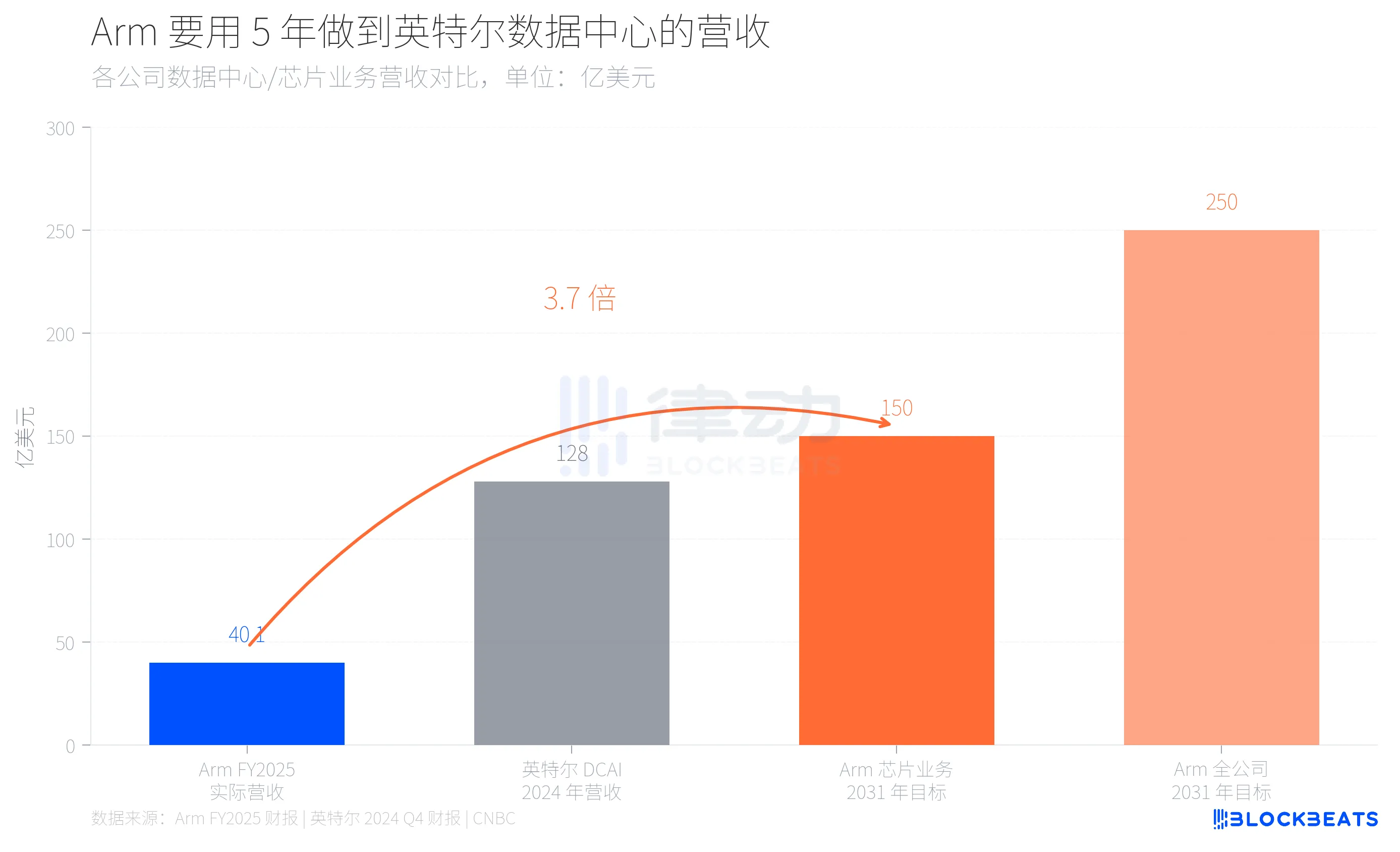
From $40 billion to $150 billion, behind the 3.7x leap is Arm's attempt to transform from a pure IP licensing company to a hybrid that sells both design blueprints and finished products. There is no precedent for this in the chip industry.
Why is Arm taking this risk? The answer lies in its customer list.
Over the past three years, Arm's largest data center customers have been doing the same thing. According to public data from AWS, Amazon has migrated over 50% of EC2 compute to its in-house Graviton chips, with the latest Graviton5 featuring 192 cores. As disclosed by Google Cloud, Google's Axion chip has already migrated over 30,000 internal applications, achieving an 80% energy efficiency gain. Microsoft's Cobalt 200 is also based on Arm Neoverse architecture, TSMC 3nm process, with 132 cores.
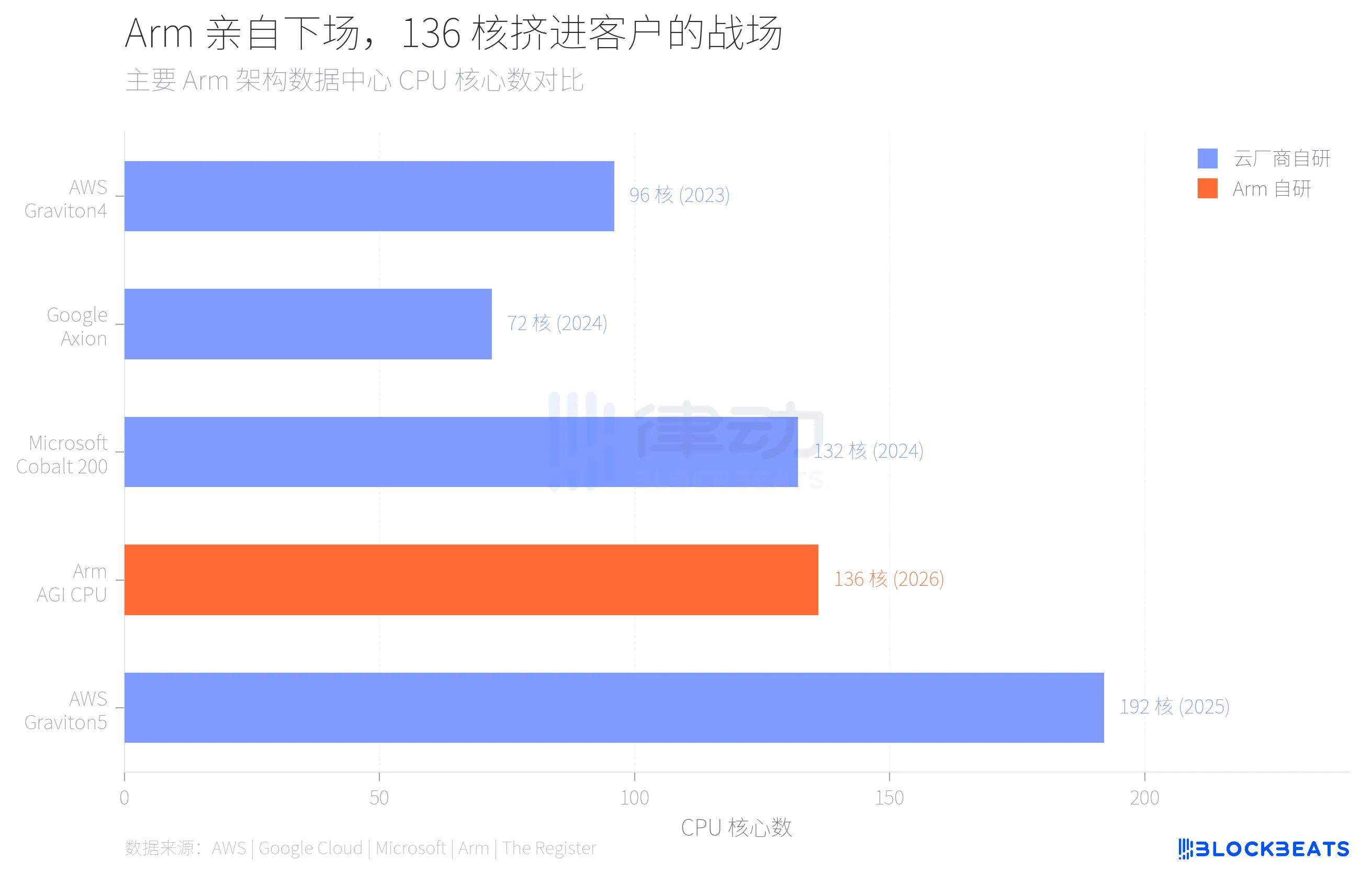
These cloud providers all use Arm's architecture license, but the chips are self-designed, self-fabricated, and self-deployed. Arm earns licensing fees and royalties rather than chip profits. As more and more computing power is consumed by these custom chips, Arm's revenue ceiling in data centers becomes clearer.
Looking at Arm's revenue structure over the past four years, the outline of this ceiling becomes more defined. According to Arm's annual reports, from FY2022 to FY2025, the company's total revenue is projected to grow from $27 billion to $40 billion, with a CAGR of around 14%. Royalty revenue is expected to increase from $15.62 billion to $21.68 billion, while licensing revenue is set to grow from $11.41 billion to $18.39 billion. The growth rate of royalties has slowed to 20% from previous years, and this 20% growth is largely driven by the upgrade to the Armv9 architecture in the mobile sector, not in data centers.
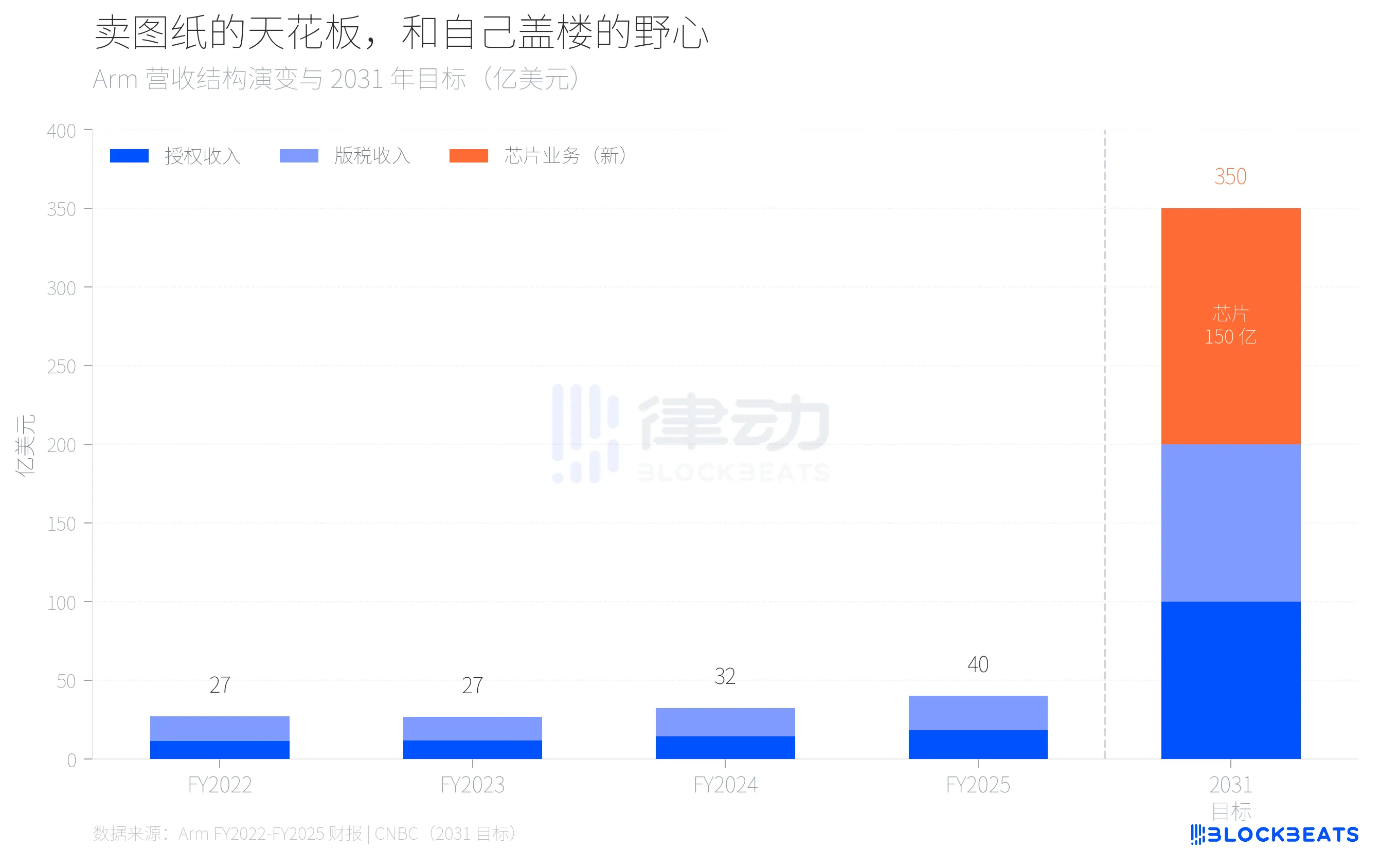
Extrapolating this growth rate, even if both licensing and royalty revenues maintain an annual growth rate of around 20%, by 2031, they will only reach about $10 billion. The remaining $15 billion must come from a business that does not yet exist today. This is the arithmetic logic behind Arm's decision to manufacture its own chips.
Arm's choice to produce its own chips fundamentally means competing with its own customers. A company that sells blueprints to others is now constructing buildings itself, while its blueprint buyers have been building for years.
This is the true background of the 136-core AGI CPU. According to The Register, this chip has a base frequency of 3.2 GHz, up to 3.7 GHz, 12-channel DDR5 memory, 6 GB/s per core bandwidth, 96 PCIe 6.0 lanes, and supports CXL 3.0. Arm positions it as the "computing foundation of the agentic AI cloud era," focusing on CPU-side task scheduling and data flow management in AI inference, rather than directly competing with GPUs.
The pace of market share change also speaks volumes. According to Omdia's estimates, by 2025, Arm architecture servers will account for approximately 21% of global shipments, with a 70% growth rate. However, within hyperscale data centers, this proportion is already close to 50%. The 40-year dominance of x86 is not collapsing but being replaced chip by chip.
The risk of Arm's in-house chip is not technical, but relational. Meta's willingness to be the first customer is partly because Meta itself does not have a mature in-house chip project like Amazon or Google. But how would Amazon, Google, or Microsoft view this? If a supplier starts competing with you, would you still hand over your most critical architecture to them?
Arm's bet is that the overall growth of the data center is faster than the deterioration of customer relationships. Rene Haas apparently believes that the incremental demand for CPUs in the AI era is large enough to allow for both in-house chips and architecture licensing to coexist. The $15 billion target is the pricing of this assessment.
After 35 years of selling blueprints, building their own building for the first time. While they continue to sell blueprints, they are also constructing the building, all on the same plot of land. It remains to be seen whether it will be too crowded.
You may also like

Pantera Capital Partner: How Tokenization is Restructuring the Private Equity and Early Investment Ecosystem?

New York Proposes Stricter Stablecoin Issuer Rules Aligned With Federal GENIUS Act
NYDFS proposed stricter stablecoin issuer rules aligned with the GENIUS Act, covering reserves, custody, redemption timelines, audits, and capital buffers.
Every exchange is a "Universal Exchange."

The counterattack of traditional finance: Alliance chains are quietly reviving

CryptoQuant Says Bitcoin Profitable Supply Is Near 45% Pressure Zone as On-Chain Data Points to Market Repricing
CryptoQuant said Bitcoin’s profitable supply is nearing the 45% pressure zone, signaling rising market stress, unrealized losses, and a possible on-chain repricing phase.

Bitcoin Falls Below 200-Week Moving Average as On-Chain Data Shows Over Half of Supply in Loss
Bitcoin dropped below its 200-week moving average as on-chain data showed over 50% of circulating supply is now in loss, signaling rising market stress.

CFTC Reportedly Plans New Prediction Market Rules Focused on Manipulation Risk and Public Interest Review
The CFTC is reportedly preparing new prediction market rules focused on manipulation risk, public interest review, and retail trader protections.

Meet the new WEEX trial fund—your gateway to greater profits

WEEX Labs Lands at Dutch Blockchain Week: A Disruptive Crypto × AI Conversation Sets Sail in Amsterdam

SK Hynix Reportedly Plans U.S. ADR Listing as Early as August, With SEC Approval Possible in Late June
SK Hynix may pursue a U.S. ADR listing as early as August, with SEC approval reportedly possible in late June amid strong AI chip supply chain demand.

SpaceX vs Tesla vs xAI: Which Elon Musk Trade Has the Biggest Upside in 2026?
OpenAI Reveals It Has Confidentially Submitted an S-1 to the SEC, Keeping the Door Open for a Future IPO
On June 9, according to an OpenAI announcement, the company recently confidentially submitted a draft S-1 registration statement to the U.S. Securities and Exchange Commission (SEC), beginning the preliminary compliance process for a potential initial public offering. OpenAI said it chose to disclose this proactively because it expected the news might leak; however, the company has not yet set a specific listing timeline, and related arrangements may still take some time.

Latest research from 13 top universities including Cornell University: The current state, challenges, and misconceptions of the fusion of Crypto and AI
Deconstructing Anthropic: The Best AI Company, Possibly Also a Type of Organizational Invention
Apollo and Blackstone Reportedly Back $35 Billion Anthropic Chip Financing as Deal Details Remain Unclear
On June 9, according to currently available news alerts, Apollo and Blackstone Group participated in a $35 billion financing for an Anthropic “chip project.” Based on the original wording of the report, the funding has already been raised, but public information remains limited. The financing structure, use of proceeds, project entity, and whether Apollo and Blackstone participated through equity, debt, or project financing have not yet been disclosed.

Humanity Protocol Security Incident Escalates: More Than $31 Million Stolen From Related Addresses as Attacker Continues Selling H for ETH
On June 9, according to monitoring by Onchain Lens, more than $31 million has been stolen from addresses linked to Humanity Protocol, and the attack is still ongoing, with the hacker continuously swapping H tokens for ETH. Project founder Terence Kwok later confirmed the security incident on X, saying the issue involved a private key leak.

Bloomberg: As Bitcoin Weakens, Stablecoins and RWA Continue to Drive Expansion in Crypto Businesses
In June, Bloomberg reported that despite Bitcoin falling below $60,000 last week, wiping out about $235 billion in market value within seven days, and dropping close to 50% from last year’s peak, some core businesses in the crypto industry are still expanding, mainly in stablecoins, real-world asset tokenization (RWA), payments, and infrastructure. The report also noted that overall altcoin activity has contracted significantly: altcoin market capitalization has fallen from a peak of about $431 billion in November 2021 to around $170 billion, and among the tens of millions of tokens issued in recent years, fewer than 1,700 still maintain meaningful trading activity.

Galaxy Deep Research Report: How Hyperliquid's HIP-4 Upgrade Changes the Landscape of Prediction Markets?
Pantera Capital Partner: How Tokenization is Restructuring the Private Equity and Early Investment Ecosystem?
New York Proposes Stricter Stablecoin Issuer Rules Aligned With Federal GENIUS Act
NYDFS proposed stricter stablecoin issuer rules aligned with the GENIUS Act, covering reserves, custody, redemption timelines, audits, and capital buffers.
Every exchange is a "Universal Exchange."
The counterattack of traditional finance: Alliance chains are quietly reviving
CryptoQuant Says Bitcoin Profitable Supply Is Near 45% Pressure Zone as On-Chain Data Points to Market Repricing
CryptoQuant said Bitcoin’s profitable supply is nearing the 45% pressure zone, signaling rising market stress, unrealized losses, and a possible on-chain repricing phase.
Bitcoin Falls Below 200-Week Moving Average as On-Chain Data Shows Over Half of Supply in Loss
Bitcoin dropped below its 200-week moving average as on-chain data showed over 50% of circulating supply is now in loss, signaling rising market stress.


