
Stablecoin $825M Pre-Deposit Flash Loan, Whale Entrance with $700M Before Official Announcement?


Original Title: "Stable's First Round of $825 Million Pre-deposit Sold Out Instantly, $700 Million Released First Before Announcement?"
Original Author: Asher, Odaily Planet Daily
The project Stable, which has been a hot topic in the community recently, announced this morning on the X platform that the first phase of its pre-deposit activity has reached the $825 million upper limit.
"What? I just rang the bell, and as soon as I opened the page, there was no quota left?" — This was a true reflection of many users who tried to participate for the first time this morning. Below, Odaily Planet Daily will take you to learn about the Stable project and review the whole process of this morning's "$825 million pre-deposit sold out instantly."
Stable: A Layer1 Blockchain Designed Specifically for USDT

Stable is a high-performance Layer1 blockchain designed specifically for USDT, aiming to provide a fast, low-cost, low-latency stablecoin transaction network. Unlike general-purpose blockchains, Stable focuses on the payment and settlement functions of USDT, hoping to make USDT have a cash-like experience on-chain, suitable for cross-border payments, e-commerce payments, and corporate settlements.
In terms of technical design, Stable adopts an independent blockchain architecture, supports EVM compatibility and sub-second transaction confirmation, and plans to introduce a gas-free USDT0 transfer mode, as well as provide institutions with apply-for exclusive block space and compliance-friendly privacy transaction support. These features are designed to lower the barriers for enterprises and end-users to use blockchain payments and enhance stablecoin transaction efficiency. The core technical framework of the project has been basically completed, but the launch dates for the testnet and mainnet have not been announced yet.
It is worth noting that Stable has received investments from well-known institutions including Bitfinex, Hack VC, and Franklin Templeton, and has been endorsed by Tether officially, with Tether CEO Paolo Ardoino also publicly supporting the project. These funds are mainly used for network infrastructure construction and global USDT payment ecosystem expansion.
Stable's Pre-deposit Activity Faces Criticism
The first phase of Stable's USDT pre-deposit activity quickly sparked a huge controversy after it opened, with a large number of community users questioning serious "insider trading" operations. According to the official timeline, Stable officially tweeted to announce the opening of the pre-deposit at 9:10 am Beijing time, but on-chain data shows that people had already deposited funds as early as 8:48, which was significantly earlier than the official time.
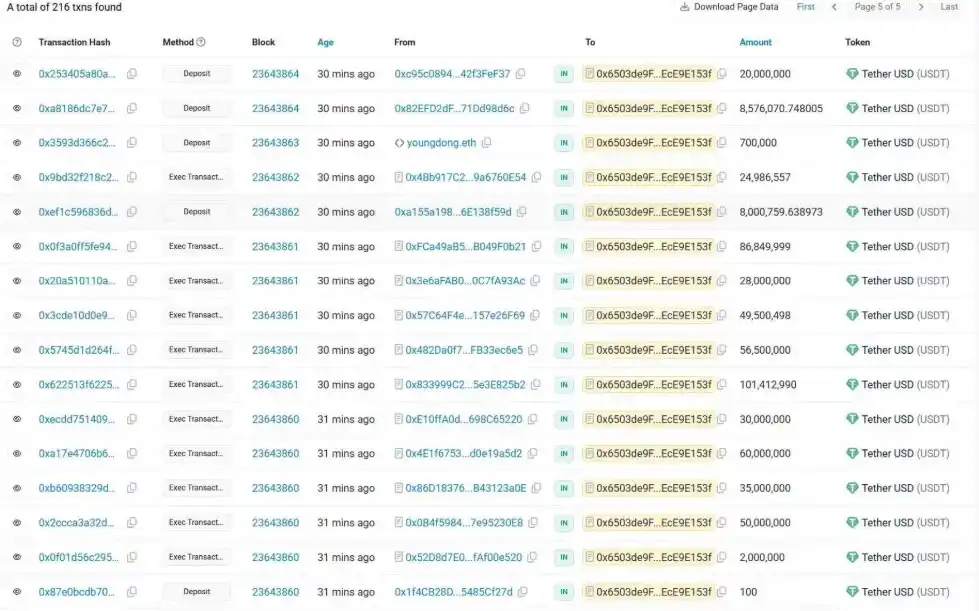
Official Announcement: Large Funds from Multiple Addresses Participated in Pre-Deposit Activity
On-chain data shows that the $825 million pre-deposit amount for this event had already been "pre-sold" for $700 million before the public announcement. Among them, 10 whale addresses collectively deposited around $600 million USDT, and all funds originated from the same wallet address, which was split and filled to the limit within 10 seconds. Further analysis revealed that these funds were all withdrawn from the BTSE CEX before being dispersed into different wallets for participation in the pre-deposit, indicating a unified operation likely conducted by the same capital group. In addition, the funds from these addresses had completed preparation and layout hours before the start of the activity, further fueling community dissatisfaction.
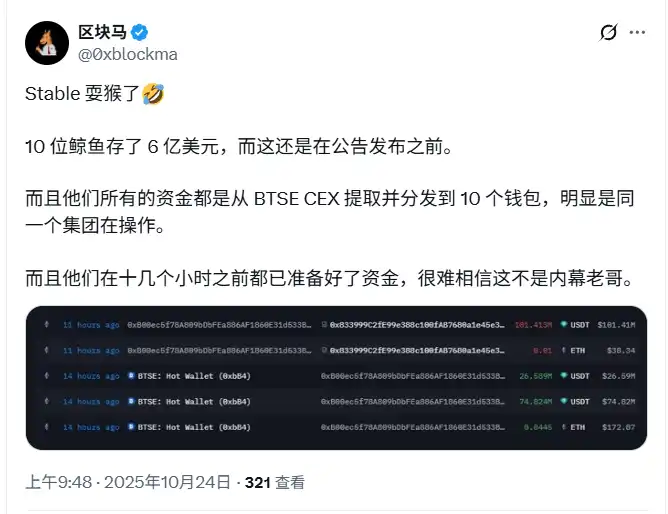
Prior to the pre-deposit event, 10 whale addresses with the same source of funds collectively deposited 600 million USDT
Relatively speaking, ordinary users had little to no participation space. Many users reported that upon entering the official website, they either encountered authorization failures or their transactions were delayed in packaging, and by the time they saw the official tweet, only 0.13 USDT was left on the page to deposit, indicating that while a small amount of allocation appeared available, retail investors were practically unable to participate.
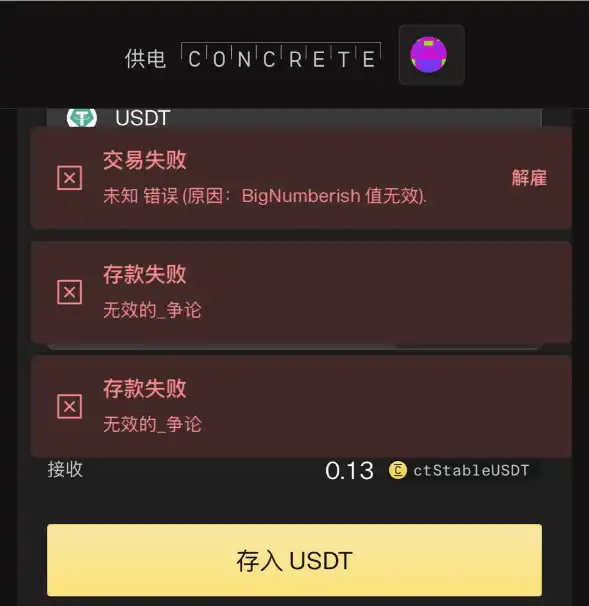
Community Feedback: Upon the official announcement, only 0.13 USDT was left to deposit on the page
According to Dune data, the $825 million pre-deposit event had only 273 addresses participating, with the participation ratio of ordinary users being almost negligible. More notably, among all participating addresses, nearly 40 addresses had deposits lower than 500 USDT, and there were even extremely small deposits of 1 USDT, 3 USDT, 5 USDT, or tens of USDT, leading the community to sarcastically label these small addresses as mere props used to inflate the number of participants, devoid of any real sense of participation.
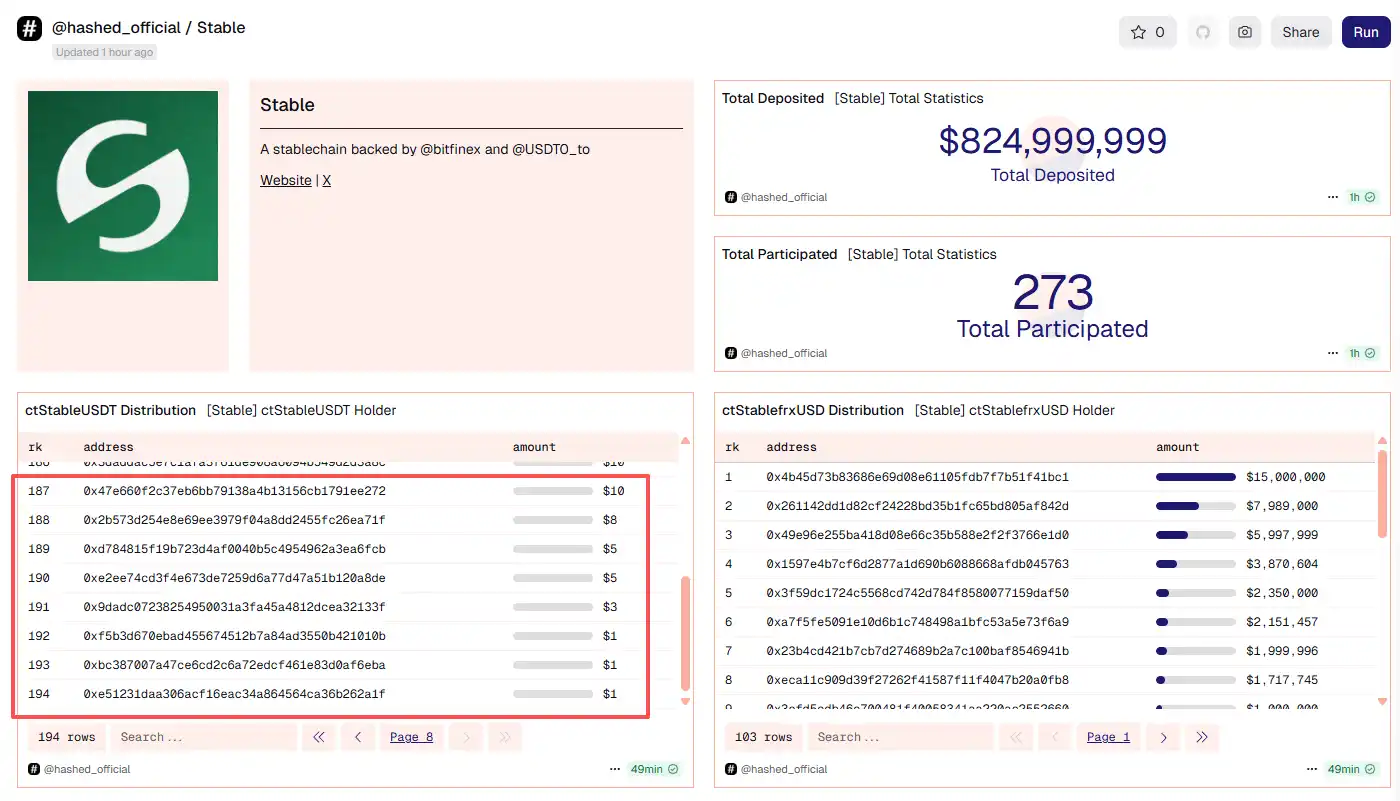
Stablecoin Pre-Deposit Data
Overall, the first phase of the $825 million Stablecoin pre-deposit activity quickly reached its limit. However, community sentiment was highly negative, being described as an "epic-level frontrunning" and a "pre-sale that was predetermined in advance".
Summary
"Insults aside, we still gotta make money." Although the first phase of the Stable project's presale was heavily controversial due to serious "insider trading" issues, considering its endorsement by Tether official and support from top-tier capital, the project still possesses strong market influence and sustained tracking value.
What is more worth paying attention to next is actually the presale activities related to centralized exchanges, especially whether Binance will launch a deposit or participation activity for Stable. Previously, Binance had launched the Plasma (XPL) deposit activity, with the first phase's individual deposit limit as high as $100,000, and subsequent batches could also deposit up to $50,000. Since it is a stablecoin deposit participation, with no principal loss, the yield from selling immediately after XPL's listing reached an annualized rate of up to 79%, becoming one of the highest-yielding projects listed on CEX this year.
From this perspective, Stable is still a project of high priority for attention. While on-chain activities may have already been consumed by large funds, the CEX phase may be the participation window suitable for ordinary retail investors.
You may also like

Morning News | Five major virtual asset platforms in South Korea have experienced 57 incidents of hacking and system failures in six years; Grayscale submits registration application for Canton ETF

Should we escape the peak? The principle of the tail-end market in the stock market

RootData: May 2026 Cryptocurrency Exchange Transparency Research Report

Founder of Baixing.com: My Experience with Claude Code in Fourteen Points

Yang Ge Gary: Agent Economics and AI Microeconomics
When reasoning becomes a scarce resource, who captures its value?

Jensen Huang dramatically "rescues" the South Korean stock market

Stablecoins vs Deposit Tokens: On the surface, they seem like opposing sides, but in reality, they are interconnected

Bitcoin Crash to $50,000 or Bear Trap Before $100,000? Deep Dive for WEEX Traders
How Could the SpaceX IPO Affect Bitcoin, Altcoins season, and Crypto Liquidity?

The ambitions of Kalshi, MTS, and a16z
The AI bubble is bursting

Real withdrawal is to release water: When crypto VCs position themselves in the Agent network effect

Has the narrative of BTC as "digital gold" failed?

A Perspective on the Indian Cryptocurrency Market: Descending into Silence or Moving Towards Maturity?

It took me a year to see the painful truth about Agent payments

Morning News | Bitmine issues preferred shares to raise $300 million; Polymarket accuses Kalshi of industrial espionage

Privacy coin trust crisis! ZEC plummets over 56% in a single day
Morning News | Five major virtual asset platforms in South Korea have experienced 57 incidents of hacking and system failures in six years; Grayscale submits registration application for Canton ETF
Should we escape the peak? The principle of the tail-end market in the stock market
RootData: May 2026 Cryptocurrency Exchange Transparency Research Report
Founder of Baixing.com: My Experience with Claude Code in Fourteen Points
Yang Ge Gary: Agent Economics and AI Microeconomics
When reasoning becomes a scarce resource, who captures its value?


