
Overseas VC's Two-Week Trip to China AI Leaves Them in Awe of Shenzhen Hardware


Original Title: What I Learned from Two Weeks Inside China's AI Ecosystem
Original Author: José Maria Macedo, Co-founder of Delphi Labs
Original Translation: DeepFlow Tech
DeepFlow Summary: The founder of Delphi Labs spent two weeks extensively exploring China's AI ecosystem, meeting numerous founders, investors, and CEOs of listed companies.
His conclusion was unexpected: more bullish on hardware than anticipated, more bearish on software than expected, and his observations of Chinese founders challenged his previous assumptions.
The article also covers topics such as valuation bubbles, the humanoid robot race, and the information asymmetry between the East and the West.
Full Text:
I spent two weeks in China, meeting a large number of founders, VCs, and CEOs of AI companies. Before going, I was bullish on this ecosystem, expecting to see world-class AI talent working at valuations far below those in the West.
My view changed when I left — in more nuanced ways: hardware is stronger than I expected, software is weaker than I expected, and some observations about Chinese founders surprised me.
Founder Issues
One common trait among exceptional founders I have backed is: independent thinking, rebelliousness, extreme focus, and passion. They don't follow the rules. They keep asking "why," refusing to accept secondhand wisdom. The decisions they make, seemingly inexplicable to others, seem perfectly logical to them. They possess an inherent, unstoppable intensity, often manifested as a long-term obsession with excellence. As a VC, encountering numerous intelligent individuals daily, these individuals stand out in a crowd because their life trajectories exhibit a distinct "sharpness."
Many founders I met in China belong to a different category, which surprised me.
They are exceptionally accomplished — graduates from top universities, with backgrounds at companies like ByteDance or DJI, publications in Nature, and multiple patents. In the West, these achievements are only seen in the most elite technical talent, but in China, they are entry-level requirements. They also work harder than almost everyone I have met. We had meetings at all hours, including weekends, and rushed between cities. One founder even came to see us on the day his wife was giving birth.
However, independent thinking, a rebellious spirit, and a vision from 0 to 1 are harder to find. The founders' backgrounds are highly similar, the pitches are more conservative, many ideas are upgrades of existing products (impressive V2), rather than truly original bets. With such a large number of tech talent coming from China, I originally expected to encounter more people presenting "ideas I've never heard of before."
My interpretation is: China's education system nurtures excellence but does not leave enough room for deviation. It produces top-notch executors who excel at solving known problems, rather than individuals who "bring forth a problem that no one knew existed."
VC Reinforcing This Pattern
What's even more interesting is how local investors are exacerbating this trend.
The investment logic of most Chinese funds is built on one premise: investing in the most outstanding individuals who have come out of ByteDance or DJI. They look at resumes, not sharpness; at background, not beliefs. The VCs themselves fit this mold — coming from large corporations or consulting and investment banking backgrounds, similar to European VCs from ten years ago.
Ironically, most of the Chinese founders who have truly built great companies have never worked in a large corporation. Jack Ma was an English teacher who took the college entrance exam twice to get in. Ren Zhengfei founded Huawei at the age of 43, with a background in the military. Liu Qiangdong started by selling goods at a trading market. Dr. Wang Xing began his entrepreneurial journey without completing his doctorate. Most recently, William Li, who founded DeepSeek, has never worked outside his own company. These individuals are outliers, part of the group without a "standard resume" — precisely the kind of people the current investment system will overlook.
Finding these individuals yields real alpha, but currently, it seems few are looking there.
Shenzhen and the Hardware Ecosystem
The most awe-inspiring thing I saw in China was not the pitch of any startup.
It was the hardware underground workshops in Shenzhen — engineers systematically acquiring Western high-end products, dismantling them part by part, and reverse-engineering everything in an extremely meticulous way. When I stepped out, I was truly unsure if most Western hardware founders understand who they are competing against. The network effects here are not theoretical; they are physical, dense, and have been accumulated over decades.
The entrepreneurs we met validated this with data: over 70% of hardware inputs come from the Greater Bay Area, nearly 100% from China itself — this means the iteration cycle is something Western hardware companies simply cannot match.
Most founders I've seen are using DJI's playbook: focusing on a specific niche to build consumer hardware—electric wheelchairs, lawn mowing robots, next-gen fitness equipment—scaling revenue to 8 to 9 digits (USD), then leveraging their customer base or underlying technology to expand into adjacent categories. Some companies have grown much larger than you'd imagine. The most impressive company I've seen this time is Bambu Lab, a 3D printing company that most Westerners haven't heard of, reportedly generating $500 million in annual profit and doubling their revenue every year.
Bearish on Chinese Software
When I left, my skepticism about the opportunities in Chinese software had deepened compared to when I arrived.
At a model level, China's open source ecosystem is indeed strong, but the closed-source models still lag significantly behind the best in the West, and the gap may be widening. The capital expenditure gap is immense. GPU access remains restricted. Western labs are increasingly cracking down on distillation. Revenue numbers tell the tale: Anthropic reportedly hit $6 billion in ARR in February alone. The top Chinese model companies are in the tens of millions of dollars range for ARR.
In the software startup realm, the mainstream profile is ByteDance alumni turned PMs and researchers building agentic or ambient consumer software targeting Western markets. The talent is indeed strong, but many of these products happen to fall within the range of native functionality that large labs might release—an update could render them obsolete. What's also surprising to me is that China lacks large, rapidly growing private software companies. In the West, apart from model companies, there's a cohort of startups already hitting 9 or even 10 digits in ARR, with astounding growth rates—Cursor, Loveable, ElevenLabs, Harvey, Glean. This breakthrough level of private software companies is basically nonexistent in China—few exceptions like HeyGen, Manus, GenSpark have emerged, but they've all exited after starting up.
Valuation Bubble
Despite the unimpressive software landscape, there's a tangible bubble—both in early and late stages.
Looking at the early stage, the most elite talent coming out of ByteDance, DeepSeek, DarkSide of the Moon, indeed costs significantly less than equivalent-level American talent, but the median valuations have converged. Consumer startups without products are commonly valued at $100-200 million. Seed rounds exceeding $30 million are not uncommon.
Late-stage digital is increasingly hard to justify. MiniMax is valued at around $40 billion in the public markets, with less than $100 million in ARR—roughly 400x revenue. Wisdom Spectrum is around $25 billion in valuation with $50 million in revenue. For comparison: OpenAI's highest valuation round was roughly 66x ARR, Anthropic around 61x.
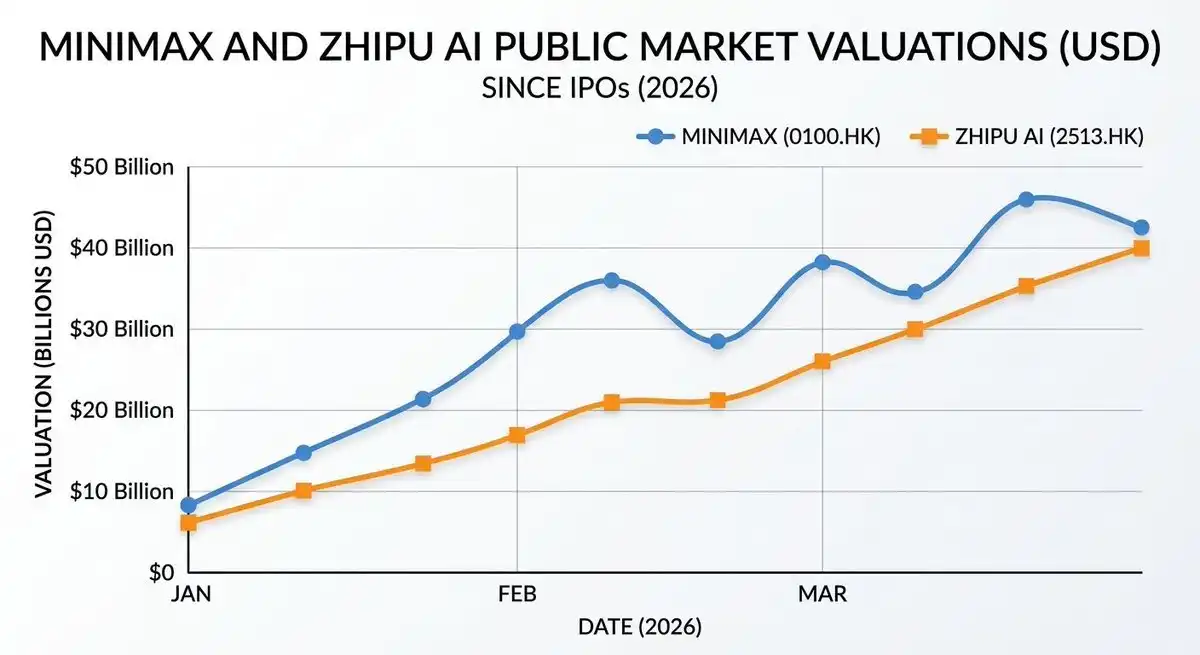
The dark side of the Moon and other private model companies are using these public market comparables to fundraise—going from $6 billion to $10 billion in a few months to $18 billion. Crypto-savvy friends will recognize this pattern well: Investors use the private valuation as a benchmark against a "pre-unlock" public market price. Furthermore, Wisdom Spectrum and MiniMax can sustain these levels, in part because they are currently the only way to get exposure to the "China AI narrative," which has its own premium.
But as more companies go public, this premium will get diluted. Lastly, the IPO window has a unique feature—it can close suddenly without warning. No one can guarantee you'll have time to unwind this arbitrage before the benchmark price moves.
The humanoid robot race is in a similar situation. China has about 200 humanoid robot companies, with around 20 raising over $100 million, several valued at several billion—almost all with no revenue, and most planning for an IPO on the Hong Kong Stock Exchange in 2026 or 2027. If this market is real, China's hardware advantage sets a relatively clear long-term trajectory. However, commercialization may take much longer than the current fundraising pace suggests, and I doubt the Hong Kong Stock Exchange can handle the many multi-billion-dollar humanoid robot companies currently queued up for IPO. I'm staying away for now.

Image: Couldn't resist sharing a video of a humanoid robot performing a front flip
Notable Information Asymmetry
One thing surprised me: Almost every founder I've met is first targeting the global market before considering China. They use Claude Code, watch Dwarkesh's podcast, and have an in-depth knowledge of the San Francisco startup ecosystem—often more so than Western investors who haven't been paying attention.
Western animosity towards China is significantly greater than Chinese animosity towards the West. Chinese founders do not see a contradiction in combining China's execution capabilities and hardware depth with Western go-to-market and product thinking. When this combination takes shape within a suitable founding team, truly remarkable companies are born.
Identifying these founders — those who do not fit the "standard resume template" optimized by the local VC system — is what we are doing now.
A special thanks to @woutergort for opening up his excellent Chinese network, @PonderingDurian for organizing this trip, and to Claude for patiently editing my ramblings on the plane.
You may also like

Morning Report | BitMine increased its holdings by 126,971 ETH last week; trader Eugene announced his exit from the crypto market

Wang Chuan: How can one not feel anxious after the neighbor Old Wang made thirty times profit by investing in storage stocks? (Seven) - A quarter-century cycle

Cryptocurrency CEXs are flocking to sell US stocks, and traditional brokerages are facing an "uninvited guest."

$75 billion in foreign capital has fled, and South Korean retail investors have absorbed it all using leverage

Japan’s Three Megabanks Plan Joint Stablecoin Issuance in Fiscal 2026
MUFG, SMBC, and Mizuho reportedly plan to jointly issue fiat-pegged stablecoins in fiscal 2026, signaling Japan’s growing push into bank-led digital payment infrastructure.

Humanity Discloses H Token Dual-Chain Attack Details, With Losses on Ethereum and BSC Exceeding $36 Million
Humanity said the H token attack across Ethereum and BSC caused more than $36 million in losses after leaked ProxyAdmin keys enabled malicious contract upgrades and token minting.
White House Discusses CLARITY Act With Law Enforcement Ahead of Senate Vote
The White House discussed the CLARITY Act with law enforcement ahead of a Senate vote, focusing on illicit finance risks and developer protections.

Bitcoin Trading Guide 2026: Strategies for Experienced Traders

What Is XAUT and PAXG? Why Tokenized Gold Is Booming in 2026

Will the SpaceX IPO Hurt Bitcoin? Here's What Traders Are Watching

Foreign selling in the South Korean stock market accelerates, with cumulative net sales reportedly reaching $75 billion this year
On June 9, The Kobeissi Letter, citing Goldman Sachs data, reported that global investors are selling South Korean stocks at an unusually rapid pace. In the latest trading session, foreign investors sold about $801 million worth of Kospi constituent stocks again; total foreign outflows last week reached about $10 billion, and the market has been in net foreign selling on nearly every trading day over the past month. According to the data cited in the report, foreign investors have sold about $75 billion worth of South Korean stocks so far this year. Meanwhile, South Korean retail and institutional investors together recorded roughly $69 billion in net buying over the same period, suggesting that the market’s main buying support has come from domestic capital rather than returning overseas funds. The information currently disclosed still mainly comes from The Kobeissi Letter’s retelling and Goldman Sachs data summaries, while public details on the statistical period and the specific definition of “selling” remain relatively limited.

Fortune Warns of Strategy’s Financing Structure Risks as Bitcoin Premium Narrows
Fortune warned that Strategy’s Bitcoin treasury model faces growing financing risks as MSTR’s net asset premium narrows and preferred stock dividend pressure increases.

Ferrari Challenge Le Mans: Carl Moon to Dominate in WEEX Livery

Sahara AI Responds to SAHARA’s Sharp Drop: No Contract or Product Security Issues Found, Internal Investigation Underway
Sahara AI responded to SAHARA’s 60% price drop, saying no token contract or product security issues have been found and an internal investigation is underway.

WEEX Deposit/Withdrawal Dynamic Island: Your Asset Status, Always in Sight
Scaling Crypto Derivatives: The Digital Asset Infrastructure Behind High-Volume Trading
In the fast-moving digital asset ecosystem, derivatives platforms face an extreme architectural test. High-leverage futures markets demand more than just standard security—they require absolute operational precision, zero-latency matching engines, and ironclad structural scalability, all while navigating intense market volatility.
As global platforms scale to meet these demands, the industry is shifting away from rigid, monolithic setups toward a more agile, "decoupled" infrastructure philosophy.
The Blueprint for High-Volume Copy TradingFor elite global exchanges like WEEX (founded in 2018), this architectural choice becomes critical when scaling high-volume retail features like social copy trading. When thousands of users automatically mirror the real-time strategies of elite traders simultaneously, it triggers sudden, monumental spikes in concurrent transactional volume.
To prevent execution latency or settlement bottlenecks during these peak volatility events, a platform's primary engine must remain entirely dedicated to risk management, copy-trade synchronization, and order matching.
The Architectural Rule: New-generation platforms must separate front-end user execution engines from heavy backend infrastructural overhead to eliminate operational friction.
By separating these layers, platforms can maintain complete sovereignty over their trading environments and user experiences while strategically aligning with institutional-grade infrastructure ecosystems. This strategic framework allows modern exchanges to leverage advanced Digital Asset Custody infrastructure such as Cobo’s behind the scenes, ensuring that backend wallet management scales elastically alongside trading spikes.
Capitalizing on Market Momentum and 400× LeverageIn a derivatives arena where platforms offer up to 400× leverage on perpetual contracts, capital efficiency and market agility are core business metrics. To capture market momentum, an exchange needs the ability to rapidly expand its asset offerings, supporting everything from legacy crypto assets to sudden, trending altcoins across a massive library of trading pairs.
Adopting a flexible, scalable Wallet-as-a-Service (WaaS) solution such as Cobo’s could completely rewrite the development timeline for high-growth exchanges. Instead of spending months of engineering capital building out custom backend wallet architectures for every new blockchain network, platforms can deploy localized infrastructure in days.
This agility allows platforms to instantly scale their listings to over a thousand trading pairs without compromising security or delaying time-to-market. It mirrors the exact operational advantages seen during high-velocity market events, similar to how advanced wallet infrastructure empowers platforms during sudden asset surges; allowing exchanges to pass that speed and liquidity directly to their global user base.
A Mature Foundation for GrowthThe synergy between trusted infrastructure ecosystems and global trading platforms represents the natural evolution of a maturing crypto market. As WEEX continues to scale its global spot and derivatives offerings for over 6 million users, adopting robust backend paradigms proves that platforms no longer have to compromise between cutting-edge trading velocity and uncompromised structural security.

Get Paid to Onboard? Try WEEX’s New Homepage with Rewards for Registration, Deposit & Trade
WEEX Custom Layout: Build Your Perfect Trading Workspace in Seconds
Morning Report | BitMine increased its holdings by 126,971 ETH last week; trader Eugene announced his exit from the crypto market
Wang Chuan: How can one not feel anxious after the neighbor Old Wang made thirty times profit by investing in storage stocks? (Seven) - A quarter-century cycle
Cryptocurrency CEXs are flocking to sell US stocks, and traditional brokerages are facing an "uninvited guest."
$75 billion in foreign capital has fled, and South Korean retail investors have absorbed it all using leverage
Japan’s Three Megabanks Plan Joint Stablecoin Issuance in Fiscal 2026
MUFG, SMBC, and Mizuho reportedly plan to jointly issue fiat-pegged stablecoins in fiscal 2026, signaling Japan’s growing push into bank-led digital payment infrastructure.
Humanity Discloses H Token Dual-Chain Attack Details, With Losses on Ethereum and BSC Exceeding $36 Million
Humanity said the H token attack across Ethereum and BSC caused more than $36 million in losses after leaked ProxyAdmin keys enabled malicious contract upgrades and token minting.


