
Musk Poached Aave App's Web3 Prodigy

Original Title: "Teenage Prodigy Behind Aave App Joins World's Richest Man"
Original Author: Eric, Foresight News
In the early hours of March 26th Beijing time, former Base Design Lead Benji Taylor announced his move to X under Musk's helm to lead design.
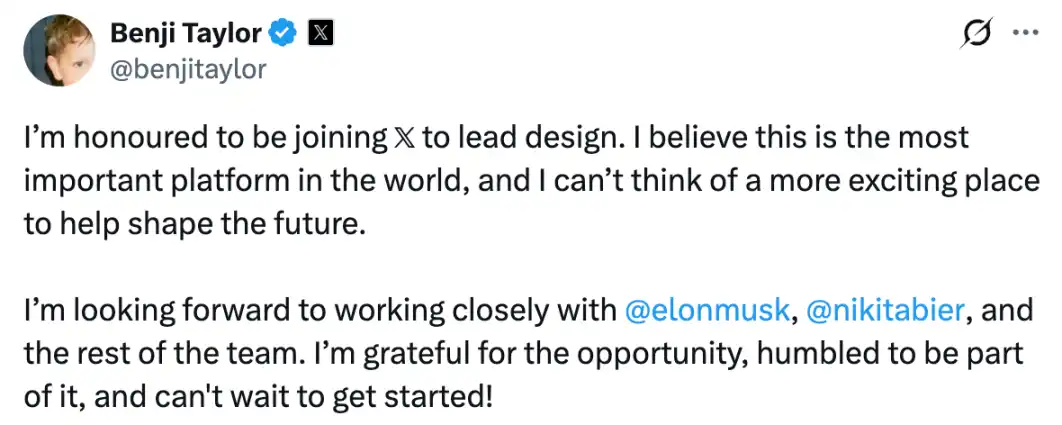
Personnel changes are nothing new in the Web3 industry, but this post, with close to 15 million views, told me there was more to it.
Upon closer inspection, I realized this individual was anything but a simple Base Design Lead.
Rebellion and Talent
Benji Taylor is only around 26 years old this year, possibly a typical "post-00s" individual.
Different from the conventional path of life, Benji Taylor was already somewhat famous at 16. In 2016, this 16-year-old "creative director" from London, UK, was interviewed by the renowned British fashion culture magazine "Dazed."
At an age when many were still diligently studying in high school classrooms, Benji Taylor had already made significant waves across the Atlantic. Many artists, including Ram Riddlz and A$AP Ant, collaborated with him. Not only that, he found time to develop an app, design his own deck of cards, and establish his design firm, Next Exit.
It wasn't something he started at 16 but something he had already accomplished. According to the interview, Next Exit had been in operation for at least a year.
"To be honest, I'm not good at art; I just have a lot of ideas and decided to put them into practice."
To Benji Taylor, the cookie-cutter design aesthetic was nauseating. As someone who considered himself not good at art, he felt his work surpassed that of many others.
In that interview from 10 years ago, Benji Taylor demonstrated a maturity beyond his years, expressing not only dissatisfaction with homogeneous education but also, when asked for advice for other young creative workers, stating:
「To have more self-awareness, understand that things don't just happen out of thin air. Going to school doesn't guarantee you'll find a job, nor does it guarantee you'll have a happy and stable life. You're still young, maybe still living with your parents, not paying rent—take advantage of that. Every penny you earn is profit, so why wait for real life to wear you down?」
From Honk to Aave
Around 2020, Benji Taylor arrived in the United States. Shortly thereafter, a company named Los Feliz Engineering (LFE) was founded, named after the first community Benji lived in after coming to the U.S.
The first product launched by this company was nothing short of a grand slam.
In December 2020, Honk burst onto the scene. The app was initially promoted on TikTok, with a single video receiving over 140,000 likes.
Honk's design was unique: the app had no send button, so whatever you typed in chat would be displayed to the other person letter by letter, allowing you to see the other person editing or deleting content in real-time, akin to "live chat." Additionally, the app had no chat history; once you left the chat room, all chat content would be permanently deleted.

If you wanted to pull someone into a chat room, you could send a "Honk," which would send a prominent notification to the other person, letting them know someone was "calling" them. This novel approach of translating the in-person chatting experience into an online mechanism was quite innovative.
In 2021, Honk expanded from familiar social connections to stranger socialization, allowing users to randomly match with strangers using a feature similar to WeChat's Shake. At its peak, Honk's open rate even surpassed that of Instagram. By the time it shut down, Honk had accumulated 2.6 billion characters of input, 170 million "Honks" sent, and hundreds of millions of images, audio, and video exchanges. It gained many loyal users in fashion, tech, and other fields.
Yes, this app was taken offline a few years ago. Despite its acclaim among users and the continued nostalgia for this "honkish" style even to this day by many product people and designers, the product-market fit was truly challenged.
The primary reason was that the app required both parties to be online simultaneously. Additionally, Honk lacked group chat functionality and never released an Android version.
Perhaps this app is considered godlike in certain niche circles, but a social app seems destined to fail if it doesn't have enough users.
In 2022, the LFE team started developing the design-focused self-hosted cryptocurrency wallet Family.
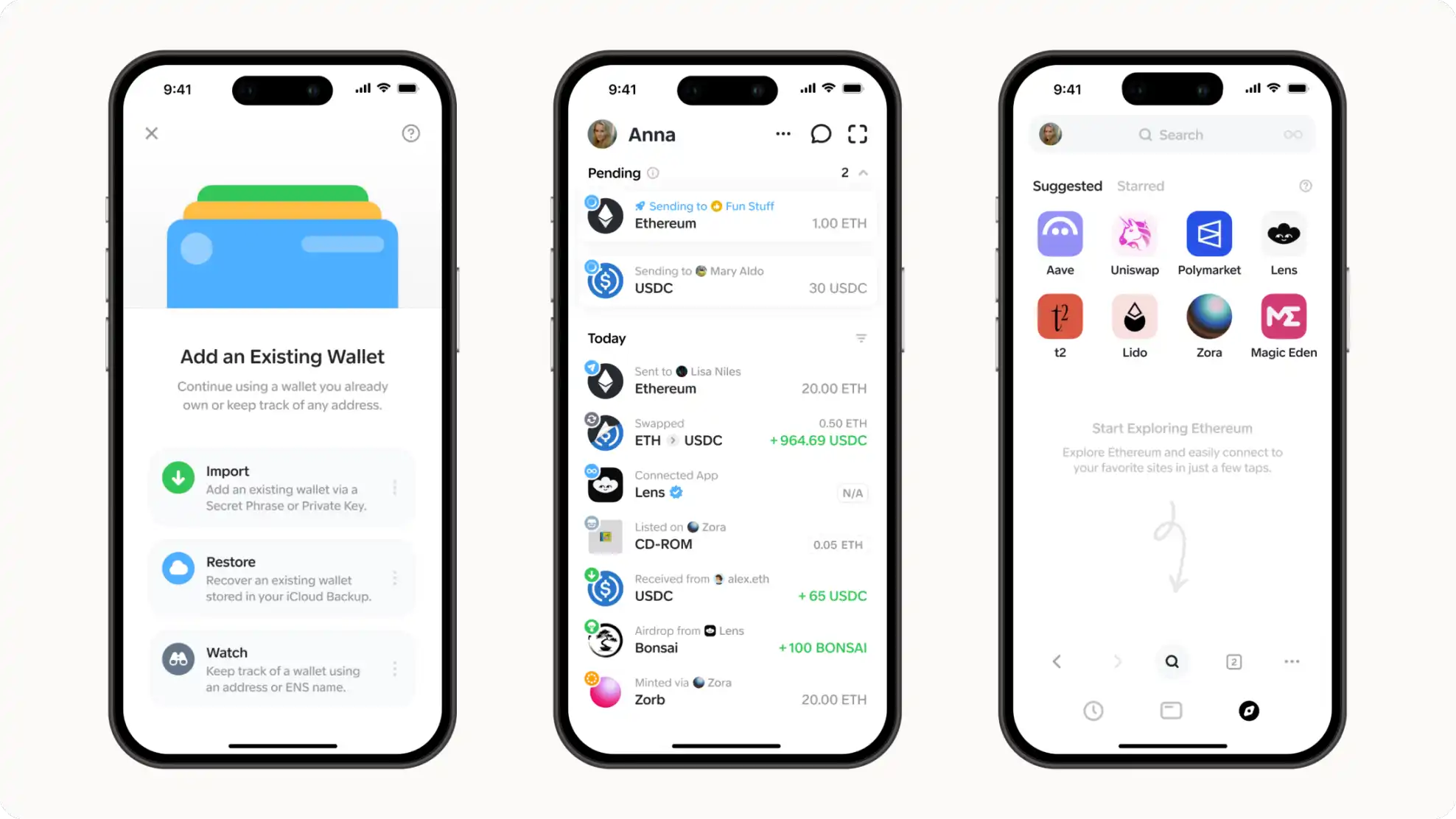
If you see a wallet app that bears a resemblance to the screenshot above, it might be inspired by Benji Taylor's design. This wallet product has also received high praise in the industry, with many users referring to it as the "best user experience cryptocurrency wallet." Of course, you probably haven't heard of this wallet because they didn't do well in terms of marketing.
Perhaps feeling that a good product was never truly recognized in the market, Benji Taylor decided to seek help from a bigger platform. In 2023, LFE was acquired by Aave Labs, and at the same time, Honk was shut down, while the Family wallet continued to operate. Unfortunately, this wallet was also abandoned in February of this year, with Aave explaining that they were focusing on their DeFi business and believed that for Web3 to attract users, it needed to be purpose-built rather than a general-purpose wallet.
Having acquired Lens, Mask Network founder Suji, today on X, stated that the Family wallet is the most impressive consumer-grade wallet product in terms of design language and depth, and it forms the foundation of the Aave App.

In October 2025, Benji Taylor left Aave and joined Base as the Head of Design. If you pay attention, you will notice that the now well-known mobile apps in the Web3 industry always have Aave and Base in their names. Some industry investors have told the author that the user experience of Web3 products on mobile apps is mostly terrible. With the global number of mobile phone users far exceeding that of PC users, the poor user experience on the PC side is also one of the obstacles to Web3 user expansion.
While there are certainly issues with infrastructure and many processes that cannot be simplified due to decentralization, it is also for this reason that only designers like Benji Taylor can create mobile applications for Web3 that might just pass as acceptable in the eyes of Web2.
The Man Chosen by Musk
The fact that the extremely picky Musk personally tweeted to welcome his joining already indicates many issues.
There were many speculations about his joining X, with some believing that the product lead Nikita Bier, who previously served as an advisor to Solana Labs and the former design lead for Base, both with backgrounds in the cryptocurrency industry, suggests Musk's intention to add more cryptocurrency-related functionality to X.
Some also speculate that his experience in social apps and cryptocurrency wallets could help X's encrypted communication app, X Chat, and payment products.
In response, Benji Taylor himself provided an answer:
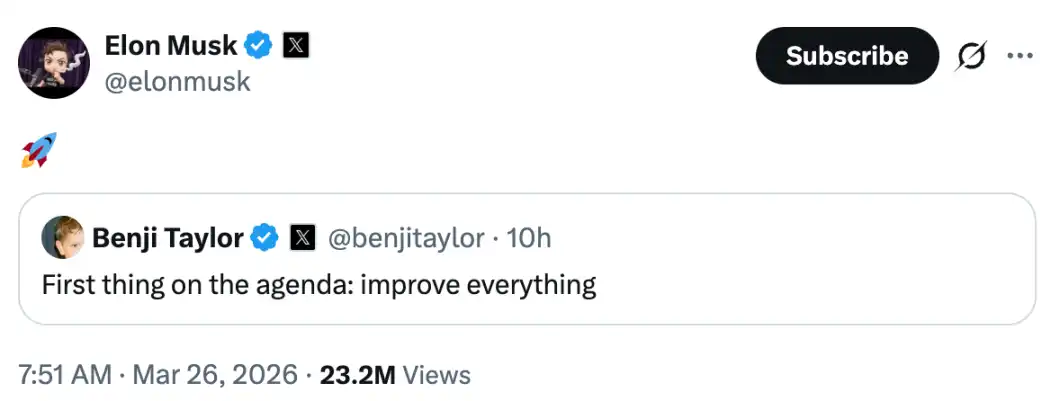
In the past, this talented young man has made many amazing designs, but from a purely business perspective, he seems to be too niche. After experiencing several years of ups and downs, it is believed that within this company integrating the social app X, the AI large model xAI, and SpaceX aiming directly at Mars immigration, Benji Taylor can unleash his talent to the fullest.
The AI's design capability is not weak, but the top-notch aesthetics do not come from billion-dollar or trillion-dollar parameters, but from the innate endowments of geniuses.
You may also like

Morning Report | BitMine increased its holdings by 126,971 ETH last week; trader Eugene announced his exit from the crypto market

Wang Chuan: How can one not feel anxious after the neighbor Old Wang made thirty times profit by investing in storage stocks? (Seven) - A quarter-century cycle

Cryptocurrency CEXs are flocking to sell US stocks, and traditional brokerages are facing an "uninvited guest."

$75 billion in foreign capital has fled, and South Korean retail investors have absorbed it all using leverage

Japan’s Three Megabanks Plan Joint Stablecoin Issuance in Fiscal 2026
MUFG, SMBC, and Mizuho reportedly plan to jointly issue fiat-pegged stablecoins in fiscal 2026, signaling Japan’s growing push into bank-led digital payment infrastructure.

Humanity Discloses H Token Dual-Chain Attack Details, With Losses on Ethereum and BSC Exceeding $36 Million
Humanity said the H token attack across Ethereum and BSC caused more than $36 million in losses after leaked ProxyAdmin keys enabled malicious contract upgrades and token minting.
White House Discusses CLARITY Act With Law Enforcement Ahead of Senate Vote
The White House discussed the CLARITY Act with law enforcement ahead of a Senate vote, focusing on illicit finance risks and developer protections.

Bitcoin Trading Guide 2026: Strategies for Experienced Traders

What Is XAUT and PAXG? Why Tokenized Gold Is Booming in 2026

Will the SpaceX IPO Hurt Bitcoin? Here's What Traders Are Watching

Foreign selling in the South Korean stock market accelerates, with cumulative net sales reportedly reaching $75 billion this year
On June 9, The Kobeissi Letter, citing Goldman Sachs data, reported that global investors are selling South Korean stocks at an unusually rapid pace. In the latest trading session, foreign investors sold about $801 million worth of Kospi constituent stocks again; total foreign outflows last week reached about $10 billion, and the market has been in net foreign selling on nearly every trading day over the past month. According to the data cited in the report, foreign investors have sold about $75 billion worth of South Korean stocks so far this year. Meanwhile, South Korean retail and institutional investors together recorded roughly $69 billion in net buying over the same period, suggesting that the market’s main buying support has come from domestic capital rather than returning overseas funds. The information currently disclosed still mainly comes from The Kobeissi Letter’s retelling and Goldman Sachs data summaries, while public details on the statistical period and the specific definition of “selling” remain relatively limited.

Fortune Warns of Strategy’s Financing Structure Risks as Bitcoin Premium Narrows
Fortune warned that Strategy’s Bitcoin treasury model faces growing financing risks as MSTR’s net asset premium narrows and preferred stock dividend pressure increases.

Ferrari Challenge Le Mans: Carl Moon to Dominate in WEEX Livery

Sahara AI Responds to SAHARA’s Sharp Drop: No Contract or Product Security Issues Found, Internal Investigation Underway
Sahara AI responded to SAHARA’s 60% price drop, saying no token contract or product security issues have been found and an internal investigation is underway.

WEEX Deposit/Withdrawal Dynamic Island: Your Asset Status, Always in Sight
Scaling Crypto Derivatives: The Digital Asset Infrastructure Behind High-Volume Trading
In the fast-moving digital asset ecosystem, derivatives platforms face an extreme architectural test. High-leverage futures markets demand more than just standard security—they require absolute operational precision, zero-latency matching engines, and ironclad structural scalability, all while navigating intense market volatility.
As global platforms scale to meet these demands, the industry is shifting away from rigid, monolithic setups toward a more agile, "decoupled" infrastructure philosophy.
The Blueprint for High-Volume Copy TradingFor elite global exchanges like WEEX (founded in 2018), this architectural choice becomes critical when scaling high-volume retail features like social copy trading. When thousands of users automatically mirror the real-time strategies of elite traders simultaneously, it triggers sudden, monumental spikes in concurrent transactional volume.
To prevent execution latency or settlement bottlenecks during these peak volatility events, a platform's primary engine must remain entirely dedicated to risk management, copy-trade synchronization, and order matching.
The Architectural Rule: New-generation platforms must separate front-end user execution engines from heavy backend infrastructural overhead to eliminate operational friction.
By separating these layers, platforms can maintain complete sovereignty over their trading environments and user experiences while strategically aligning with institutional-grade infrastructure ecosystems. This strategic framework allows modern exchanges to leverage advanced Digital Asset Custody infrastructure such as Cobo’s behind the scenes, ensuring that backend wallet management scales elastically alongside trading spikes.
Capitalizing on Market Momentum and 400× LeverageIn a derivatives arena where platforms offer up to 400× leverage on perpetual contracts, capital efficiency and market agility are core business metrics. To capture market momentum, an exchange needs the ability to rapidly expand its asset offerings, supporting everything from legacy crypto assets to sudden, trending altcoins across a massive library of trading pairs.
Adopting a flexible, scalable Wallet-as-a-Service (WaaS) solution such as Cobo’s could completely rewrite the development timeline for high-growth exchanges. Instead of spending months of engineering capital building out custom backend wallet architectures for every new blockchain network, platforms can deploy localized infrastructure in days.
This agility allows platforms to instantly scale their listings to over a thousand trading pairs without compromising security or delaying time-to-market. It mirrors the exact operational advantages seen during high-velocity market events, similar to how advanced wallet infrastructure empowers platforms during sudden asset surges; allowing exchanges to pass that speed and liquidity directly to their global user base.
A Mature Foundation for GrowthThe synergy between trusted infrastructure ecosystems and global trading platforms represents the natural evolution of a maturing crypto market. As WEEX continues to scale its global spot and derivatives offerings for over 6 million users, adopting robust backend paradigms proves that platforms no longer have to compromise between cutting-edge trading velocity and uncompromised structural security.

Get Paid to Onboard? Try WEEX’s New Homepage with Rewards for Registration, Deposit & Trade
WEEX Custom Layout: Build Your Perfect Trading Workspace in Seconds
Morning Report | BitMine increased its holdings by 126,971 ETH last week; trader Eugene announced his exit from the crypto market
Wang Chuan: How can one not feel anxious after the neighbor Old Wang made thirty times profit by investing in storage stocks? (Seven) - A quarter-century cycle
Cryptocurrency CEXs are flocking to sell US stocks, and traditional brokerages are facing an "uninvited guest."
$75 billion in foreign capital has fled, and South Korean retail investors have absorbed it all using leverage
Japan’s Three Megabanks Plan Joint Stablecoin Issuance in Fiscal 2026
MUFG, SMBC, and Mizuho reportedly plan to jointly issue fiat-pegged stablecoins in fiscal 2026, signaling Japan’s growing push into bank-led digital payment infrastructure.
Humanity Discloses H Token Dual-Chain Attack Details, With Losses on Ethereum and BSC Exceeding $36 Million
Humanity said the H token attack across Ethereum and BSC caused more than $36 million in losses after leaked ProxyAdmin keys enabled malicious contract upgrades and token minting.


