
Middle East Conflict Escalation and Rate Hike Expectation Trigger Worst Gold Sell-Off in 43 Years


Original Title: "Gold Plunges for a Week! '1983 Great Sell-off' Reappears, Middle East 'Gold Selling for Fundraising'? "
Original Author: Dong Jing, Wall Street News
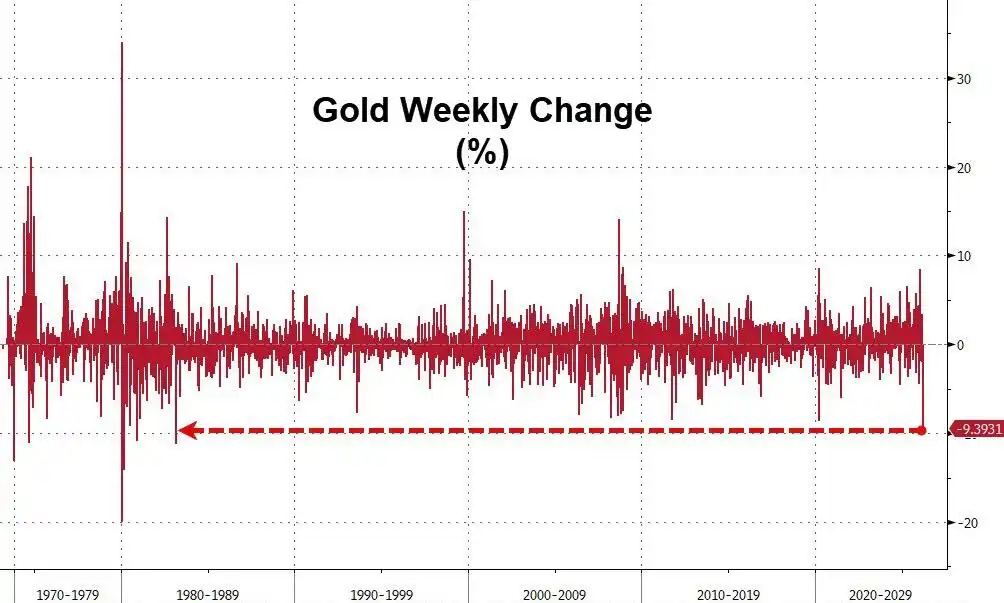
Gold suffered its most severe weekly decline in 43 years this week, with echoes of history sending chills through the market.
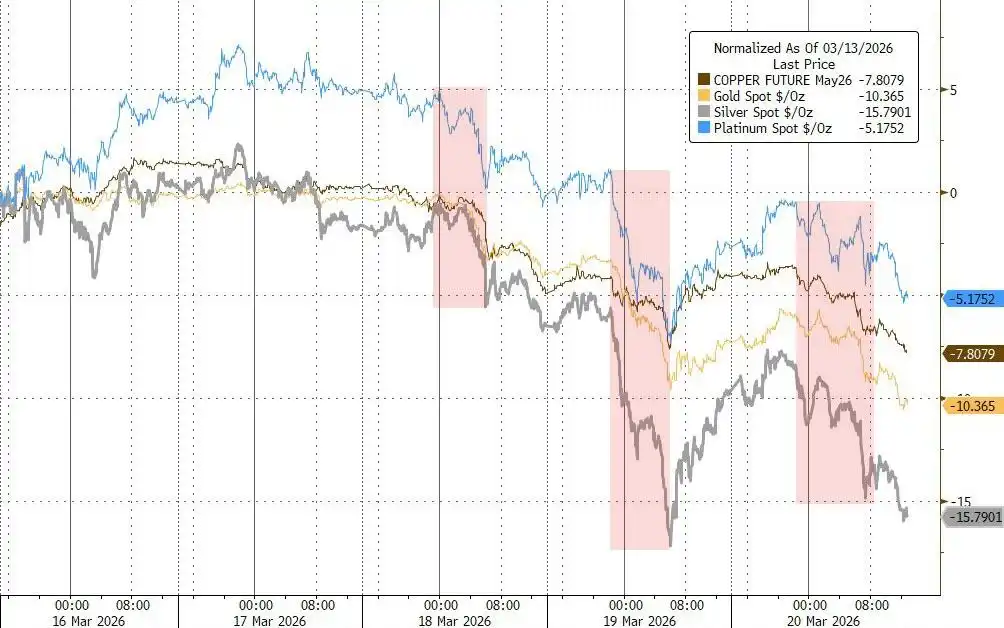
This week, gold saw its largest weekly decline since March 1983, with spot gold prices falling for eight consecutive trading days, marking the longest losing streak since October 2023. Meanwhile, silver plunged over 15% this week, and palladium and platinum also moved lower in sync.
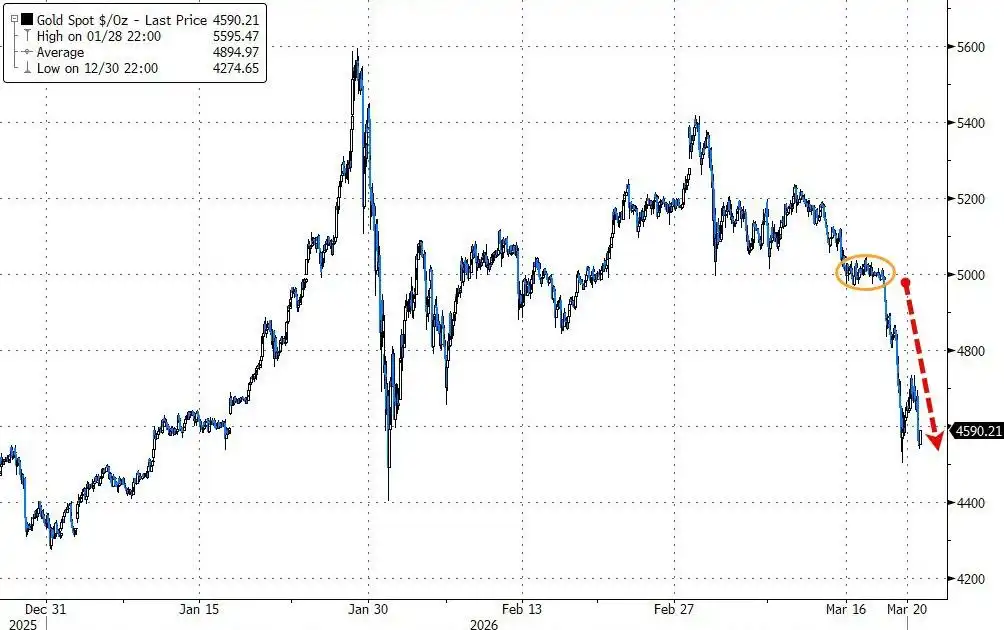
The trigger for this round of sell-off was the escalating tensions in the Middle East driving up energy prices, subsequently suppressing rate cut expectations. Market bets on a Fed rate hike rose to 50%, intensifying the wave of precious metals sell-off.
What's even more alarming is that the current situation bears a striking resemblance to the historic meltdown triggered by a massive gold sell-off by oil-producing countries in the Middle East back in March 1983—back then, OPEC member countries facing a sharp drop in oil revenue were forced to sell off their gold reserves for cash, causing a gold price drop of over $100 in a matter of days.
It is worth noting that historical data shows that this week's gold plunge is the most severe since the "gold selling for fundraising" storm 43 years ago.
Rate Cut Expectations Dashed, Gold's Safe-Haven Logic Fails
Since the US and Israel launched attacks on Iran last month, gold has been falling for several weeks, presenting a stark contrast to its traditional role as a "safe-haven asset."
The reason is that war brings not easing expectations but inflationary pressure. Currently, the market's assessment of the Fed's policy path has undergone a fundamental reversal.
Traders are now betting that the probability of a Fed rate hike before October has risen to 50%. Soaring energy prices have pushed up inflation expectations, and gold, as a non-yielding asset, has become much less attractive in an environment of rising real interest rates.
At the same time, there are signs of tightening US dollar liquidity in the current market. Cross-currency basis swaps have started to widen noticeably this week, indicating some degree of dollar funding pressure.
This phenomenon may explain the underlying logic behind the gold sell-off—when US dollar liquidity tightens, gold is often one of the assets investors are quick to cash out.
It is worth noting that this week, the most severe sell-off in the metals market was concentrated during the Asian and European trading sessions, which is in line with the pattern of the offshore market showing the initial signs of dollar shortage pressure.
Technical Stop-loss Trigger, Sell-off Self-reinforcement
Amid the continued decline, gold's technical indicators have significantly deteriorated, with the 14-day Relative Strength Index (RSI) falling below 30, entering a zone that some traders view as oversold.
StoneX Financial analyst Rhona O'Connell pointed out that this round of gold pullback is the result of profit-taking and liquidity clearing working together. She stated that the gold price attracted a significant amount of buying interest above $5200 earlier, creating a considerable pullback vulnerability in the market.
Once the price started to slide, a large number of investor stop-loss orders were automatically triggered, and selling pressure quickly formed a self-reinforcing spiral. Technical signals such as moving averages further intensified the downward pressure.
At the same time, the passive selling triggered by the stock market's decline also affected gold.
O'Connell pointed out that forced liquidation related to stock assets may have weighed on the gold price, while a slowdown in central bank gold purchases and ongoing outflows from gold ETFs further dampened market sentiment. According to Bloomberg data, gold ETFs have seen net outflows for three consecutive weeks, with a total reduction in holdings of over 60 tons in three weeks.
The Ghost of the 1983 Middle East "Gold-for-Funding" Crisis
The current situation inevitably reminds market participants of the gold collapse triggered 43 years ago by the oil crisis.
Historical records show that around February 21, 1983, British and Norwegian oil producers were the first to cut prices, putting pressure on OPEC to follow suit. The global oil market suddenly worsened due to oversupply. Faced with a sharp decline in oil revenue, oil-producing countries in the Middle East (mainly OPEC members) were forced to sell gold reserves on a large scale to raise cash, triggering a gold price collapse.
A report by The New York Times at the time confirmed this assessment. According to a March 1, 1983 article in The New York Times, traders explicitly stated that the sale of gold by Middle Eastern oil-producing countries was the direct trigger for the gold price crash, and warned that if oil revenues continued to decline, these Arab countries might sell more gold. At that time, the gold price plummeted over $105 in less than a week, with a single-day maximum decline of $42.5, the largest in nearly three years.
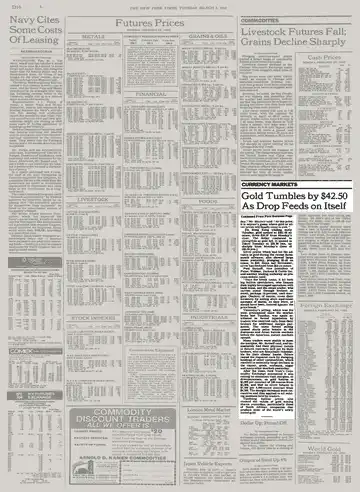
According to The New York Times at the time, the proceeds from the Middle East sell-off promptly flowed into European dollars and other short-term investment instruments, causing a softening of short-term interest rates, thereby sending a warning signal to the global gold market. As February 21 fell on the Presidents' Day holiday in the United States, the New York market was closed, and the impact did not fully manifest until the following week, triggering a chain reaction of forced liquidation, impacting commodities such as copper, grains, soybeans, sugar, and more.
ZeroHedge pointed out that the 1983 gold crash marked the beginning of a bear market cycle in the oil market, with OPEC discipline weakening, continuous market share losses, and oil prices remaining under pressure throughout the entire 1980s.
Arc of Stagflation Looms, Can Gold Price Stabilize?
Despite suffering heavy losses this week, gold has still risen by about 4% year-to-date. In late January of this year, the gold price touched a historical high of nearly $5,600 per ounce, driven by investor enthusiasm, central bank gold purchases, and concerns in the market about Trump's interference with Fed independence.
However, the current macro environment has significantly deteriorated. According to Bloomberg, Goldman Sachs economist Joseph Briggs predicts that the rise in energy prices will drag global GDP down by 0.3 percentage points over the next year and push overall inflation up by 0.5 to 0.6 percentage points. The risk of stagflation is increasing, severely limiting the central bank's policy space.
Goldman analyst Chris Hussey pointed out that the blockade in the Strait of Hormuz has entered its fourth week, and hopes for a quick resolution to the conflict are fading. The longer the conflict continues and oil prices remain high, the more challenging it will be to sustain the narrative of "seeing through short-term pain" in the stock and bond markets, further exposing the vulnerability of global assets.
For gold, the trend in real interest rates will be a key variable. If the conflict persists, inflation expectations continue to rise, and the Fed's path to rate hikes becomes clearer, the pressure on gold may continue; however, once there are signals of easing in the geopolitical situation, whether the suppressed safe-haven demand can be revived remains the biggest suspense in the market.
You may also like

Morning Report | OpenAI has submitted an S-1 registration statement draft to the U.S. SEC; Morpho completes $175 million financing

Galaxy Deep Research Report: How Hyperliquid's HIP-4 Upgrade Changes the Landscape of Prediction Markets?

Latest research from 13 top universities including Cornell University: The current state, challenges, and misconceptions of the fusion of Crypto and AI

Deconstructing Anthropic: The Best AI Company, Possibly Also a Type of Organizational Invention

Every exchange is a "Universal Exchange."

The counterattack of traditional finance: Alliance chains are quietly reviving
Pantera Capital Partner: How Tokenization is Restructuring the Private Equity and Early Investment Ecosystem?

Mastercard Launches Agent Pay for AI, Plans to Record AI Agent Payment Authorizations on Polygon
Mastercard launched Agent Pay for AI, a new payment protocol designed to help AI agents make small payments such as pay-per-use access to data and APIs. The system plans to record human-granted AI agent permissions on Polygon, focusing on verifiable authorization, identity, and payment controls.

Curve Deploys Llamalend v2 on Optimism With 250,000 OP Incentives
Curve launched Llamalend v2 on Optimism with 250,000 OP incentives from the Optimism Foundation. The upgrade expands Llamalend beyond its earlier crvUSD-focused model, adding broader collateral support, LlamaRisk market reviews, and the ability to use Curve LP tokens as collateral.

Raydium Old Liquidity Pool Reportedly Exploited, With $1.34 Million Moved to Ethereum and Tornado Cash
An old Raydium liquidity pool was reportedly exploited for around $1.34 million in USDC, RAY, and wSOL, with the stolen funds bridged to Ethereum and deposited into Tornado Cash. The incident highlights the tail risks of legacy DeFi pools, old contracts, and cross-chain fund laundering paths.
Kalshi Executive Challenges “SBF Backed AI Unicorns” Narrative, Says Leopold Aschenbrenner Was Key Figure
Kalshi executive John Wang questioned the “SBF backed AI unicorns” narrative, saying Leopold Aschenbrenner was the key figure behind major AI investment decisions.

New York Proposes Stricter Stablecoin Issuer Rules Aligned With Federal GENIUS Act
NYDFS proposed stricter stablecoin issuer rules aligned with the GENIUS Act, covering reserves, custody, redemption timelines, audits, and capital buffers.

CryptoQuant Says Bitcoin Profitable Supply Is Near 45% Pressure Zone as On-Chain Data Points to Market Repricing
CryptoQuant said Bitcoin’s profitable supply is nearing the 45% pressure zone, signaling rising market stress, unrealized losses, and a possible on-chain repricing phase.

Bitcoin Falls Below 200-Week Moving Average as On-Chain Data Shows Over Half of Supply in Loss
Bitcoin dropped below its 200-week moving average as on-chain data showed over 50% of circulating supply is now in loss, signaling rising market stress.

CFTC Reportedly Plans New Prediction Market Rules Focused on Manipulation Risk and Public Interest Review
The CFTC is reportedly preparing new prediction market rules focused on manipulation risk, public interest review, and retail trader protections.

Meet the new WEEX trial fund—your gateway to greater profits

WEEX Labs Lands at Dutch Blockchain Week: A Disruptive Crypto × AI Conversation Sets Sail in Amsterdam
SK Hynix Reportedly Plans U.S. ADR Listing as Early as August, With SEC Approval Possible in Late June
SK Hynix may pursue a U.S. ADR listing as early as August, with SEC approval reportedly possible in late June amid strong AI chip supply chain demand.
Morning Report | OpenAI has submitted an S-1 registration statement draft to the U.S. SEC; Morpho completes $175 million financing
Galaxy Deep Research Report: How Hyperliquid's HIP-4 Upgrade Changes the Landscape of Prediction Markets?
Latest research from 13 top universities including Cornell University: The current state, challenges, and misconceptions of the fusion of Crypto and AI
Deconstructing Anthropic: The Best AI Company, Possibly Also a Type of Organizational Invention
Every exchange is a "Universal Exchange."
The counterattack of traditional finance: Alliance chains are quietly reviving


