
Meta Layoff Explained: On the same day as laying off 700 people, they handed out $90 billion in retention bonuses to executives

On March 25, Meta notified about 700 employees to leave, involving five departments including Reality Labs, Facebook Social Media, Recruiting, Sales, etc. On the same day, the SEC disclosed an executive stock option plan, where 6 key executives will receive stock options tied to a $9 trillion market value. This is the first time Meta has granted options to executives since its 2012 IPO.
While downsizing on one side, Meta rolled out the most aggressive executive incentive plan in Silicon Valley history. What Meta did on the same day is not contradictory, but two sides of the same strategic coin. The AI race doesn't need more people; it needs more expensive people and more machines.
Fewer People, Each More "Valuable"
2022 was the peak year for Meta's workforce, with a total of 86,482 employees. In that year, Zuckerberg doubled down on the metaverse, aggressively hiring, only to see the annual revenue drop from $117.9 billion the previous year to $116.6 billion. Revenue per person plummeted to a low of $1.35 million.
Everyone knows what happened next. In November 2022, 11,000 people were laid off, followed by another 21,000 in 2023, cutting a quarter of the entire company's workforce. Zuckerberg dubbed 2023 as the "efficiency year."
The results of efficiency are evident in the numbers. According to Meta's Q4 2025 earnings report, by the end of 2025, the company had 78,865 employees, nearly 8,000 less than at its peak. However, annual revenue had grown from $116.6 billion to $201 billion, a 72% increase. Revenue per person soared from $1.35 million to $2.55 million, an 89% growth.
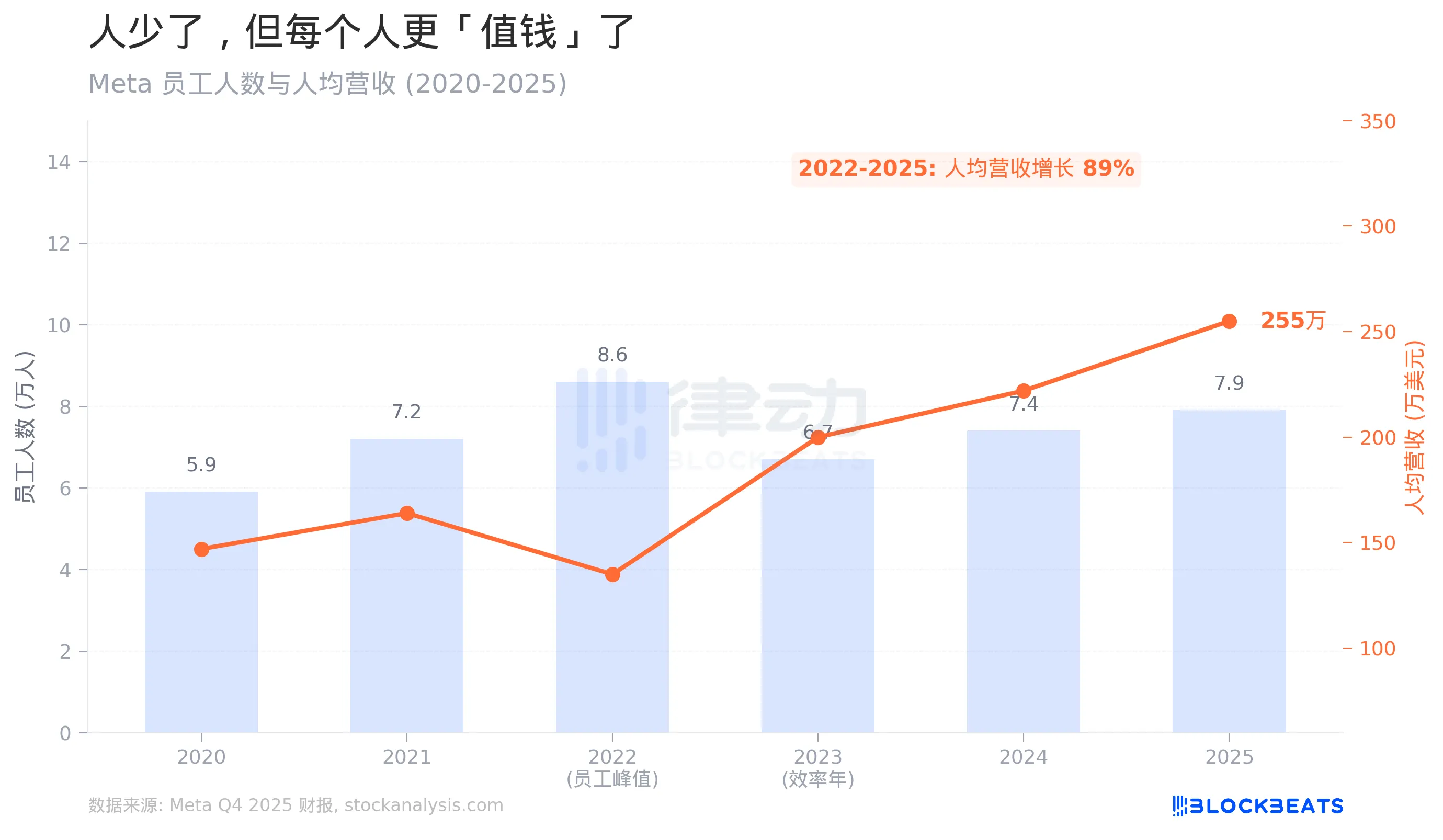
The implications of these numbers are straightforward. Meta made more money with fewer people. In 2022, the marginal revenue generated by each additional employee was decreasing, but by 2024 and 2025, the revenue increment corresponding to each laid-off employee was expanding. This is a typical scale effect in tech companies, but Meta accelerated this process through layoffs.
This sets the backdrop for the March 2026 round of 700 job cuts. According to The Register, this is already Meta's second round of layoffs this year, with around 1,000 employees laid off in January in Reality Labs. NBC News, citing insiders, said there could be further, larger-scale reductions, potentially affecting up to 20% of the total workforce, around 15,000 people, which would bring Meta's employee count back to the 2021 level.
During the January earnings call, Zuckerberg's exact words were that the plan is to "flatten the team," allowing outstanding individual contributors to complete projects that used to require large teams. A Meta spokesperson's response was also quite templated, stating that "teams are regularly reorganized or adjusted to ensure they are in the best position to meet their goals."
Continuing to Bet on the AI Arms Race
Where did the money saved from the layoffs go? A look at capital expenditures makes it clear.
According to the Q4 2025 earnings reports and public guidance from various companies, the combined capital expenditures of the four companies, Amazon, Google, Microsoft, and Meta, will reach approximately $650 billion in 2026, a year-over-year increase of about 130%. Amazon accounts for around $200 billion (a 167% increase), Google for $175 billion to $185 billion (a 140% increase), Microsoft for an annualized amount of around $145 billion (a 127% increase), and Meta for $115 billion to $135 billion (a 73% increase).
As reported by CNBC, this is the largest single-year capital expenditure in the history of the tech industry. The AI infrastructure investment of these four companies in one year exceeds the GDP of Sweden.
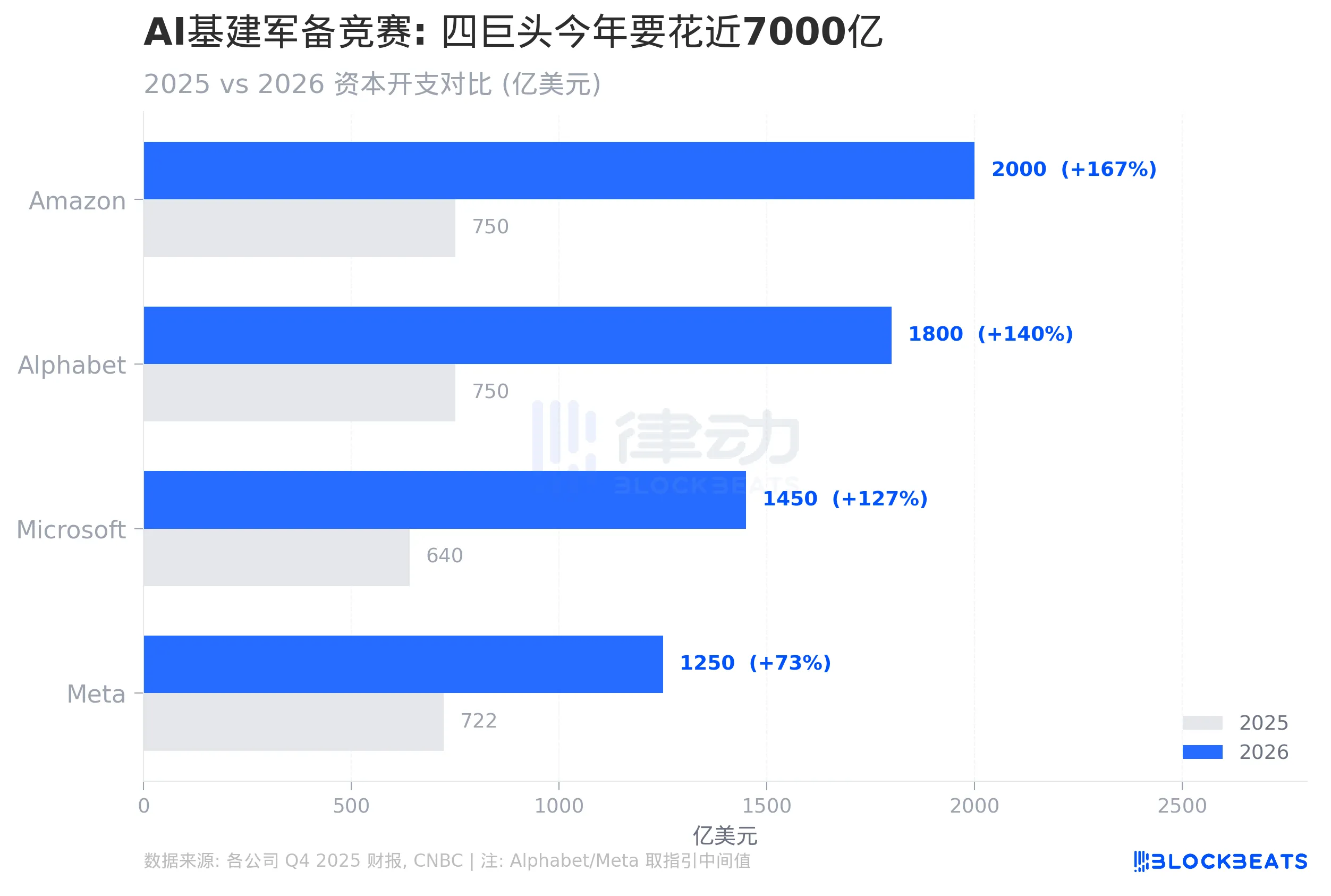
Meta ranks fourth in absolute value, but in relation to its own size, the density of this investment is astonishing. Calculated at the median value of $1.25 trillion, the AI infrastructure investment per Meta employee is approximately $1.59 million, close to 62% of the per capita revenue ($2.55 million). In other words, for every $100 earned, Meta invests $62 in data centers.
The cost of this money is also direct. According to Barclay's analyst estimates cited by CNBC, Meta's free cash flow is expected to drop by almost 90% in 2026. Amazon is even more aggressive, with Morgan Stanley estimating a negative free cash flow of about $17 billion for Amazon in 2026. The four giants are all doing the same thing: trading today's cash flow for tomorrow's AI infrastructure.
A $9 Trillion Bet
Now let's look at the stock option plan. According to SEC filings and Motley Fool analysis, this plan covers six executives, including Chief Technology Officer Bosworth, Chief Product Officer Cox, Chief Operating Officer Olivan, Chief Financial Officer Susan, Chief Legal Officer Maoni, and Vice Chairman McCormick. Zuckerberg is not on the list, as his super-voting shares have already provided him with sufficient incentives.
The option's exercise conditions are designed with a step-up price threshold. According to the Motley Fool, the lowest-tier exercise price is $1,116 per share, requiring a price increase of 88% from the current approximately $615. The highest-tier is $3,727 per share, corresponding to a market value of about $9 trillion, which is 6 times the current $1.5 trillion. Five-year window, cash-out by 2031. If Meta truly reaches a $9 trillion market value, according to the Motley Fool's calculation, the top four executives (Bosworth, Cox, Olivan, Lee-Susan) each have a potential gain of about $2.7 billion.
The signal of this plan is very clear. Meta is not giving bonuses to executives but using options to bind the core team to an extremely aggressive growth target. With the current market value at $1.5 trillion and the target at $9 trillion, the $7.5 trillion difference in the middle is what Meta is betting AI can create in value.
Let's put the scale into perspective. $9 trillion is roughly equivalent to the current market value sum of Apple and Nvidia. Currently, no company globally has ever reached this market value. Meta has given its core executives five years to reach a number that has never existed in human business history.
A Formula
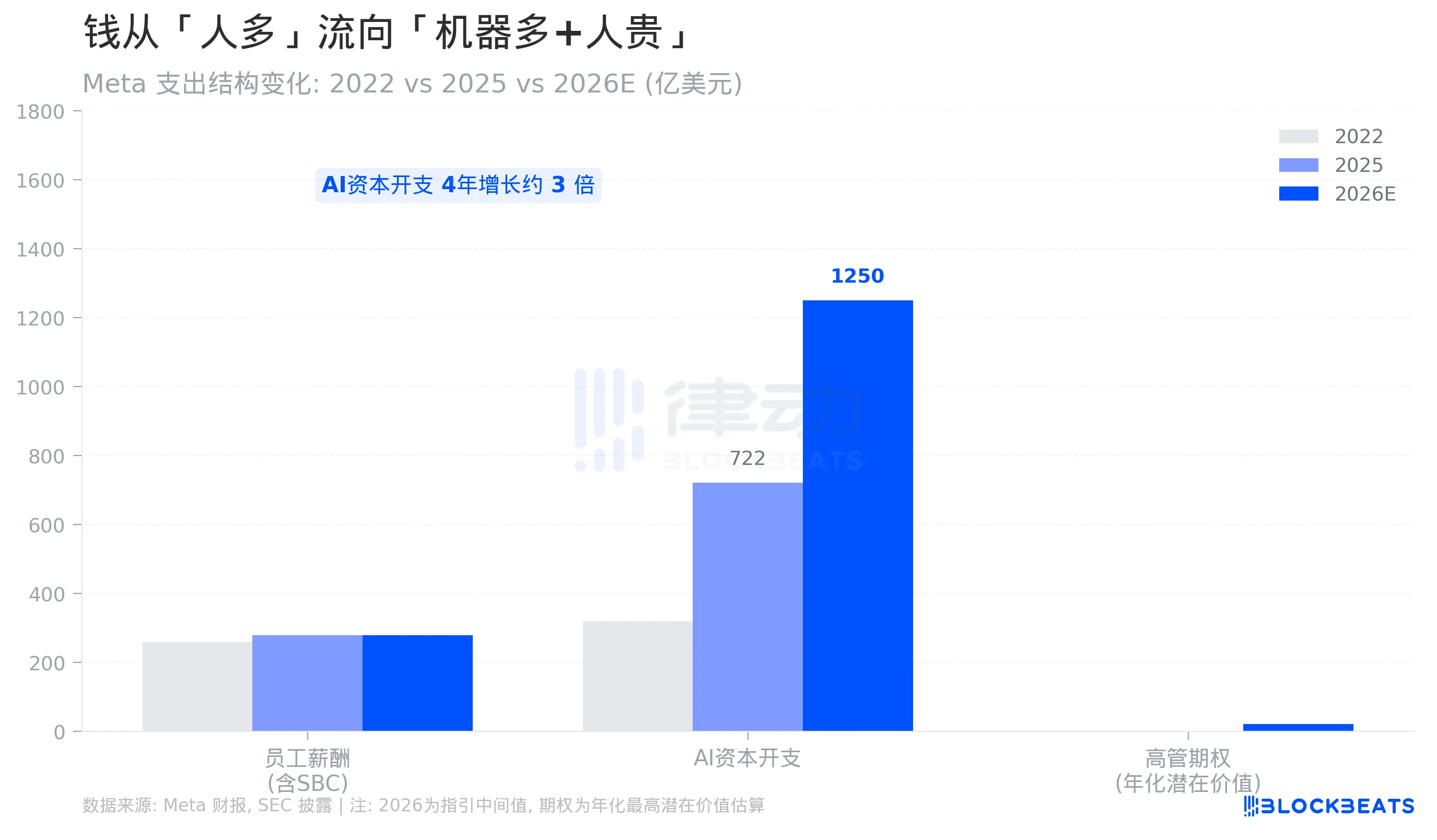
Putting three things together, Meta's logic is a simple resource allocation formula. Total employee compensation (including equity incentives) is roughly flat in 2022 and 2026, both around $26 to $28 billion. But AI capital spending has skyrocketed from $32 billion to $125 billion, a fourfold increase over four years. Meanwhile, a brand-new executive option pool has emerged, locking in the top six people for the next five years.
According to Benzinga, Meta's equity compensation expense in 2025 is about $42 billion, consuming most of the free cash flow. AI researchers' signing bonuses have reached the nine-figure mark, with researchers brought in from OpenAI reportedly receiving signing packages at the $100 million level. These figures, contrasted with the 700 employees laid off, clearly illustrate Meta's pricing logic regarding "people."
The money saved by laying off 700 people is roughly equivalent to Meta's AI infrastructure spending for a day and a half.
You may also like

Morning Report | OpenAI has submitted an S-1 registration statement draft to the U.S. SEC; Morpho completes $175 million financing

Morning Report | BitMine increased its holdings by 126,971 ETH last week; trader Eugene announced his exit from the crypto market

Wang Chuan: How can one not feel anxious after the neighbor Old Wang made thirty times profit by investing in storage stocks? (Seven) - A quarter-century cycle

Cryptocurrency CEXs are flocking to sell US stocks, and traditional brokerages are facing an "uninvited guest."

$75 billion in foreign capital has fled, and South Korean retail investors have absorbed it all using leverage

Japan’s Three Megabanks Plan Joint Stablecoin Issuance in Fiscal 2026
MUFG, SMBC, and Mizuho reportedly plan to jointly issue fiat-pegged stablecoins in fiscal 2026, signaling Japan’s growing push into bank-led digital payment infrastructure.

Humanity Discloses H Token Dual-Chain Attack Details, With Losses on Ethereum and BSC Exceeding $36 Million
Humanity said the H token attack across Ethereum and BSC caused more than $36 million in losses after leaked ProxyAdmin keys enabled malicious contract upgrades and token minting.
White House Discusses CLARITY Act With Law Enforcement Ahead of Senate Vote
The White House discussed the CLARITY Act with law enforcement ahead of a Senate vote, focusing on illicit finance risks and developer protections.

Bitcoin Trading Guide 2026: Strategies for Experienced Traders

What Is XAUT and PAXG? Why Tokenized Gold Is Booming in 2026

Will the SpaceX IPO Hurt Bitcoin? Here's What Traders Are Watching

Foreign selling in the South Korean stock market accelerates, with cumulative net sales reportedly reaching $75 billion this year
On June 9, The Kobeissi Letter, citing Goldman Sachs data, reported that global investors are selling South Korean stocks at an unusually rapid pace. In the latest trading session, foreign investors sold about $801 million worth of Kospi constituent stocks again; total foreign outflows last week reached about $10 billion, and the market has been in net foreign selling on nearly every trading day over the past month. According to the data cited in the report, foreign investors have sold about $75 billion worth of South Korean stocks so far this year. Meanwhile, South Korean retail and institutional investors together recorded roughly $69 billion in net buying over the same period, suggesting that the market’s main buying support has come from domestic capital rather than returning overseas funds. The information currently disclosed still mainly comes from The Kobeissi Letter’s retelling and Goldman Sachs data summaries, while public details on the statistical period and the specific definition of “selling” remain relatively limited.

Fortune Warns of Strategy’s Financing Structure Risks as Bitcoin Premium Narrows
Fortune warned that Strategy’s Bitcoin treasury model faces growing financing risks as MSTR’s net asset premium narrows and preferred stock dividend pressure increases.

Ferrari Challenge Le Mans: Carl Moon to Dominate in WEEX Livery

Sahara AI Responds to SAHARA’s Sharp Drop: No Contract or Product Security Issues Found, Internal Investigation Underway
Sahara AI responded to SAHARA’s 60% price drop, saying no token contract or product security issues have been found and an internal investigation is underway.

WEEX Deposit/Withdrawal Dynamic Island: Your Asset Status, Always in Sight
Scaling Crypto Derivatives: The Digital Asset Infrastructure Behind High-Volume Trading
In the fast-moving digital asset ecosystem, derivatives platforms face an extreme architectural test. High-leverage futures markets demand more than just standard security—they require absolute operational precision, zero-latency matching engines, and ironclad structural scalability, all while navigating intense market volatility.
As global platforms scale to meet these demands, the industry is shifting away from rigid, monolithic setups toward a more agile, "decoupled" infrastructure philosophy.
The Blueprint for High-Volume Copy TradingFor elite global exchanges like WEEX (founded in 2018), this architectural choice becomes critical when scaling high-volume retail features like social copy trading. When thousands of users automatically mirror the real-time strategies of elite traders simultaneously, it triggers sudden, monumental spikes in concurrent transactional volume.
To prevent execution latency or settlement bottlenecks during these peak volatility events, a platform's primary engine must remain entirely dedicated to risk management, copy-trade synchronization, and order matching.
The Architectural Rule: New-generation platforms must separate front-end user execution engines from heavy backend infrastructural overhead to eliminate operational friction.
By separating these layers, platforms can maintain complete sovereignty over their trading environments and user experiences while strategically aligning with institutional-grade infrastructure ecosystems. This strategic framework allows modern exchanges to leverage advanced Digital Asset Custody infrastructure such as Cobo’s behind the scenes, ensuring that backend wallet management scales elastically alongside trading spikes.
Capitalizing on Market Momentum and 400× LeverageIn a derivatives arena where platforms offer up to 400× leverage on perpetual contracts, capital efficiency and market agility are core business metrics. To capture market momentum, an exchange needs the ability to rapidly expand its asset offerings, supporting everything from legacy crypto assets to sudden, trending altcoins across a massive library of trading pairs.
Adopting a flexible, scalable Wallet-as-a-Service (WaaS) solution such as Cobo’s could completely rewrite the development timeline for high-growth exchanges. Instead of spending months of engineering capital building out custom backend wallet architectures for every new blockchain network, platforms can deploy localized infrastructure in days.
This agility allows platforms to instantly scale their listings to over a thousand trading pairs without compromising security or delaying time-to-market. It mirrors the exact operational advantages seen during high-velocity market events, similar to how advanced wallet infrastructure empowers platforms during sudden asset surges; allowing exchanges to pass that speed and liquidity directly to their global user base.
A Mature Foundation for GrowthThe synergy between trusted infrastructure ecosystems and global trading platforms represents the natural evolution of a maturing crypto market. As WEEX continues to scale its global spot and derivatives offerings for over 6 million users, adopting robust backend paradigms proves that platforms no longer have to compromise between cutting-edge trading velocity and uncompromised structural security.

Get Paid to Onboard? Try WEEX’s New Homepage with Rewards for Registration, Deposit & Trade
Morning Report | OpenAI has submitted an S-1 registration statement draft to the U.S. SEC; Morpho completes $175 million financing
Morning Report | BitMine increased its holdings by 126,971 ETH last week; trader Eugene announced his exit from the crypto market
Wang Chuan: How can one not feel anxious after the neighbor Old Wang made thirty times profit by investing in storage stocks? (Seven) - A quarter-century cycle
Cryptocurrency CEXs are flocking to sell US stocks, and traditional brokerages are facing an "uninvited guest."
$75 billion in foreign capital has fled, and South Korean retail investors have absorbed it all using leverage
Japan’s Three Megabanks Plan Joint Stablecoin Issuance in Fiscal 2026
MUFG, SMBC, and Mizuho reportedly plan to jointly issue fiat-pegged stablecoins in fiscal 2026, signaling Japan’s growing push into bank-led digital payment infrastructure.


