
Is the era of Embodied AI's "GPT Moment" Approaching? Axis Robotics Announces End of Testing, Set to Launch on Base Chain


Article Source: Axis
Axis Robotics is restructuring embodied intelligence's data diversity and scalable production approach with a Simulation-First strategy.
By 2025, multiple technological paths in the robotics industry are rapidly converging: the commercialization upgrade of embodied hardware supply chains has made previously expensive prototypes capable of large-scale deployment for the first time; Vision-Language-Action (VLA) models provide robots with a "brain" that understands semantics, inference, and planning; and the multi-layer data pyramid composed of video priors and synthetic simulation is also providing continuous fuel for the ongoing evolution of embodied intelligence.
However, the industry still faces a core bottleneck: data. Compared to large language models and autonomous driving, embodied intelligence still has a significant data gap during the pretraining stage. Around this gap, the industry is advancing along multiple paths: UMI's large-scale operational data, first-person (Ego-Centric) video natural interaction data, and the rapidly developing synthetic simulation data system. Against the backdrop of the evolution of these data sources, academia and industry are gradually forming a new technological consensus: Relying on high-quality, large-scale simulation data for pretraining, followed by fine-tuning with a small amount of real-world data, is currently one of the most viable paths.
However, this consensus also sets higher requirements—the simulation data must possess high quality, low cost, and scalability simultaneously, otherwise, the dual dilemma of high real-world data costs and inadequate simulation quality will continue to slow down the iteration speed of model training.
So, is the "GPT moment" for embodied intelligence approaching?
Axis's answer is affirmative—provided that a thorough reshaping of robot data's scalable production approach is needed, and a redefinition of the deployment paradigm in the physical world is required.
Axis Robotics Enables Ordinary People to Participate in Embodied Intelligence Data Collection
Traditional robot data collection relies on small expert teams or local remote operation, which is both difficult to scale and lacks sufficient diversity. To overcome this bottleneck, Axis adopts a Simulation-First strategy, building an end-to-end embodied intelligence data infrastructure and significantly enhancing data production capacity through distributed human collaboration. Robots serve humans and are continuously built and evolved in large-scale human participation.
From its inception, Axis has realized that merely providing data is far from enough. To truly address the data dilemma of embodied intelligence, a complete end-to-end technical pipeline covering core processes must be built. The three key processes are: task generation, data collection, and data evaluation and processing:
● Task Generation: Infinitely Scalable Dynamic Task Engine.
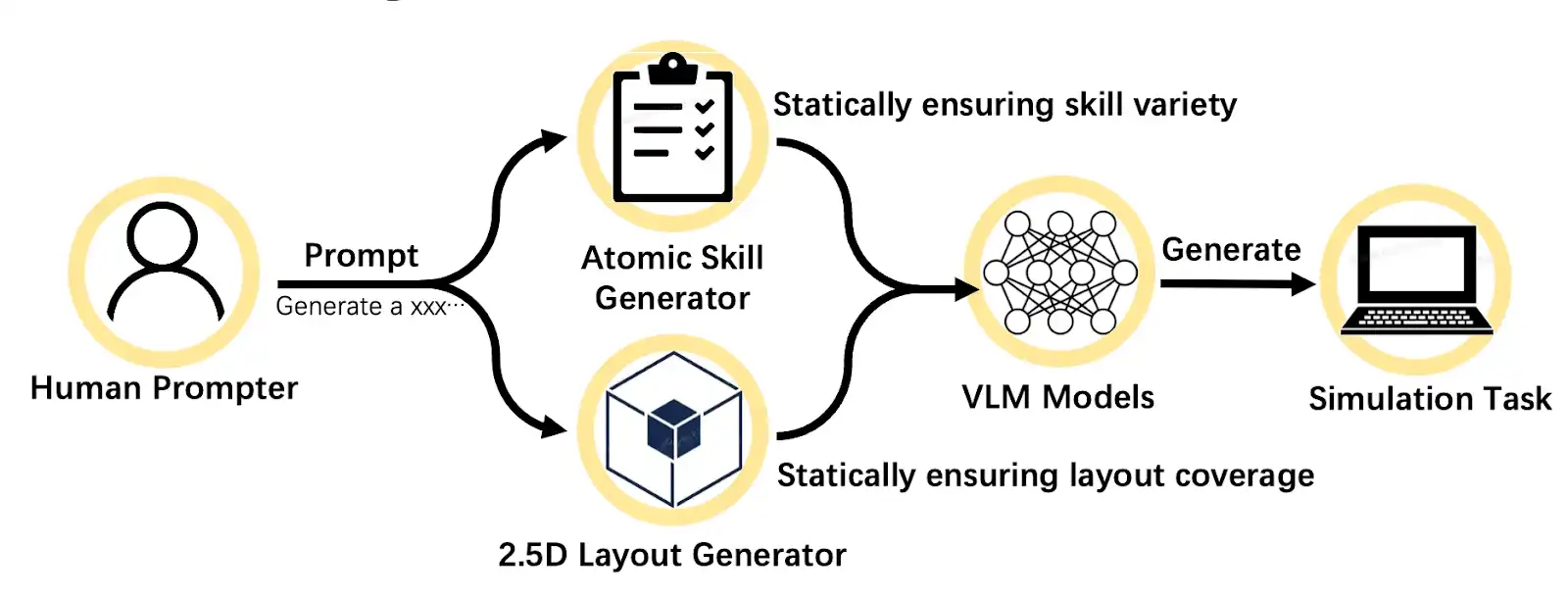
The boundary of data determines the capability boundary of robots. Axis has built a next-generation 3D dynamic task generation engine, which breaks down the essential skills required for robots into atomic skills and can generate a massive amount of high-quality simulated tasks through cue words. From single scenarios to complex chained tasks, robots can continuously evolve in an infinitely rich task space.
● Data Collection: A Zero-Threshold Collection Platform for Everyone
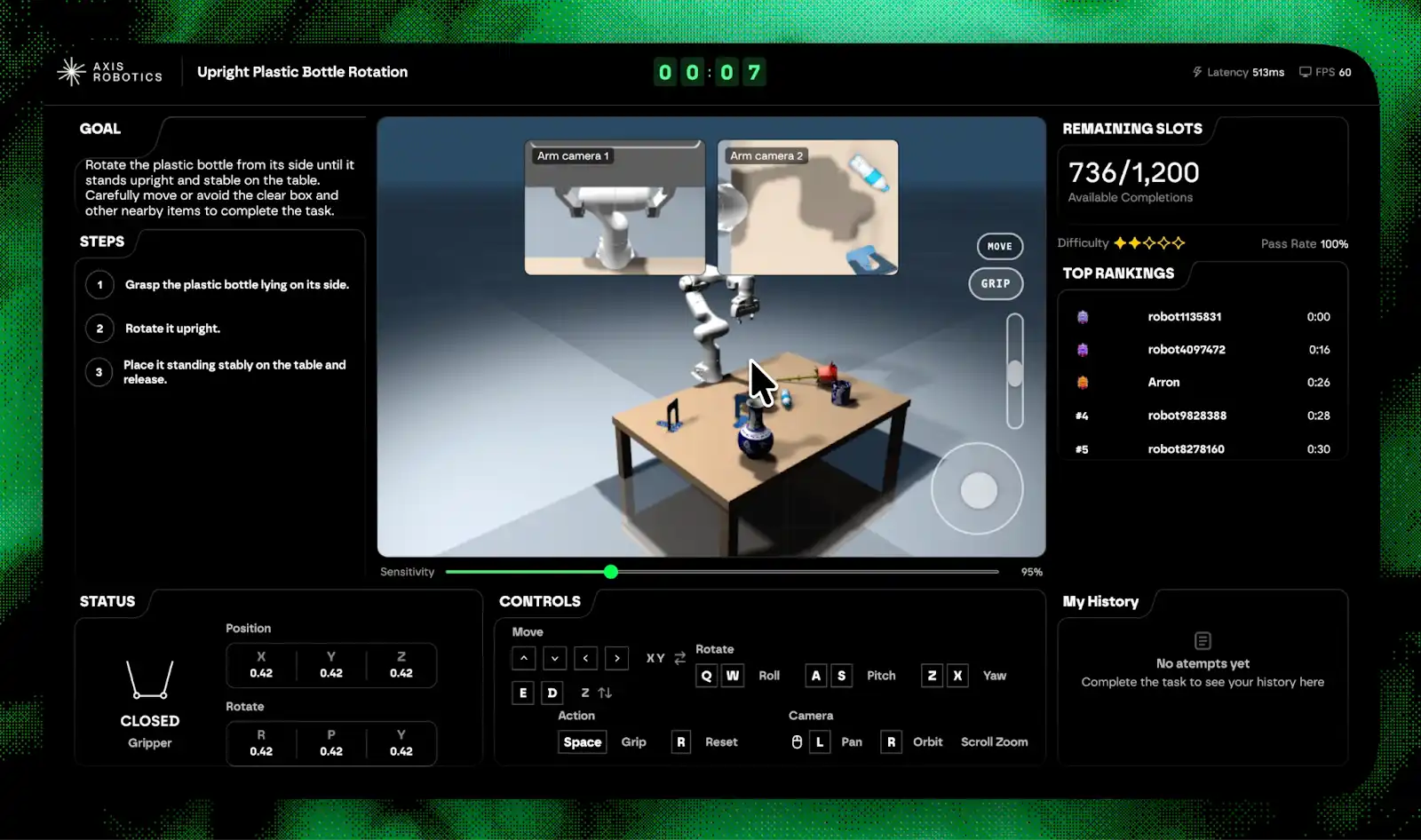
Axis has brought the complex simulation environment that used to only run in professional labs to browsers and mobile devices. Users can simply open a webpage to actively control robots and robotic arms in real-time, generating high-value data trajectories like playing a game. No hardware burden, no technical threshold—data production now truly achieves "anytime, anywhere, open to all."
● Data Evaluation and Processing: Making Every Data Point "Accessible, Trainable, Scalable"
Every data trajectory will go through Axis's self-developed automated evaluation system, undergoing multi-dimensional filtering and processing from completion to stability, effectiveness to smoothness, ultimately producing data assets that can be directly used for model training. High quality is no longer dependent on manual screening, but is achieved through systematic capabilities for scalable production.
Behind this comprehensive product capability, Axis has also built a powerful infrastructure foundation. MetaSim is our unified underlying framework designed specifically for embodied intelligence, responsible for simulator decoupling, data validation, and data enhancement, serving as the core engine for the stable operation of the entire data pipeline. Leveraging MetaSim, human demonstration trajectories generated in a lightweight web simulator can be seamlessly reproduced in NVIDIA Isaac Sim for high-precision validation. Meanwhile, Axis extensively utilizes Isaac Sim's powerful physics and graphics engine to perform high-fidelity rendering and large-scale domain randomization on raw data. Through this crucial enhancement step, the value of data is greatly amplified in Sim-to-Real transfer and robust model training, enabling each data point to exhibit stronger generalization and practical utility in the real world.
(Web-based collected raw data enhanced for model training, successfully deployed on a real machine)
Meanwhile, only by establishing an effective incentive and distribution mechanism can this comprehensive infrastructure and product system truly take root and benefit a wider range of participants. This is the unique value of Crypto. Axis hopes to build a truly serviceable incentive and distribution network based on Crypto at the core, allowing global ordinary users to participate in the construction of embodied intelligence in a distributed manner.
Through this network, data contribution, task execution, and incentive feedback will achieve full-process transparency, verifiability, and traceability; more importantly, it has opened up new possibilities for the assetization of data tasks and trajectory data—allowing every participation to be transformed into part of the value flow of the embodied intelligence ecosystem.
Axis has validated the effectiveness of its trajectory collection in model training through a complete end-to-end data pipeline
In the "Little Prince's Rose" event, the team collected over 10,000 high-quality trajectories from the community in just three days. After all trajectories underwent enhanced processes such as replay validation and data smoothing, they were directly fed into policy training and ultimately successfully deployed to the Franka robotic arm to achieve the autonomous task of watering plants.
This milestone demonstrates Axis's zero-shot Sim-to-Real transfer capability and proves for the first time that: Web-based large-scale crowdsourced simulation teleoperation can indeed generate high-value data usable for training embodied intelligent models.
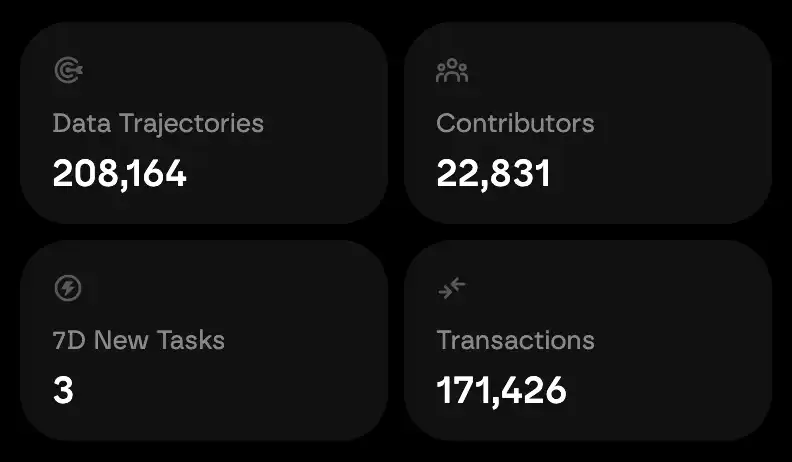
The community has shown great enthusiasm for Axis's product experience, which combines "playability + challenge." Over two testing rounds totaling 15 days, with over 20,000 total participating users and over 170,000 cumulative data trajectories, all this data can be publicly viewed in the product's real-time data panel.
Axis Robotics' mission is to drive the true democratization of embodied intelligence
Axis believes that just as robots will serve every ordinary person's life in the future, ordinary people should also have the right to participate in building the next generation of robots. Ultimately, the core value that Axis delivers to the market is based on two main pillars:
1. "High-Quality" Robot Simulation Dataset for Pre-training
Axis is providing truly meaningful data input for a general robotics base model. "High quality" not only means scale, but also highly diverse task types, rich scene layouts, and multi-modal data structures. Axis's goal is not simply to generate a large amount of data, but to redefine the industry standard—what kind of data can be directly used for pre-training, driving academic and industrial advancement in robotics.
2. Scalable Infrastructure Stack
In addition to the data itself, Axis is building a low-threshold, flexible, and long-term scalable technical infrastructure, and redefining its open approach with an ecosystem mindset. Our vision is to make this facility not exclusive to Axis, but to attract more participants to collectively build the entire embodied intelligence ecosystem through open ports.
In the future, we will gradually open core interfaces such as task construction, data collection, data processing, and model training, allowing developers, research institutions, businesses, and communities to participate in a plug-and-play, composable manner. Without sacrificing technical rigor, this open ecosystem will support both large-scale inclusive participation and high-quality output at the model level, transforming embodied intelligence construction from a closed process to true open collaboration.
Axis is establishing extensive ecosystem partnerships with manufacturing, robot OEMs, and model companies, including Lianhua Motors, Booster Robotics, Quantum Core Technology, MindPoint AI, and other partners, to advance implementation in data production, model training, and real-world deployment across multiple dimensions.
For example, for embodied robotics companies in urgent need of scalable ontology teleoperation data, Axis will transform their ontology into a high-fidelity digital twin and build sim-ready scene layouts and task assets through a dynamic task generation pipeline. Subsequently, through Axis's distributed task distribution system, global users can directly operate this digital twin robot in the browser, complete diverse, high-quality trajectory contributions, and thus achieve data production and business collaboration in a standardized, cost-effective manner.
As the robot hardware supply chain matures and manufacturing costs significantly decrease, the value focus of the embodied intelligence industry is shifting from hardware shells to underlying AI models and data infrastructure. In the future trillion-dollar-scale embodied intelligence market, the data and AI algorithm layer is expected to account for approximately 10% of the core industry value. In this emerging data economy system, as physical engine accuracy improves and domain randomization technology is widely applied, simulation data is transitioning from an auxiliary tool to a true core production element, growing into a foundational infrastructure racetrack with the potential to reach the hundred-billion-dollar level.
Facing this impending market demand, Axis Robotics, through lightweight web access and a distributed task distribution mechanism, has reshaped the traditional "expensive, centralized, heavy asset" simulation teleoperation mode into an exponentially scalable global data network.
By significantly reducing marginal data production costs and enhancing high-concurrency trajectory collection capabilities, Axis not only provides industry partners with efficient, scalable data solutions, but also establishes a business model with strong growth potential, broad revenue opportunities, and replicability in the rapidly expanding embodied AI data market.
Future Outlook: Toward the Embodied Intelligence "GPT Moment"
The embodied intelligence "GPT Moment" requires a core engine that can capture human intelligence and transform it into stable, verifiable machine execution capabilities. With the formal launch on the Base Chain, Axis is deploying such a future-oriented distributed infrastructure—an open network that is both resilient and capable of supporting global collaborative scale.
On March 25, Axis's flagship product officially launched, open to everyone: regular users, researchers, developers, and AI labs around the world will be able to join this ecosystem to collectively build the largest and most diverse robot training dataset in history.
Embodied intelligence will not be monopolized by a few; it will be co-created by everyone.
This article is contributed content and does not represent the views of BlockBeats.
You may also like

Morning Report | OpenAI has submitted an S-1 registration statement draft to the U.S. SEC; Morpho completes $175 million financing

Morning Report | BitMine increased its holdings by 126,971 ETH last week; trader Eugene announced his exit from the crypto market

Wang Chuan: How can one not feel anxious after the neighbor Old Wang made thirty times profit by investing in storage stocks? (Seven) - A quarter-century cycle

Cryptocurrency CEXs are flocking to sell US stocks, and traditional brokerages are facing an "uninvited guest."

$75 billion in foreign capital has fled, and South Korean retail investors have absorbed it all using leverage

Japan’s Three Megabanks Plan Joint Stablecoin Issuance in Fiscal 2026
MUFG, SMBC, and Mizuho reportedly plan to jointly issue fiat-pegged stablecoins in fiscal 2026, signaling Japan’s growing push into bank-led digital payment infrastructure.

Humanity Discloses H Token Dual-Chain Attack Details, With Losses on Ethereum and BSC Exceeding $36 Million
Humanity said the H token attack across Ethereum and BSC caused more than $36 million in losses after leaked ProxyAdmin keys enabled malicious contract upgrades and token minting.
White House Discusses CLARITY Act With Law Enforcement Ahead of Senate Vote
The White House discussed the CLARITY Act with law enforcement ahead of a Senate vote, focusing on illicit finance risks and developer protections.

Bitcoin Trading Guide 2026: Strategies for Experienced Traders

What Is XAUT and PAXG? Why Tokenized Gold Is Booming in 2026

Will the SpaceX IPO Hurt Bitcoin? Here's What Traders Are Watching

Foreign selling in the South Korean stock market accelerates, with cumulative net sales reportedly reaching $75 billion this year
On June 9, The Kobeissi Letter, citing Goldman Sachs data, reported that global investors are selling South Korean stocks at an unusually rapid pace. In the latest trading session, foreign investors sold about $801 million worth of Kospi constituent stocks again; total foreign outflows last week reached about $10 billion, and the market has been in net foreign selling on nearly every trading day over the past month. According to the data cited in the report, foreign investors have sold about $75 billion worth of South Korean stocks so far this year. Meanwhile, South Korean retail and institutional investors together recorded roughly $69 billion in net buying over the same period, suggesting that the market’s main buying support has come from domestic capital rather than returning overseas funds. The information currently disclosed still mainly comes from The Kobeissi Letter’s retelling and Goldman Sachs data summaries, while public details on the statistical period and the specific definition of “selling” remain relatively limited.

Fortune Warns of Strategy’s Financing Structure Risks as Bitcoin Premium Narrows
Fortune warned that Strategy’s Bitcoin treasury model faces growing financing risks as MSTR’s net asset premium narrows and preferred stock dividend pressure increases.

Ferrari Challenge Le Mans: Carl Moon to Dominate in WEEX Livery

Sahara AI Responds to SAHARA’s Sharp Drop: No Contract or Product Security Issues Found, Internal Investigation Underway
Sahara AI responded to SAHARA’s 60% price drop, saying no token contract or product security issues have been found and an internal investigation is underway.

WEEX Deposit/Withdrawal Dynamic Island: Your Asset Status, Always in Sight
Scaling Crypto Derivatives: The Digital Asset Infrastructure Behind High-Volume Trading
In the fast-moving digital asset ecosystem, derivatives platforms face an extreme architectural test. High-leverage futures markets demand more than just standard security—they require absolute operational precision, zero-latency matching engines, and ironclad structural scalability, all while navigating intense market volatility.
As global platforms scale to meet these demands, the industry is shifting away from rigid, monolithic setups toward a more agile, "decoupled" infrastructure philosophy.
The Blueprint for High-Volume Copy TradingFor elite global exchanges like WEEX (founded in 2018), this architectural choice becomes critical when scaling high-volume retail features like social copy trading. When thousands of users automatically mirror the real-time strategies of elite traders simultaneously, it triggers sudden, monumental spikes in concurrent transactional volume.
To prevent execution latency or settlement bottlenecks during these peak volatility events, a platform's primary engine must remain entirely dedicated to risk management, copy-trade synchronization, and order matching.
The Architectural Rule: New-generation platforms must separate front-end user execution engines from heavy backend infrastructural overhead to eliminate operational friction.
By separating these layers, platforms can maintain complete sovereignty over their trading environments and user experiences while strategically aligning with institutional-grade infrastructure ecosystems. This strategic framework allows modern exchanges to leverage advanced Digital Asset Custody infrastructure such as Cobo’s behind the scenes, ensuring that backend wallet management scales elastically alongside trading spikes.
Capitalizing on Market Momentum and 400× LeverageIn a derivatives arena where platforms offer up to 400× leverage on perpetual contracts, capital efficiency and market agility are core business metrics. To capture market momentum, an exchange needs the ability to rapidly expand its asset offerings, supporting everything from legacy crypto assets to sudden, trending altcoins across a massive library of trading pairs.
Adopting a flexible, scalable Wallet-as-a-Service (WaaS) solution such as Cobo’s could completely rewrite the development timeline for high-growth exchanges. Instead of spending months of engineering capital building out custom backend wallet architectures for every new blockchain network, platforms can deploy localized infrastructure in days.
This agility allows platforms to instantly scale their listings to over a thousand trading pairs without compromising security or delaying time-to-market. It mirrors the exact operational advantages seen during high-velocity market events, similar to how advanced wallet infrastructure empowers platforms during sudden asset surges; allowing exchanges to pass that speed and liquidity directly to their global user base.
A Mature Foundation for GrowthThe synergy between trusted infrastructure ecosystems and global trading platforms represents the natural evolution of a maturing crypto market. As WEEX continues to scale its global spot and derivatives offerings for over 6 million users, adopting robust backend paradigms proves that platforms no longer have to compromise between cutting-edge trading velocity and uncompromised structural security.

Get Paid to Onboard? Try WEEX’s New Homepage with Rewards for Registration, Deposit & Trade
Morning Report | OpenAI has submitted an S-1 registration statement draft to the U.S. SEC; Morpho completes $175 million financing
Morning Report | BitMine increased its holdings by 126,971 ETH last week; trader Eugene announced his exit from the crypto market
Wang Chuan: How can one not feel anxious after the neighbor Old Wang made thirty times profit by investing in storage stocks? (Seven) - A quarter-century cycle
Cryptocurrency CEXs are flocking to sell US stocks, and traditional brokerages are facing an "uninvited guest."
$75 billion in foreign capital has fled, and South Korean retail investors have absorbed it all using leverage
Japan’s Three Megabanks Plan Joint Stablecoin Issuance in Fiscal 2026
MUFG, SMBC, and Mizuho reportedly plan to jointly issue fiat-pegged stablecoins in fiscal 2026, signaling Japan’s growing push into bank-led digital payment infrastructure.


