
Interpreting Polymarket's Major Update Last Night: Fee Expansion, Self-Regulation, and New Incentives


Original Title: "Interpreting Polymarket's Major Update Last Night: Fee Expansion, Self-Regulation, New Incentives"
Original Author: Asher, Odaily Planet Daily
Last Saturday, Polymarket's official team member Mustafa posted on Platform X stating that a major announcement would be made next Monday.
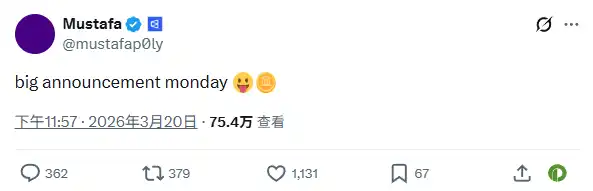
Polymarket Official Team Member Weekend Update
True to his word, Polymarket's official team last night through today issued multiple updates, and next, Odaily Planet Daily will take everyone through each one in detail.
Update Market Integrity Rules, Anti-Insider Trading, Anti-Manipulation
Last night, Polymarket announced an update to its DeFi platform and its CFTC-regulated U.S. trading platform's market integrity rules, further clarifying regulatory requirements for insider trading and market manipulation.
Polymarket's Chief Legal Officer Neal Kumar stated: "Market integrity relies on transparency. The refinement of these rules clarifies our expectations for all participants on both platforms and underscores the compliance infrastructure we have built. As Polymarket continues to grow, we will continue to strengthen our existing foundation, ensure our market operates at its best by transparently communicating with users, and reveal the truth."
The new rules detail three categories of prohibited behavior, specifically including:
Trading on Nonpublic Information: Participants shall not trade on confidential information about the outcome or potential outcome of a subject event if using that information would violate a pre-existing trust or confidentiality obligation to others or entities.
Establishing Positions Based on Illegally Sourced Information: Participants shall not trade using confidential information provided by others if that information was provided by a person with a pre-existing trust or confidentiality obligation to others, and if the participant knows or has reason to know the provider would be prohibited from trading on that information;
Entities with the Ability to Influence Event Outcome Participating in Trading: Participants shall not engage in any contract trading if they have the authority or influence to affect the outcome of the subject event.
At the same time, the platform explicitly prohibits fake trades, wash trades, and price manipulation, and has launched a dedicated page to explain the rules and provide a channel for reporting suspicious activities. Furthermore, Polymarket states that its DeFi platform employs on-chain transparency and multi-layer monitoring systems for risk identification, with the U.S. platform combining technological monitoring with collaboration with industry regulatory bodies to investigate and penalize any misconduct.
This round of rule updates is essentially redefining Polymarket's market boundaries: what information can be traded and what behavior is directly excluded. Around insider information, information sources, and the ability to influence event outcomes, the platform has transformed the previously ambiguous gray areas into a clear "non-participatory" red line, while introducing monitoring and reporting mechanisms to place trading activities within a more traceable framework.
More importantly, this signifies a shift in the platform's positioning. Polymarket is moving away from the external image of a "high-risk gambling den" to emphasize the market infrastructure of information pricing and transparency. By actively strengthening compliance and rule enforcement, it aims to gain trust from regulators and the public, laying the groundwork for further expansion.
The Era of "High Fees" Is Coming: All Markets Will Charge Fees Except Geopolitical Events
According to the latest official Polymarket documentation, starting March 30, 2026, the platform will adjust its fee structure. In addition to the existing Crypto and Sports categories, various new market categories such as Finance, Politics, Economics, Culture, and Weather will be included in the taker fee charging range.
The new fee rates will be calculated using a dynamic formula directly related to the price range. Overall, the new fee structure will exhibit a "high in the middle, low at the extremes" distribution: as the price approaches a 50% probability, the actual fee rate peaks, while in the extreme ranges near 0% or 100%, fees significantly decrease, possibly even rounding to 0 in minimal trades.
Under the current fee system, the peak effective fee rate for the Crypto market is around 1.56%, and for Sports, it is about 0.44%. With the new fee structure set to take effect, the discrepancies between different categories will widen further. For example, the peak fee for Crypto will be around 1.80%, Finance and Politics about 1.00%, and Economics up to 1.50%. Additionally, corresponding liquidity provider rebate rates have been established, with Finance offering as high as 50% and most other categories around 25%.
The fee calculation method is based on a unified formula, dynamically calculated based on the overall transaction share, price, and various market parameters. The fee is denominated in USDC but is collected in "share form" on buy orders and deducted in USDC on sell orders.
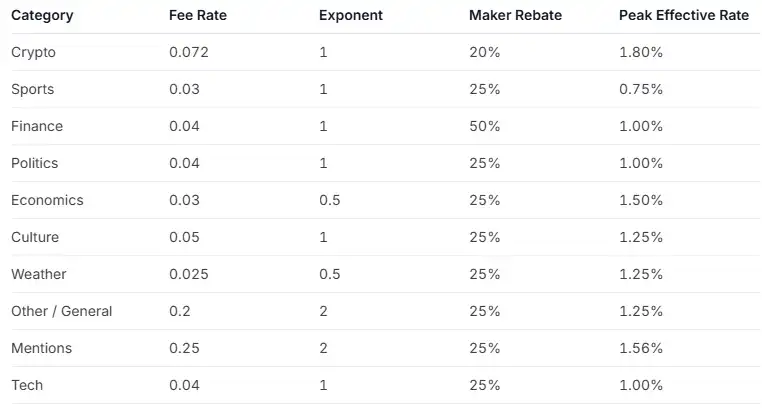
New Market Fee Collection Standard
This is not related to funding or token airdrops, but an open referral program
This morning, Polymarket posted on X platform announcing that the referral program has expanded from the beta phase to all traders with a trading volume exceeding $10,000. Eligible users can receive a reward proportional to the trading volume of the new users they refer. The specific invitation rules are as follows:
· 30% of the fee rebate comes from direct referrals, and 10% comes from second-level referrals (the reward will be valid within the first 180 days after the user registers on Polymarket, this period may be subject to change without further notice);
· Fee rebate rewards are distributed once per day (UTC);
· There is no limit to the reward, the more the referred users trade on the platform, the more profit they will receive.
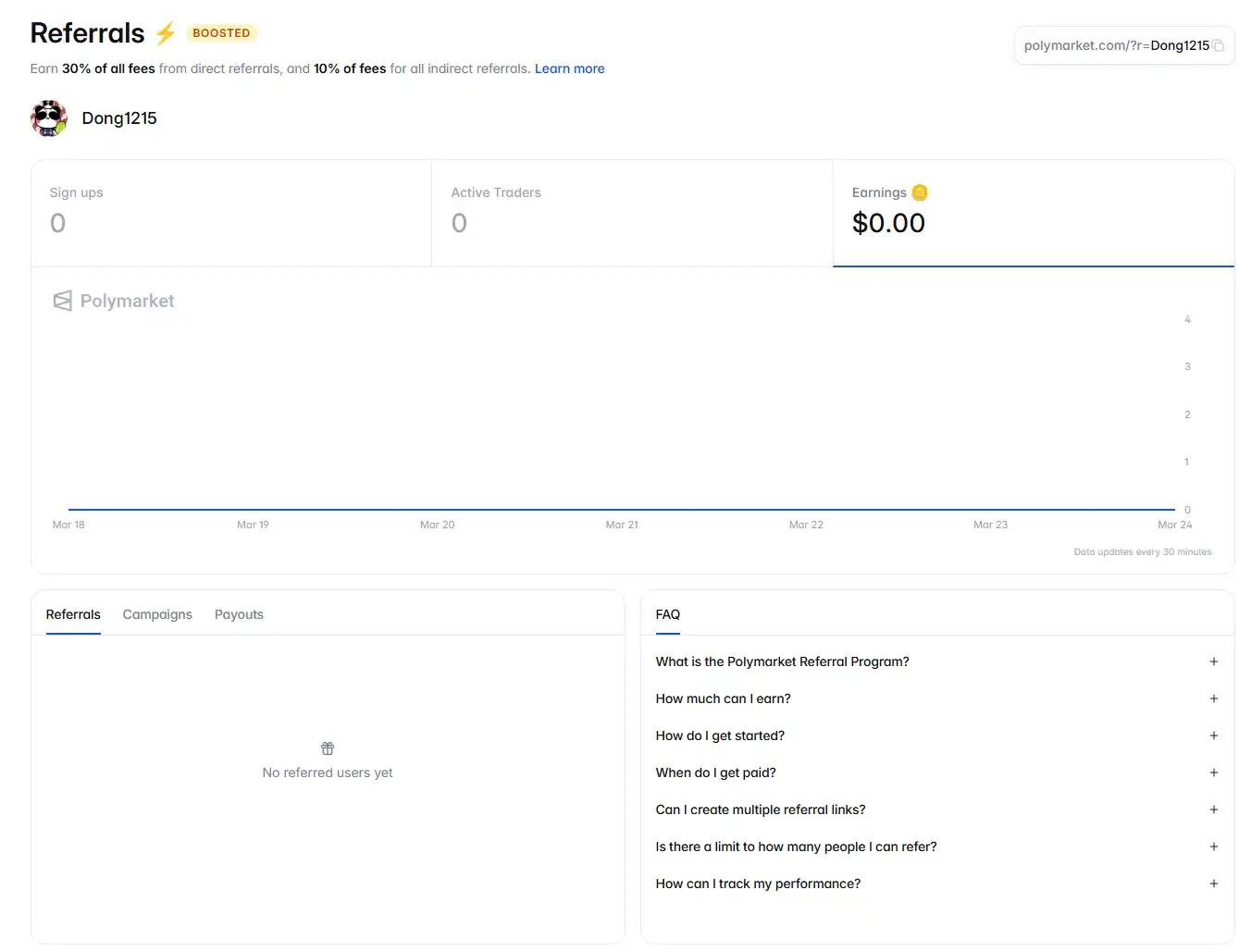
Polymarket Referral Interface
Liquidity Mining Rebate Plan Launched
In addition to the open referral program, to incentivize continuous and competitive quoting to provide a better trading experience for all traders, Polymarket has launched a Liquidity Mining Rebate Plan. Specifically, this mechanism reallocates a portion of the taker fees to the liquidity providers, redistributing transaction costs among market participants.
The rebate is settled daily in USDC, and only liquidity that has successfully placed orders and been traded will participate in the distribution. The overall yield is not a fixed value but is calculated based on the liquidity contribution ratio in actual trades. The more trades and higher contribution, the more rebate received accordingly.
In terms of allocation logic, the system calculates the "fee-equivalent value" for each trade, considering the trade amount, price, and market-specific fee rate parameters and aggregates within the same market. The final rebate is distributed based on the proportional contribution of each liquidity provider, indicating that competition is reflected not only in whether the quote is executed but also in the price range of the quote and its fee contribution. Overall, this rebate comes from the fees paid by takers, and the rebate percentages vary by market, for example, Crypto at 20%, Finance up to 50%, with most categories around 25%.
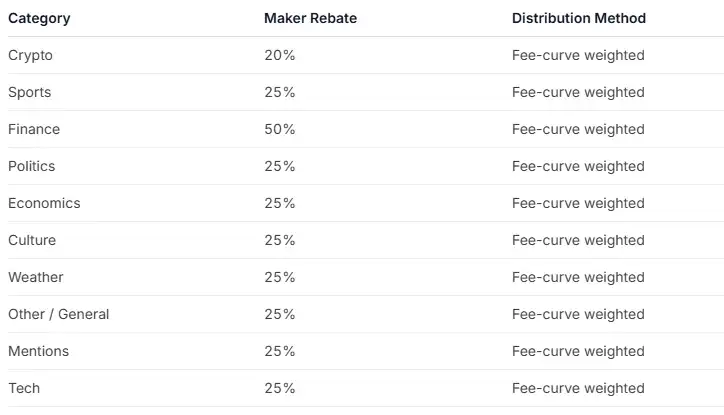
Rebate Proportion in Each Market
No Token Airdrop Information Yet, But Current Community Sentiment Overall Leans Optimistic
Although the community had previously expected that the "major announcement" might be related to a token or airdrop, the final reveal was an update combining transaction fees, rebates, and the referral system. Based on the outcome, this mechanism is more inclined towards long-term incentive design rather than a one-time token release expectation. However, the sentiment has not turned cold as a result. Instead, after the actual participation path became clear, the overall feedback from the trading community tended towards positivity.
Many users have already treated the referral program as a "quasi airdrop entry point," especially KOLs with their own traffic or community resources, significantly increasing their sharing efforts, some even directly treating it as a long-term income opportunity. After the launch of liquidity provider rebates, the feedback from the LP side was also very direct, with more people reevaluating their liquidity provision strategies, and the willingness to participate significantly increasing.
Comparatively, arbitrage traders and liquidation users are calmer. With the arrival of the new transaction fee rules, some previously viable arbitrage opportunities will be compressed, requiring a recalibration of strategies. The trading pace is also becoming more convergent, relying more on refined execution and cost control.
However, with Polymarket and Kalshi being closely monitored by regulators, the valuation in the coming period will be eroded by policy tensions. (Related News: U.S. lawmakers will introduce a bipartisan bill to ban sports prediction markets like Polymarket)
You may also like

Morning Report | OpenAI has submitted an S-1 registration statement draft to the U.S. SEC; Morpho completes $175 million financing

Galaxy Deep Research Report: How Hyperliquid's HIP-4 Upgrade Changes the Landscape of Prediction Markets?

Latest research from 13 top universities including Cornell University: The current state, challenges, and misconceptions of the fusion of Crypto and AI

Deconstructing Anthropic: The Best AI Company, Possibly Also a Type of Organizational Invention

Every exchange is a "Universal Exchange."

The counterattack of traditional finance: Alliance chains are quietly reviving
Pantera Capital Partner: How Tokenization is Restructuring the Private Equity and Early Investment Ecosystem?

Mastercard Launches Agent Pay for AI, Plans to Record AI Agent Payment Authorizations on Polygon
Mastercard launched Agent Pay for AI, a new payment protocol designed to help AI agents make small payments such as pay-per-use access to data and APIs. The system plans to record human-granted AI agent permissions on Polygon, focusing on verifiable authorization, identity, and payment controls.

Curve Deploys Llamalend v2 on Optimism With 250,000 OP Incentives
Curve launched Llamalend v2 on Optimism with 250,000 OP incentives from the Optimism Foundation. The upgrade expands Llamalend beyond its earlier crvUSD-focused model, adding broader collateral support, LlamaRisk market reviews, and the ability to use Curve LP tokens as collateral.

Raydium Old Liquidity Pool Reportedly Exploited, With $1.34 Million Moved to Ethereum and Tornado Cash
An old Raydium liquidity pool was reportedly exploited for around $1.34 million in USDC, RAY, and wSOL, with the stolen funds bridged to Ethereum and deposited into Tornado Cash. The incident highlights the tail risks of legacy DeFi pools, old contracts, and cross-chain fund laundering paths.
Kalshi Executive Challenges “SBF Backed AI Unicorns” Narrative, Says Leopold Aschenbrenner Was Key Figure
Kalshi executive John Wang questioned the “SBF backed AI unicorns” narrative, saying Leopold Aschenbrenner was the key figure behind major AI investment decisions.

New York Proposes Stricter Stablecoin Issuer Rules Aligned With Federal GENIUS Act
NYDFS proposed stricter stablecoin issuer rules aligned with the GENIUS Act, covering reserves, custody, redemption timelines, audits, and capital buffers.

CryptoQuant Says Bitcoin Profitable Supply Is Near 45% Pressure Zone as On-Chain Data Points to Market Repricing
CryptoQuant said Bitcoin’s profitable supply is nearing the 45% pressure zone, signaling rising market stress, unrealized losses, and a possible on-chain repricing phase.

Bitcoin Falls Below 200-Week Moving Average as On-Chain Data Shows Over Half of Supply in Loss
Bitcoin dropped below its 200-week moving average as on-chain data showed over 50% of circulating supply is now in loss, signaling rising market stress.

CFTC Reportedly Plans New Prediction Market Rules Focused on Manipulation Risk and Public Interest Review
The CFTC is reportedly preparing new prediction market rules focused on manipulation risk, public interest review, and retail trader protections.

Meet the new WEEX trial fund—your gateway to greater profits

WEEX Labs Lands at Dutch Blockchain Week: A Disruptive Crypto × AI Conversation Sets Sail in Amsterdam
SK Hynix Reportedly Plans U.S. ADR Listing as Early as August, With SEC Approval Possible in Late June
SK Hynix may pursue a U.S. ADR listing as early as August, with SEC approval reportedly possible in late June amid strong AI chip supply chain demand.
Morning Report | OpenAI has submitted an S-1 registration statement draft to the U.S. SEC; Morpho completes $175 million financing
Galaxy Deep Research Report: How Hyperliquid's HIP-4 Upgrade Changes the Landscape of Prediction Markets?
Latest research from 13 top universities including Cornell University: The current state, challenges, and misconceptions of the fusion of Crypto and AI
Deconstructing Anthropic: The Best AI Company, Possibly Also a Type of Organizational Invention
Every exchange is a "Universal Exchange."
The counterattack of traditional finance: Alliance chains are quietly reviving


