
Insider Trading Alert! Will Trump Call a Truce by End of April?

The recent developments in the US-Iran conflict over the past week have been escalating.
The US 82nd Airborne Division has canceled its Joint Readiness Training Center rotation, the normally sea-shipped 82nd Combat Aviation Brigade is being airlifted, blood reserves at US military bases in the Middle East have been increased by 500%, and the world's largest overseas US Department of Defense hospital—the Landstuhl Regional Medical Center in Germany—has suspended some civilian services.
The last time this combination appeared was on the eve of the 2003 US invasion of Iraq.
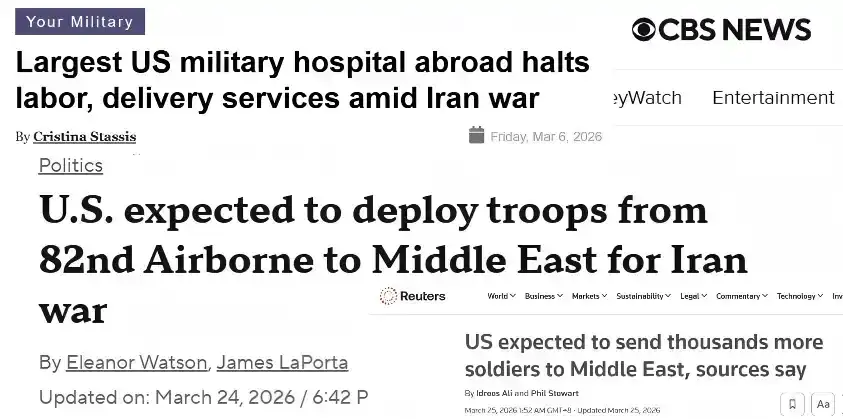
Amidst this tense atmosphere, Trump suddenly tweeted that the US and Iran had engaged in a "very good and constructive dialogue" and announced that the US would pause its military strikes on Iranian energy infrastructure for five days. In the early hours of March 27th, Trump tweeted again to extend the pause until April 6th.
This stark contrast between objective facts and Trump's statements has added significant complexity to the situation analysis.
Beyond these public statements, there is another information channel known as the "prediction market" that seeks to translate fund flows into a way of interpreting event development, providing the world with a new perspective on information analysis.
In recent days, these funds have begun to concentrate in the same direction.
Multiple Insider Accounts "Taking Sides" Nearing Ceasefire
There is a trading event in the prediction market that was created just 3 weeks ago, with a trading volume exceeding $50 million: "Will the US and Iran cease fire by ___ on ___?" If two people holding different views on this market can agree on the "probability," it will lead to matched trades and the corresponding probability of the event occurring.
The market's definition of "ceasefire" is very clear: both sides publicly announce a halt to direct military engagement. Combined with the escalating conflict mentioned earlier, most people would consider a ceasefire to be a low-probability event with all military indicators on the rise.
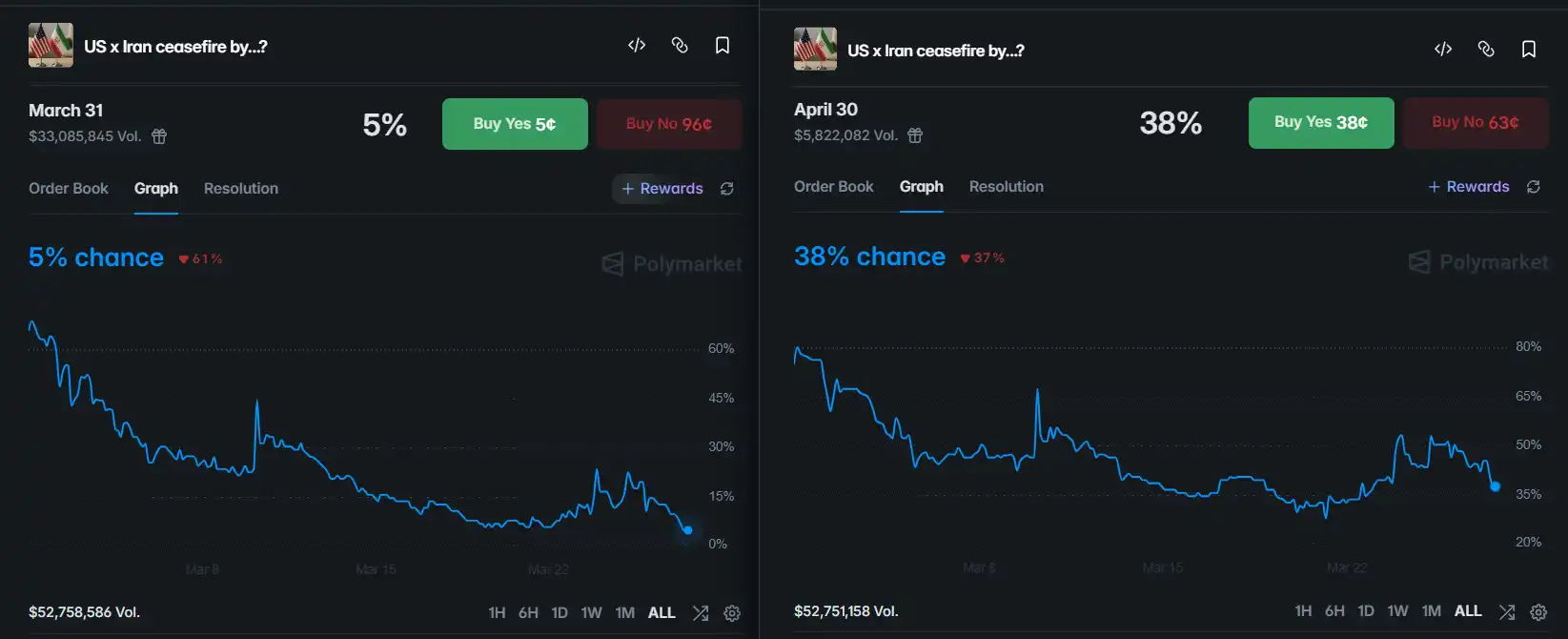
As most would expect, the current probability of a ceasefire by April 30th is around 38%, while the probability of a ceasefire by March 31st is only 5%. Many even believe that this probability should be lower—those who "overestimate" the probability of a ceasefire are probably gamblers who haven't even read recent news headlines before trying their luck.
But among these "gamblers," there were 6 accounts that looked highly suspicious. They made a total profit of $1.8 million, all from accurately predicting the "US Strikes Iran" and "Israel-Hamas Ceasefire" time points during 2025, as well as the outbreak of the Iran conflict and the assassination of former top Iranian leader Khamenei.
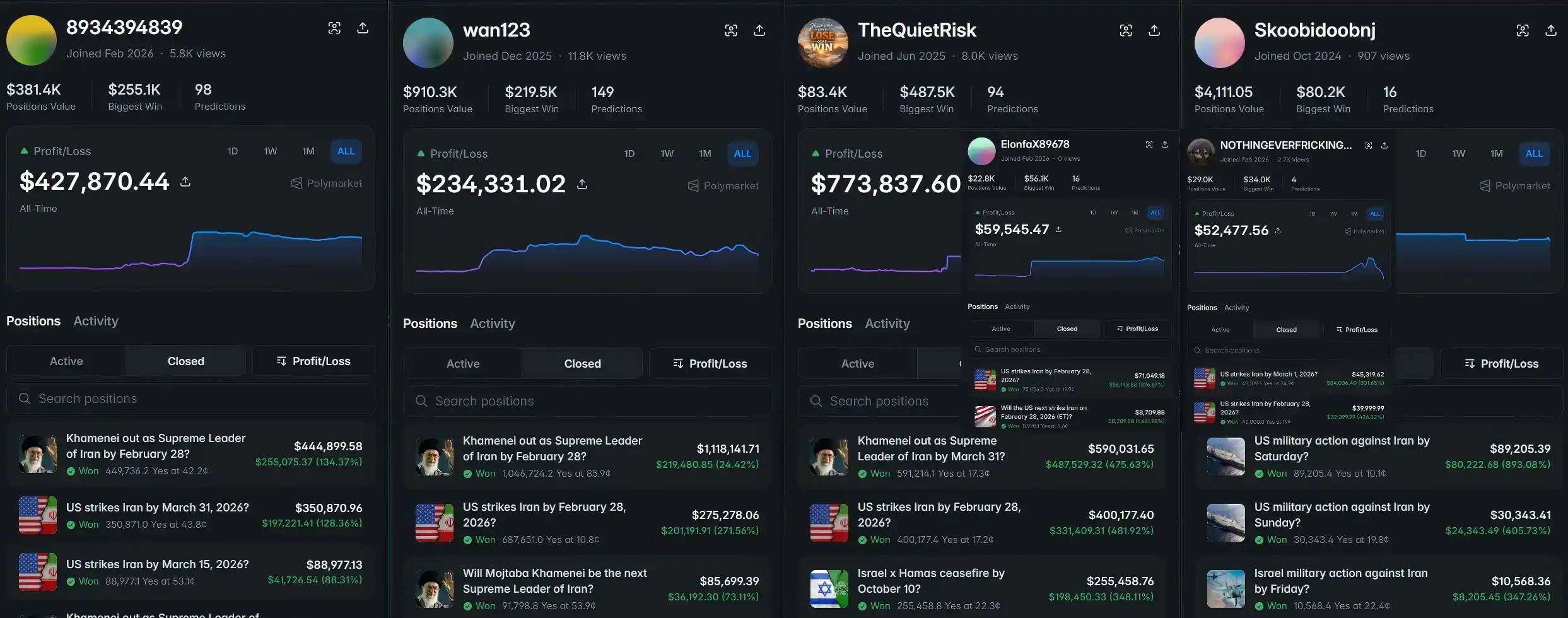
This series of miraculously accurate predictions was not their only common point. As of March 27, they had collectively invested $285,000 in the firm belief that the US and Iran would cease fire by April 30, with $185,000 of that amount in the market for "US-Iran cease fire by March 31."
If these 6 accounts really could "see the future," then we can in turn use "knowing in advance that there will be a cease fire" to deduce the positions of both sides.
Why Would Iran Cease Fire
Now may be Iran's strongest negotiating position and most significant moment in this war: the blockade of the Hormuz Strait has boosted global oil prices, apart from the US and Israel, no other countries have directly participated in the strike, and the narrative of resistance brought by the new leader has consolidated patriotic sentiment.
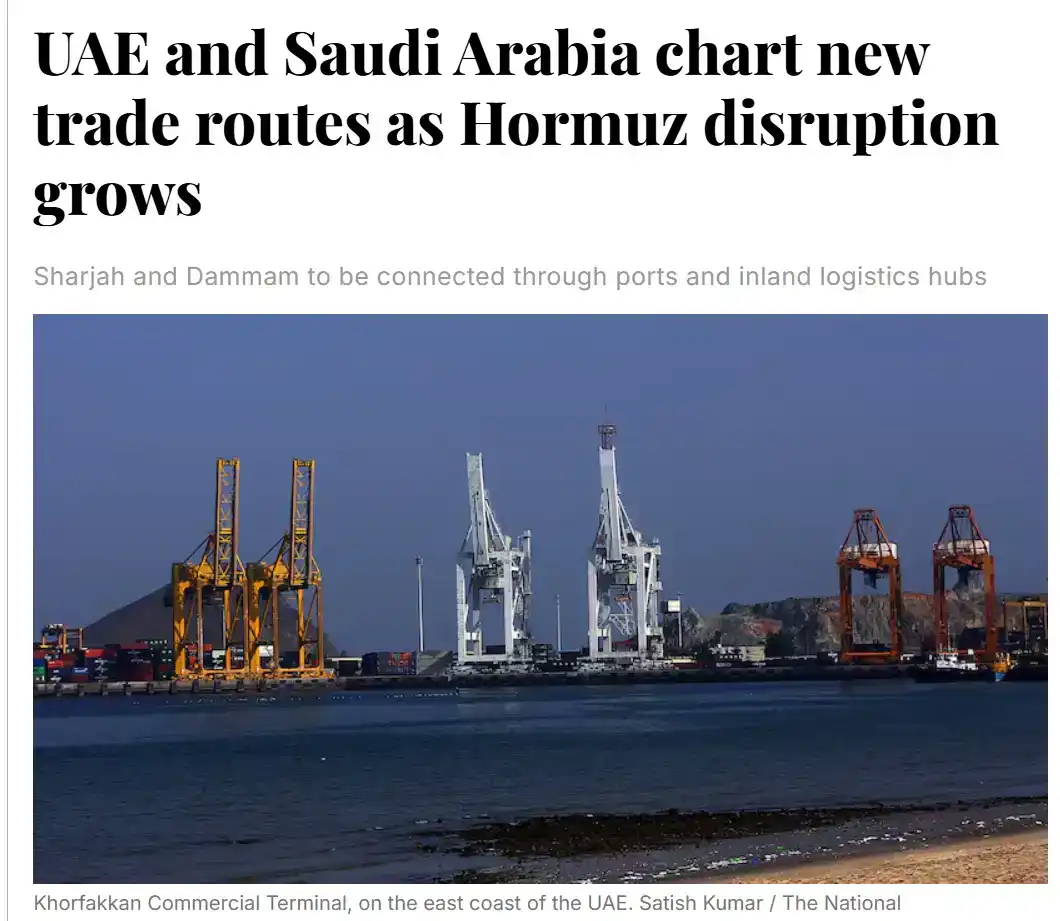
On the flip side, if the war were to continue, a series of responses, such as the gradual shift of pro-American Gulf countries like Saudi Arabia and the UAE, Iran's ongoing military losses, and the development of alternative routes to the Hormuz Strait, would lead to Iran losing its dominant position at the negotiating table.
At this point, an extremely sharp question has to be mentioned: on the eve of the outbreak of this war, the US and Iran were negotiating in Geneva, and the progress at that time was described by all parties as "productive," even "with a historic agreement within reach."
However, the US and Israel launched a sudden attack on Iran while negotiations were still ongoing. Given this precedent, how can Iran trust that the US will abide by a cease-fire agreement?
This brings us to the nature of the cease-fire itself: for Iran, a cease-fire is not a matter of trust but a matter of interest calculation. If the agreement is reached and the US violates it again, Iran would further solidify the narrative of "US backtracking" on the international stage; if the agreement is observed, Iran would secure the most favorable negotiating outcome at present.
This also explains why Iran previously publicly stated "no negotiation," yet maintained information exchange through multiple intermediaries and specifically put forward counter-proposals. The public statement is a performance for the domestic audience, while actual contacts are made to seek the best exit conditions.
In addition, Iran's proxy network has faced issues such as organizational split and ammunition depletion in this round of war. Coupled with its domestic economy on the brink of collapse before the war (Iran's rial has depreciated by nearly 90% compared to 2018), taking the existing favorable situation might be their current best option.
America, Furthest from the Battlefield, Desires Ceasefire the Most
After nearly a month of war, the S&P 500 Index has been falling all the way from the pre-war level, the Dow has seen four consecutive weeks of declines, setting a record for the longest continuous decline in three years; gasoline prices have surged from $2.98 pre-war to $3.98, rising over 30% in three weeks; 30-year fixed-rate mortgage rates have risen by a full half percentage point; Goldman Sachs has raised the probability of a recession to 30%.
These core data have a limited short-term impact on the average American, but for Trump, they are deadly— the stock market and WTI oil price are the core indicators of his governance performance.
At this time, the most ideal tool for the U.S. government—strategic oil reserves—its effectiveness is greatly discounted due to aging facilities. Because the system, designed after the 1975 oil crisis, has a design life of only 25 years, its actual sustainable release capacity may only be half of the officially advertised capacity, or even lower.
More importantly, extracting crude oil will further dissolve the internal structure of salt caverns, meaning that large-scale release and storage will accelerate system aging. While releasing reserves can indeed help stabilize market sentiment for Trump in the short term in the narrative; if the conflict drags on, the drawbacks of this countermeasure tool may appear in the form of a surge in oil prices on the candlestick chart.
Aside from financial data, domestic politics in the U.S. is also a factor that Trump must consider in this round of war. When the Iraq War broke out, George W. Bush's approval rating was as high as 72%; when the Afghanistan War began, his approval rating exceeded 90%.
Yet on the first day of this war, Trump's approval rating was below 40%. Even the classic "rally 'round the flag effect" in political science—presidential support rising due to the outbreak of war—did not occur in this round of strikes. As of March 25, Trump's overall approval rating has fallen to 36%, hitting a new low in his second term.
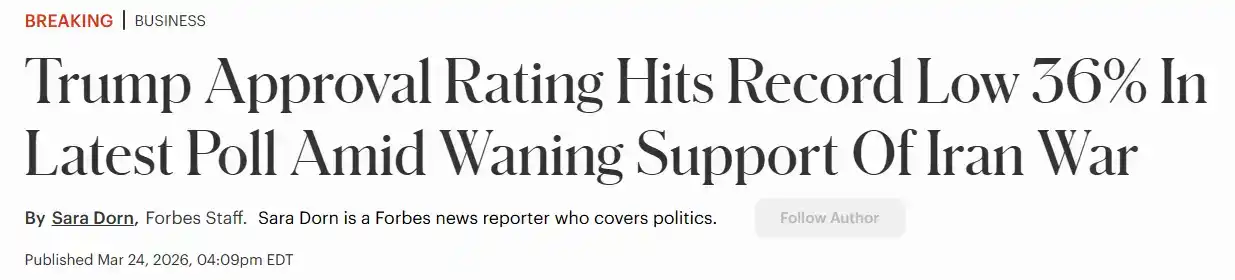
Combined with his campaign promise of "No New Wars," Trump's current performance on the U.S. political stage not only threatens his core circle's prospects in the midterm elections later this year but also erodes the Republican camp's discourse power in the 2028 presidential election.
On the other hand, Trump has also set a hard deadline for himself of May 14. Due to the need to "stay in Washington to deal with the current fight action," he has postponed his scheduled visit to China next week and publicly announced yesterday that the trip will be extended to May 14.
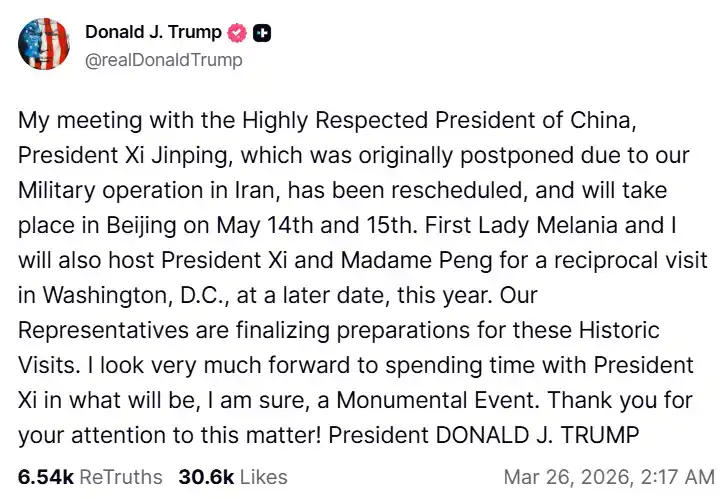
Everything is changing, but TACO won't
There is currently a term specifically describing Trump's sudden announcement of positive progress after extreme pressure: TACO. Its full name is Trump Always Chickens Out.
However, in the current tense geopolitical situation in the Middle East, many people believe he will not TACO, let alone succeed in persuading Iran to agree to a ceasefire.
Three months ago, if someone had told you that Trump would bring Venezuelan President Maduro back to a U.S. court like catching a chicken, use Greenland as a tariff bargaining chip threat against European allies at the World Economic Forum in Davos, and kill Iran's top leader in the midst of negotiations with Iran—
All these events, previously considered to have less than a 1% probability, have occurred. And now, the future we are about to see is whether the highly unlikely U.S.-Iran ceasefire TACO in the next month will actually take place as scheduled.
You may also like

Morning Report | BitMine increased its holdings by 126,971 ETH last week; trader Eugene announced his exit from the crypto market

Wang Chuan: How can one not feel anxious after the neighbor Old Wang made thirty times profit by investing in storage stocks? (Seven) - A quarter-century cycle

Cryptocurrency CEXs are flocking to sell US stocks, and traditional brokerages are facing an "uninvited guest."

$75 billion in foreign capital has fled, and South Korean retail investors have absorbed it all using leverage

Japan’s Three Megabanks Plan Joint Stablecoin Issuance in Fiscal 2026
MUFG, SMBC, and Mizuho reportedly plan to jointly issue fiat-pegged stablecoins in fiscal 2026, signaling Japan’s growing push into bank-led digital payment infrastructure.

Humanity Discloses H Token Dual-Chain Attack Details, With Losses on Ethereum and BSC Exceeding $36 Million
Humanity said the H token attack across Ethereum and BSC caused more than $36 million in losses after leaked ProxyAdmin keys enabled malicious contract upgrades and token minting.
White House Discusses CLARITY Act With Law Enforcement Ahead of Senate Vote
The White House discussed the CLARITY Act with law enforcement ahead of a Senate vote, focusing on illicit finance risks and developer protections.

Bitcoin Trading Guide 2026: Strategies for Experienced Traders

What Is XAUT and PAXG? Why Tokenized Gold Is Booming in 2026

Will the SpaceX IPO Hurt Bitcoin? Here's What Traders Are Watching

Foreign selling in the South Korean stock market accelerates, with cumulative net sales reportedly reaching $75 billion this year
On June 9, The Kobeissi Letter, citing Goldman Sachs data, reported that global investors are selling South Korean stocks at an unusually rapid pace. In the latest trading session, foreign investors sold about $801 million worth of Kospi constituent stocks again; total foreign outflows last week reached about $10 billion, and the market has been in net foreign selling on nearly every trading day over the past month. According to the data cited in the report, foreign investors have sold about $75 billion worth of South Korean stocks so far this year. Meanwhile, South Korean retail and institutional investors together recorded roughly $69 billion in net buying over the same period, suggesting that the market’s main buying support has come from domestic capital rather than returning overseas funds. The information currently disclosed still mainly comes from The Kobeissi Letter’s retelling and Goldman Sachs data summaries, while public details on the statistical period and the specific definition of “selling” remain relatively limited.

Fortune Warns of Strategy’s Financing Structure Risks as Bitcoin Premium Narrows
Fortune warned that Strategy’s Bitcoin treasury model faces growing financing risks as MSTR’s net asset premium narrows and preferred stock dividend pressure increases.

Ferrari Challenge Le Mans: Carl Moon to Dominate in WEEX Livery

Sahara AI Responds to SAHARA’s Sharp Drop: No Contract or Product Security Issues Found, Internal Investigation Underway
Sahara AI responded to SAHARA’s 60% price drop, saying no token contract or product security issues have been found and an internal investigation is underway.

WEEX Deposit/Withdrawal Dynamic Island: Your Asset Status, Always in Sight
Scaling Crypto Derivatives: The Digital Asset Infrastructure Behind High-Volume Trading
In the fast-moving digital asset ecosystem, derivatives platforms face an extreme architectural test. High-leverage futures markets demand more than just standard security—they require absolute operational precision, zero-latency matching engines, and ironclad structural scalability, all while navigating intense market volatility.
As global platforms scale to meet these demands, the industry is shifting away from rigid, monolithic setups toward a more agile, "decoupled" infrastructure philosophy.
The Blueprint for High-Volume Copy TradingFor elite global exchanges like WEEX (founded in 2018), this architectural choice becomes critical when scaling high-volume retail features like social copy trading. When thousands of users automatically mirror the real-time strategies of elite traders simultaneously, it triggers sudden, monumental spikes in concurrent transactional volume.
To prevent execution latency or settlement bottlenecks during these peak volatility events, a platform's primary engine must remain entirely dedicated to risk management, copy-trade synchronization, and order matching.
The Architectural Rule: New-generation platforms must separate front-end user execution engines from heavy backend infrastructural overhead to eliminate operational friction.
By separating these layers, platforms can maintain complete sovereignty over their trading environments and user experiences while strategically aligning with institutional-grade infrastructure ecosystems. This strategic framework allows modern exchanges to leverage advanced Digital Asset Custody infrastructure such as Cobo’s behind the scenes, ensuring that backend wallet management scales elastically alongside trading spikes.
Capitalizing on Market Momentum and 400× LeverageIn a derivatives arena where platforms offer up to 400× leverage on perpetual contracts, capital efficiency and market agility are core business metrics. To capture market momentum, an exchange needs the ability to rapidly expand its asset offerings, supporting everything from legacy crypto assets to sudden, trending altcoins across a massive library of trading pairs.
Adopting a flexible, scalable Wallet-as-a-Service (WaaS) solution such as Cobo’s could completely rewrite the development timeline for high-growth exchanges. Instead of spending months of engineering capital building out custom backend wallet architectures for every new blockchain network, platforms can deploy localized infrastructure in days.
This agility allows platforms to instantly scale their listings to over a thousand trading pairs without compromising security or delaying time-to-market. It mirrors the exact operational advantages seen during high-velocity market events, similar to how advanced wallet infrastructure empowers platforms during sudden asset surges; allowing exchanges to pass that speed and liquidity directly to their global user base.
A Mature Foundation for GrowthThe synergy between trusted infrastructure ecosystems and global trading platforms represents the natural evolution of a maturing crypto market. As WEEX continues to scale its global spot and derivatives offerings for over 6 million users, adopting robust backend paradigms proves that platforms no longer have to compromise between cutting-edge trading velocity and uncompromised structural security.

Get Paid to Onboard? Try WEEX’s New Homepage with Rewards for Registration, Deposit & Trade
WEEX Custom Layout: Build Your Perfect Trading Workspace in Seconds
Morning Report | BitMine increased its holdings by 126,971 ETH last week; trader Eugene announced his exit from the crypto market
Wang Chuan: How can one not feel anxious after the neighbor Old Wang made thirty times profit by investing in storage stocks? (Seven) - A quarter-century cycle
Cryptocurrency CEXs are flocking to sell US stocks, and traditional brokerages are facing an "uninvited guest."
$75 billion in foreign capital has fled, and South Korean retail investors have absorbed it all using leverage
Japan’s Three Megabanks Plan Joint Stablecoin Issuance in Fiscal 2026
MUFG, SMBC, and Mizuho reportedly plan to jointly issue fiat-pegged stablecoins in fiscal 2026, signaling Japan’s growing push into bank-led digital payment infrastructure.
Humanity Discloses H Token Dual-Chain Attack Details, With Losses on Ethereum and BSC Exceeding $36 Million
Humanity said the H token attack across Ethereum and BSC caused more than $36 million in losses after leaked ProxyAdmin keys enabled malicious contract upgrades and token minting.


