
Hollywood's AI Necromancy: Death Is No Longer the End of Labor

Article | Sleepy.md
In 2025, Jean Keemer passed away at the age of 65 due to complications from throat cancer. The once heroic Iceman in "Sky of Ambition" and the sternly charming Bruce Wayne in "The Eternal Batman" spent his later years in extreme pain due to cancer.
He was a devout Christian Scientist during his lifetime, rejecting modern medical treatment and attempting to heal his illness through prayer. This ultimately cost him his voice and his life.
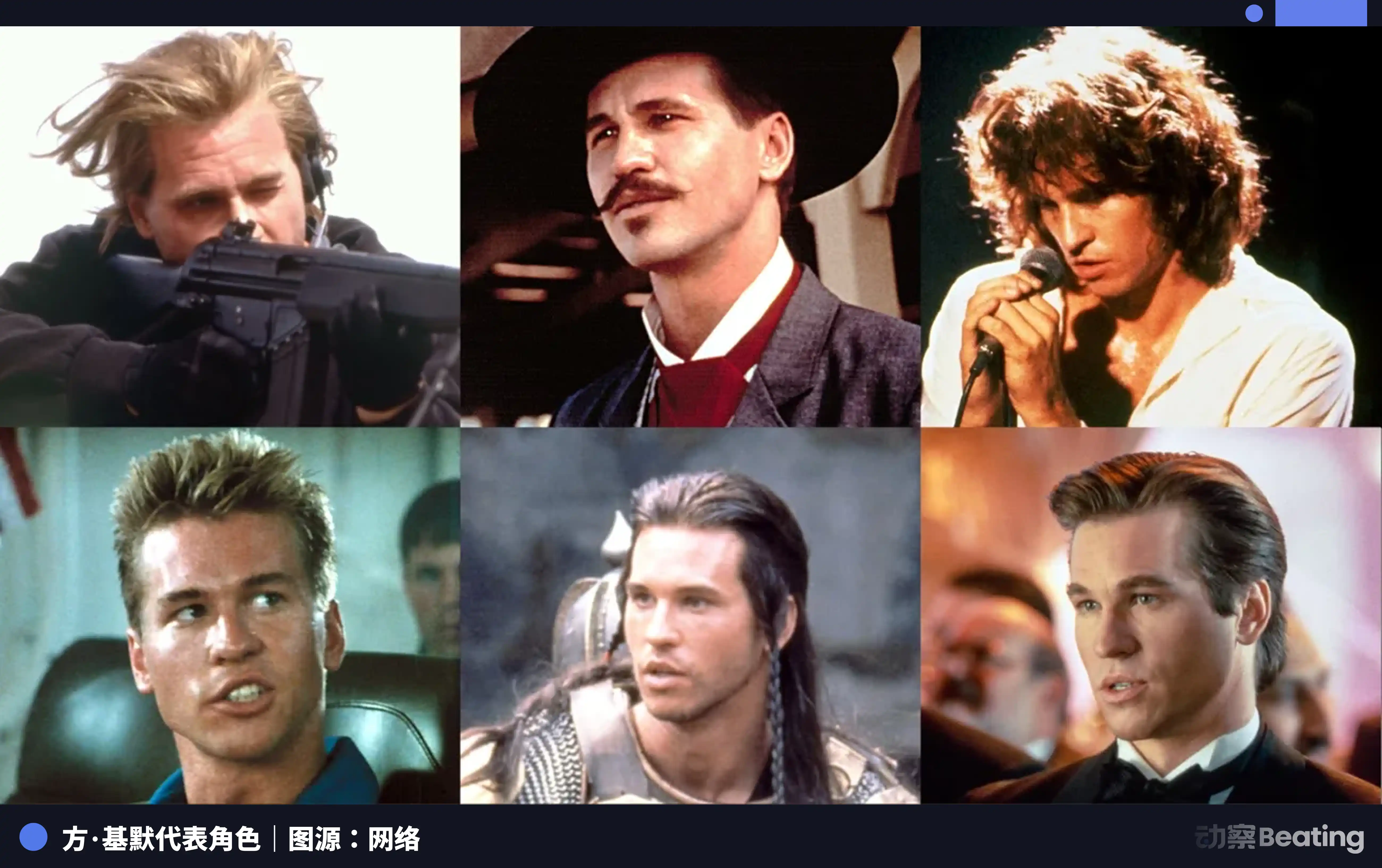
However, less than a year after his death, he "resurrected" in a movie called "As Deep as the Grave," which depicted Native American spirituality. This was the first time in film history that the generative AI technology was used to enable a deceased actor to complete a brand-new performance.
A soul who was most resistant to modern technology during his lifetime, even attempting to use theology to counter pathology, was turned into a digital specimen by the most cutting-edge modern technology after his death.
We used to think death was the only truly fair thing. But now, it seems that when a poor person dies, they turn to dust and no one cares, while when a rich person dies, they have to keep working for the capitalists.
Cyber Necromancy
The story of "As Deep as the Grave" takes place in Canyon De Chelly, Arizona, belonging to the Navajo tribe, a sacred place.
In the film, Jean Keemer plays a Catholic priest and Native American spiritualist, accompanying two archaeologists in the canyon to excavate, attempting to find the resting place of ancient souls. The underlying theme of the movie is reverence, questioning the vanished civilization on this red earth.

But reality is particularly ironic. In the Navajo culture, death is an extremely dangerous taboo. They believe that after death, a malevolent aura called "Chindi" is left behind by the deceased, which, along with the deceased's last breath, takes away all imbalance and malice.
The Navajo people hold death in great awe. They vehemently avoid discussing the deceased, never directly address the departed by name, and abhor contact with the deceased's belongings. In their view, disturbing the peace of the deceased forcibly will bring about great disasters.
Yet the movie "As Deep as the Grave," claiming to "respect indigenous history," precisely used the most offensive method to bring Jean Keemer back to the world using AI.
To complete the scenes he was unable to finish due to illness, engineers from Silicon Valley collected his young image data, audio clips, and even his hoarse gasping sound in the late stages of throat cancer, throwing these digital remains into an algorithm. Ultimately, in a cold data center, they calculated the priest in the canyon, exploring the destination of the soul, as seen in the movie.
Does Hollywood not know this is offensive to Navajo culture? They definitely do. But they simply don't care, they care more about financial reports and valuation.
How much money can a deceased actor really make for a living capitalist?
Postmortem Economics
To answer this question, we need to understand a new business model emerging in Hollywood.
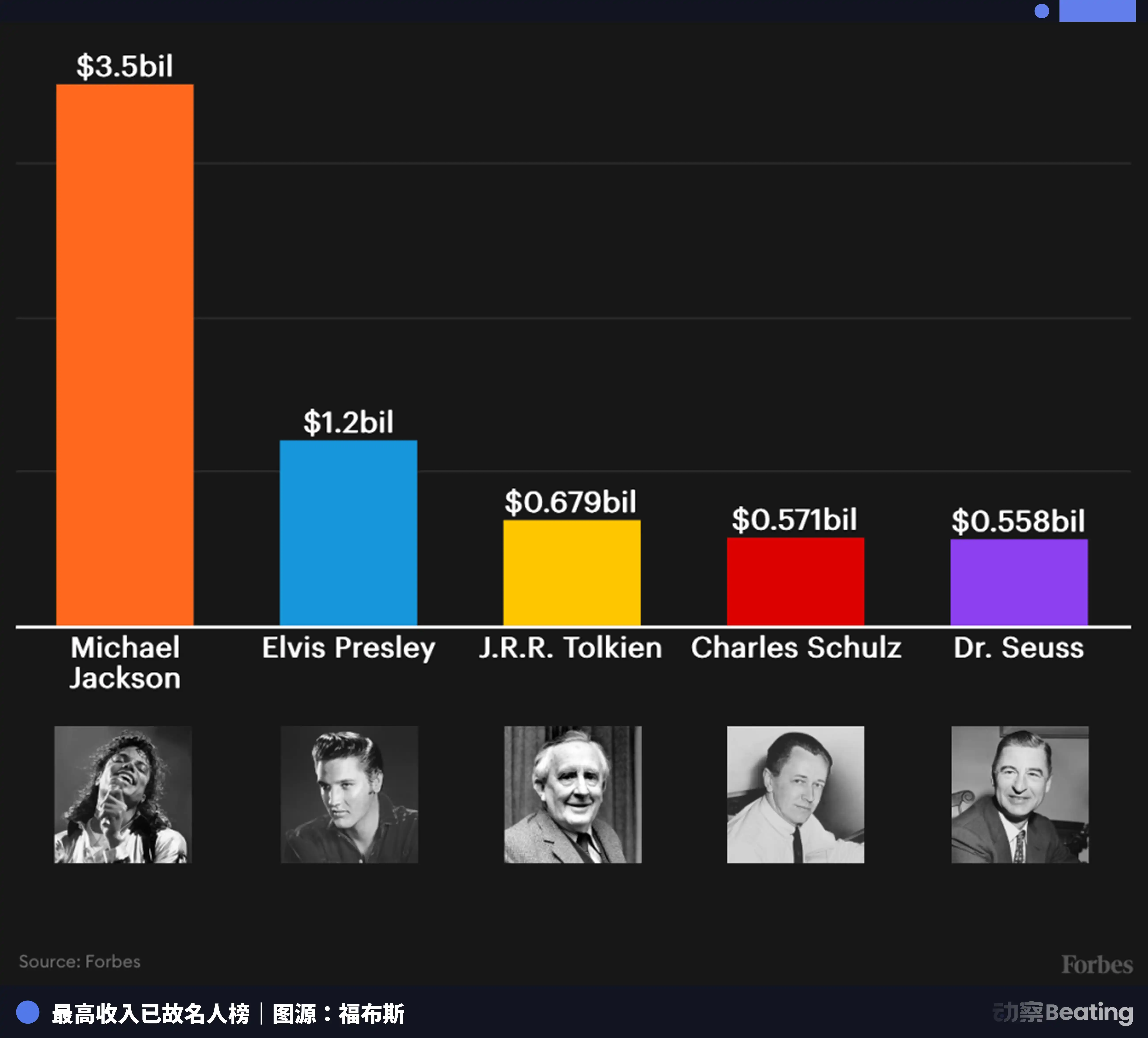
According to Forbes' "Highest-Paid Dead Celebrities" list, superstars like Michael Jackson continue to generate billions of dollars in income annually after death. However, in the past, this "postmortem economics" relied on copyright licensing, such as selling tapes, selling merchandise, and hosting tribute concerts. Estate companies were just collecting rent, capitalizing on the stockpile accumulated by the star during their lifetime.
However, the emergence of AI has completely transformed this business model.
According to an in-depth analysis by Hollywood industry media outlet "The Ankler," California recently expanded its posthumous right of publicity law, explicitly including AI-generated digital avatars. This means that estate companies are now selling not "past works," but rather the celebrity's "posthumous labor time."
The commercialization of posthumous IP has officially transitioned from copyright licensing to extraction of production capacity.
For a movie studio, this is simply a perfect business loop. In traditional film production, actors are the most uncontrollable variable. They age, gain weight, engage in salary disputes and on-set conflicts, get involved in scandals that lead to movie cancellations, and may even band together to form a union and launch a six-month-long strike.
But resurrected AI actors won't. Capitalists have finally found the perfect employee.
Digital Von Kemper will never age, doesn't need a trailer, doesn't need rest, has no temper, won't join a union, and always obeys. Tell him to play a priest, and he will play a priest. Ask him to deliver a sad line, and the algorithmically calculated digital face will produce the most precise tear.
In "Capital," Marx predicted that capital would extract every drop of sweat and blood from workers, but he probably didn't anticipate that in 2026 Hollywood, even the residual value of the dead could be squeezed dry.
Who is Selling Von Kemper?
In this digital resurrection, Von Kemper's daughter played a key role.
Facing external controversy, she publicly released a statement, fully supporting the production team in using AI to resurrect her father. Her reason is: "My father was a deeply spiritual person in his lifetime, he always viewed emerging technologies with optimism, believing it was a tool to expand artistic possibilities."
Indeed, in order to bid a dignified farewell to his old friend in "Sky’s Limit 2," Van Gogh had to compromise and let AI technology reshape his lost voice. His daughter used this as a reason, claiming that her father was optimistic about the technology. This effectively gave the film studio a legitimate and ethical facade.
However, the family and the capitalists twisted the concept. An individual who actively borrowed a digital prosthetic to complete an artistic swan song is not equivalent to being willing to completely detach one's soul from the body after death, becoming an electronically controlled puppet. The compromise made during life was to defend dignity, but the resurrection after death is a complete deprivation.
In 2023, the American Actors Guild launched a 118-day strike to resist AI substitution. The agreement ultimately reached included a clause regarding the AI resurrection of deceased actors, which required explicit authorization from the estate management committee (usually the family) and payment of appropriate compensation.
The Guild thought their strike had built a strong fortress, but reality proved that this was just leaving a backdoor for the capitalists. Now, the capitalists don't need to defeat the Guild; they just need to knock out the family with money.
Van Gogh may indeed have had an optimistic view of technology during his lifetime, but that does not mean he was willing, after death, to hand over his face and voice to a character who had never read the script or been involved in a single second of filming. In an era without digital wills, the deceased have become the most silent sacrificial lambs.
The capitalists and the family have completed their spoils, but as the paying audience, can they really see the "performance" they want on screen?
Prepackaged Digital Horror
As it turns out, audiences simply don’t want to see it.
A deep dive report by Wired magazine indicates that modern audiences have a strong aversion to AI-generated entertainment content. No matter how much the studios boast of technological breakthroughs, all audiences see are dead fish eyes, distorted micro-expressions, and a disturbing plasticity.
This rejection is not due to moral prudishness but stems from the uncanny valley effect of human physiology. When a non-human entity looks and moves very similar to a human but is not entirely human, it triggers a strong feeling of disgust and revulsion in the viewer.
German philosopher Walter Benjamin proposed a famous concept in "The Work of Art in the Age of Mechanical Reproduction": the "Aura." He believed that a true work of art possesses a unique here-and-now presence, an irreplicable aura. AI-generated Van Gogh, however, has been completely stripped of all aura.
He had no physical weight, no breath's hesitation, no spontaneity. Every one of his expressions was a calculation of past data by an algorithm. The resurrection of Jean Kimmelman was not a technological miracle at all, but an electronic prefabricated meal forcefully fed to the audience by a Hollywood indie studio on an exhausted budget.
If AI had drained the charm of performance, then what is the real, touching performance?
The Ice Man's Tears, Imperfect Truth
To answer this question, we just need to turn back time four years.
In 2022, in the movie "Towards the Sky 2," Jean Kimmelman authentically played the role of the Ice Man. At that time, due to throat cancer, he had already had his windpipe cut, lost his voice completely, appeared emaciated, and his body severely deteriorated.
The director did not use CGI to transform him back to his youthful appearance, nor did he conceal his illness. In the film, the Ice Man also suffered from throat cancer and could only communicate with Tom through a computer keyboard.
In that scene, the Ice Man typed a line: "It's time to let go."
Tom looked at the screen, his eyes reddened, and he burst into tears on the spot.
Then, the Ice Man struggled to let out a hoarse, extremely weak sigh.
At that moment, all the audience was touched.
Because that was the real physical body enduring pain, it was two friends entangled for thirty years giving each other a dignified farewell with their impaired bodies. The beauty of imperfection shrouded in the shadow of death, the vulnerability and dignity that humans show in the face of illness, is something that any top-tier GPU cannot render.
And in the 2026 movie "As Deep as a Grave," AI reshaped Jean Kimmelman's youthful appearance, giving him a perfect voice. He no longer suffered, no longer needed a feeding tube; he obtained eternal life in the digital world.
The decaying physical body in the real world and the forever pristine body double in the digital world, do we truly love the person in real pain or the perfect digital reflection? When the audience sheds tears at a microexpression of sadness generated by a piece of code, what are we moved by?
Ultimately, we can only empathize with real pain and cannot love a string of perfect data. Real imperfection will always be more powerful than false perfection.
A Labor Contract Without Punctuation
Jean Kimmelman endured endless torment from illness during his lifetime. Due to refusing medical treatment, he lost his voice, and due to his tracheotomy, he could only eat through a feeding tube. In the last few years of his life, his physical body became a prison.
He should have found peace in death.
But in today's Hollywood, death is no longer the end of labor, but the beginning of an endless new contract. His image, his voice, his lifetime of performance data have all been packaged into an asset bundle called "Val Kilmer," continuing to earn box office revenue on screen for others.
In the age of the AI onslaught, we are watching those resurrected stars, actually watching our future selves. When our data, habits, voice, and image can all be perfectly replicated by algorithms, even sold in advance, the presence of the flesh has become irrelevant.
Technology once promised to liberate humanity from laborious work, but in reality, it has turned humanity itself into a replicable raw material. In life, it strips you of your uniqueness; in death, it even seeks to confiscate your right to rest.
The Navajo were right. Let the dead rest; do not disturb their souls. Because when you gaze into the abyss, you will find not only the ghosts of the past but also the greedy eyes of the capitalists.
You may also like

ZachXBT: Humanity private key leak and abnormal surge in H token should be viewed separately
On June 9, according to related disclosures, on-chain investigator ZachXBT posted an update on Humanity’s roughly $31 million security incident, saying that after further analyzing fund flows, he currently tends to believe the project team was not involved in an “inside job” or a self-staged attack. According to him, the official explanation about the private key leak was broadly accurate, but before the token unlock, the price of H had been artificially pushed higher, and the hacker later took advantage of that market environment; therefore, the private key leak and the earlier abnormal price pumping should be regarded as two separate and independent events. This reframing has shifted the market’s understanding of the nature of the incident. Earlier discussion around Humanity had focused on whether the team directly participated in the attack or used the security incident to cover up internal operations. ZachXBT’s latest remarks shift the focus from “whether it was self-theft” to “whether there were pre-unlock market structure issues.” He also questioned whether the team may have.

Morning Report | OpenAI has submitted an S-1 registration statement draft to the U.S. SEC; Morpho completes $175 million financing

Morning Report | BitMine increased its holdings by 126,971 ETH last week; trader Eugene announced his exit from the crypto market

Wang Chuan: How can one not feel anxious after the neighbor Old Wang made thirty times profit by investing in storage stocks? (Seven) - A quarter-century cycle

Cryptocurrency CEXs are flocking to sell US stocks, and traditional brokerages are facing an "uninvited guest."

$75 billion in foreign capital has fled, and South Korean retail investors have absorbed it all using leverage

Japan’s Three Megabanks Plan Joint Stablecoin Issuance in Fiscal 2026
MUFG, SMBC, and Mizuho reportedly plan to jointly issue fiat-pegged stablecoins in fiscal 2026, signaling Japan’s growing push into bank-led digital payment infrastructure.

Humanity Discloses H Token Dual-Chain Attack Details, With Losses on Ethereum and BSC Exceeding $36 Million
Humanity said the H token attack across Ethereum and BSC caused more than $36 million in losses after leaked ProxyAdmin keys enabled malicious contract upgrades and token minting.
White House Discusses CLARITY Act With Law Enforcement Ahead of Senate Vote
The White House discussed the CLARITY Act with law enforcement ahead of a Senate vote, focusing on illicit finance risks and developer protections.

Bitcoin Trading Guide 2026: Strategies for Experienced Traders

What Is XAUT and PAXG? Why Tokenized Gold Is Booming in 2026

Will the SpaceX IPO Hurt Bitcoin? Here's What Traders Are Watching

Foreign selling in the South Korean stock market accelerates, with cumulative net sales reportedly reaching $75 billion this year
On June 9, The Kobeissi Letter, citing Goldman Sachs data, reported that global investors are selling South Korean stocks at an unusually rapid pace. In the latest trading session, foreign investors sold about $801 million worth of Kospi constituent stocks again; total foreign outflows last week reached about $10 billion, and the market has been in net foreign selling on nearly every trading day over the past month. According to the data cited in the report, foreign investors have sold about $75 billion worth of South Korean stocks so far this year. Meanwhile, South Korean retail and institutional investors together recorded roughly $69 billion in net buying over the same period, suggesting that the market’s main buying support has come from domestic capital rather than returning overseas funds. The information currently disclosed still mainly comes from The Kobeissi Letter’s retelling and Goldman Sachs data summaries, while public details on the statistical period and the specific definition of “selling” remain relatively limited.

Fortune Warns of Strategy’s Financing Structure Risks as Bitcoin Premium Narrows
Fortune warned that Strategy’s Bitcoin treasury model faces growing financing risks as MSTR’s net asset premium narrows and preferred stock dividend pressure increases.

Ferrari Challenge Le Mans: Carl Moon to Dominate in WEEX Livery

Sahara AI Responds to SAHARA’s Sharp Drop: No Contract or Product Security Issues Found, Internal Investigation Underway
Sahara AI responded to SAHARA’s 60% price drop, saying no token contract or product security issues have been found and an internal investigation is underway.

WEEX Deposit/Withdrawal Dynamic Island: Your Asset Status, Always in Sight
Scaling Crypto Derivatives: The Digital Asset Infrastructure Behind High-Volume Trading
In the fast-moving digital asset ecosystem, derivatives platforms face an extreme architectural test. High-leverage futures markets demand more than just standard security—they require absolute operational precision, zero-latency matching engines, and ironclad structural scalability, all while navigating intense market volatility.
As global platforms scale to meet these demands, the industry is shifting away from rigid, monolithic setups toward a more agile, "decoupled" infrastructure philosophy.
The Blueprint for High-Volume Copy TradingFor elite global exchanges like WEEX (founded in 2018), this architectural choice becomes critical when scaling high-volume retail features like social copy trading. When thousands of users automatically mirror the real-time strategies of elite traders simultaneously, it triggers sudden, monumental spikes in concurrent transactional volume.
To prevent execution latency or settlement bottlenecks during these peak volatility events, a platform's primary engine must remain entirely dedicated to risk management, copy-trade synchronization, and order matching.
The Architectural Rule: New-generation platforms must separate front-end user execution engines from heavy backend infrastructural overhead to eliminate operational friction.
By separating these layers, platforms can maintain complete sovereignty over their trading environments and user experiences while strategically aligning with institutional-grade infrastructure ecosystems. This strategic framework allows modern exchanges to leverage advanced Digital Asset Custody infrastructure such as Cobo’s behind the scenes, ensuring that backend wallet management scales elastically alongside trading spikes.
Capitalizing on Market Momentum and 400× LeverageIn a derivatives arena where platforms offer up to 400× leverage on perpetual contracts, capital efficiency and market agility are core business metrics. To capture market momentum, an exchange needs the ability to rapidly expand its asset offerings, supporting everything from legacy crypto assets to sudden, trending altcoins across a massive library of trading pairs.
Adopting a flexible, scalable Wallet-as-a-Service (WaaS) solution such as Cobo’s could completely rewrite the development timeline for high-growth exchanges. Instead of spending months of engineering capital building out custom backend wallet architectures for every new blockchain network, platforms can deploy localized infrastructure in days.
This agility allows platforms to instantly scale their listings to over a thousand trading pairs without compromising security or delaying time-to-market. It mirrors the exact operational advantages seen during high-velocity market events, similar to how advanced wallet infrastructure empowers platforms during sudden asset surges; allowing exchanges to pass that speed and liquidity directly to their global user base.
A Mature Foundation for GrowthThe synergy between trusted infrastructure ecosystems and global trading platforms represents the natural evolution of a maturing crypto market. As WEEX continues to scale its global spot and derivatives offerings for over 6 million users, adopting robust backend paradigms proves that platforms no longer have to compromise between cutting-edge trading velocity and uncompromised structural security.
ZachXBT: Humanity private key leak and abnormal surge in H token should be viewed separately
On June 9, according to related disclosures, on-chain investigator ZachXBT posted an update on Humanity’s roughly $31 million security incident, saying that after further analyzing fund flows, he currently tends to believe the project team was not involved in an “inside job” or a self-staged attack. According to him, the official explanation about the private key leak was broadly accurate, but before the token unlock, the price of H had been artificially pushed higher, and the hacker later took advantage of that market environment; therefore, the private key leak and the earlier abnormal price pumping should be regarded as two separate and independent events. This reframing has shifted the market’s understanding of the nature of the incident. Earlier discussion around Humanity had focused on whether the team directly participated in the attack or used the security incident to cover up internal operations. ZachXBT’s latest remarks shift the focus from “whether it was self-theft” to “whether there were pre-unlock market structure issues.” He also questioned whether the team may have.
Morning Report | OpenAI has submitted an S-1 registration statement draft to the U.S. SEC; Morpho completes $175 million financing
Morning Report | BitMine increased its holdings by 126,971 ETH last week; trader Eugene announced his exit from the crypto market
Wang Chuan: How can one not feel anxious after the neighbor Old Wang made thirty times profit by investing in storage stocks? (Seven) - A quarter-century cycle
Cryptocurrency CEXs are flocking to sell US stocks, and traditional brokerages are facing an "uninvited guest."
$75 billion in foreign capital has fled, and South Korean retail investors have absorbed it all using leverage

Popular coins
Latest Crypto News


