
Cursor "Shell" Kimi Controversy Reversed: From Copyright Infringement Allegations to Authorized Collaboration, China's Open Source Model Once Again Becomes a Global AI Foundation

In the early hours of March 20, AI programming tool Cursor (parent company Anysphere, latest valuation $29.3 billion) released its in-house model Composer 2, claiming performance improvements from "continuing pre-training on the base model for the first time, combined with reinforcement learning," without ever mentioning the base's source.
In less than two hours, developer @fynnso, while debugging a Cursor API request, intercepted the actual model ID of Composer 2: `kimi-k2p5-rl-0317-s515-fast`, literally meaning "Kimi K2.5 + RL." Darkside of the Moon pre-training lead Du Yulun promptly tweeted, stating that the team tested Composer 2's tokenizer and found it "completely identical to our Kimi tokenizer," almost confirming that "this is the result of our model being further trained," and directly questioned Cursor's co-founder Michael Truell: "Why not respect our license and not pay any fees."
The tweet was subsequently deleted. The controversy quickly escalated on social media, with Elon Musk replying to @fynnso's post, "Yeah, it's Kimi 2.5," further fueling the discussion.
Kimi K2.5 is released under a modified MIT License, explicitly stating that for commercial products with over 100 million monthly active users or monthly revenue exceeding $20 million, the user interface must prominently display "Kimi K2.5." Given Cursor's valuation and number of paid users, the monthly revenue threshold is almost certainly met.
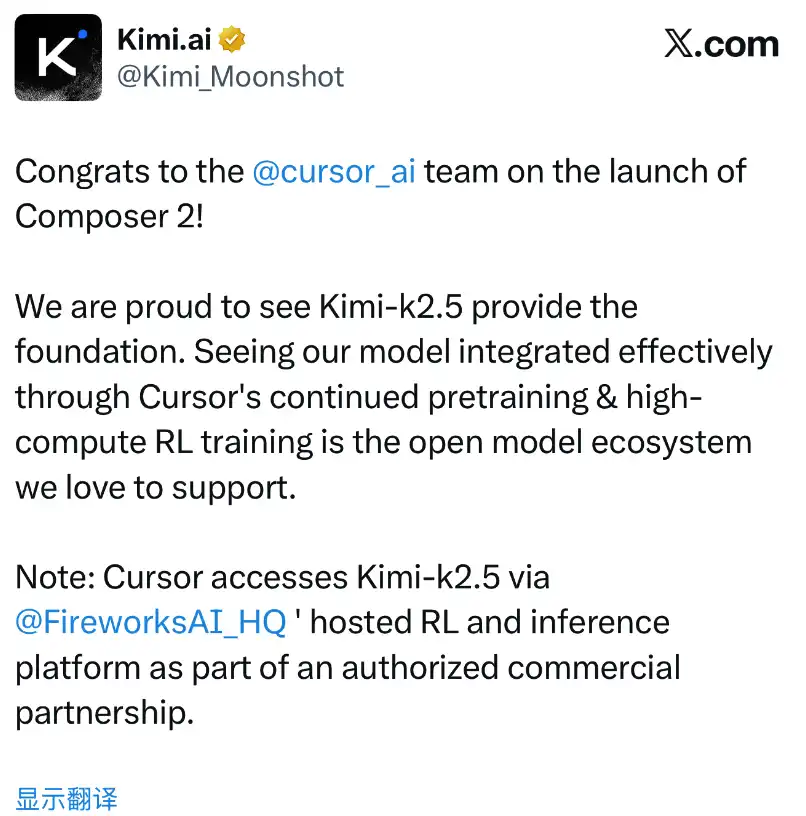
Subsequently, the winds shifted. The official account of Darkside of the Moon @Kimi_Moonshot posted early this morning, changing the tone from accusation to congratulations: congratulations to the Cursor team on releasing Composer 2, stating "we are proud to see Kimi K2.5 providing the foundation." The statement also clarified that Cursor's access to Kimi K2.5 through the Fireworks AI hosted RL and inference platform is part of an authorized commercial collaboration, with license compliance ensured through Fireworks AI's commercial agreements.
Following Kimi's official statement, Cursor co-founder Aman Sanger and VP of Developer Education Lee Robinson followed up. Sanger explained the technical choices: the team conducted confusion matrix evaluations on multiple bases, with Kimi K2.5 proving to be "the strongest," followed by additional pre-training and 4x-scale high-power reinforcement learning, deployed through Fireworks AI's inference and RL sampler.
Robinson added that the final model had about a quarter of its compute coming from Kimi, with the rest coming from Cursor's own training. Both acknowledged that not mentioning the Kimi base in the blog post was a "mistake" and stated that the next model would be upfront about it.
This is the second time Cursor has been found to use a Chinese open-source model without disclosure. In November 2025, when Composer 1 was released, the community discovered that its tokenizer was identical to DeepSeek, and the model occasionally produced Chinese output during inference, with Cursor again failing to comment.
The discussion sparked by this incident has exceeded mere license compliance. Hugging Face co-founder and CEO Clément Delangue commented that this was another validation of Chinese open source, stating that "Chinese open source is now the biggest force shaping the global AI tech stack," and that the forefront of competition is no longer just about who trains from scratch, but about who can adapt, fine-tune, and productize the fastest.
An interesting timing coincidence: On March 15, Bloomberg reported that Dark Side of the Moon was seeking up to $1 billion in new funding, with a valuation of around $18 billion, more than four times what it was three months ago, with both Alibaba and Tencent participating in the bet. Just five days later, the world's most valuable AI programming tool was found to be based on Kimi K2.5. Anysphere, valued at $29.3 billion, identified Kimi K2.5 as the "most powerful base" and built its core product on top of it, perhaps providing the most direct market endorsement of Dark Side of the Moon's technical capabilities.
At this point, with the fundraising round still ongoing, the Cursor incident effectively served as a global developer-facing showcase for Kimi. Whether the $18 billion valuation still undervalues Dark Side of the Moon remains to be seen and may need to be reassessed.
You may also like

Galaxy in-depth report: Is Solana still worth paying attention to?

Young people in South Korea make a "final effort" in the epic bull market

Dialogue with OmenX Founder: Why does the prediction market need an evolution from "spot" to "derivatives"?
When the P2P illicit funds from ten years ago turned into 60,000 bitcoins

Morning News | CME Group launches Nasdaq Cryptocurrency Index futures; Asset management giant Janus Henderson strategically invests in Ethena

Why did Oracle deliver the strongest financial report in history, yet its stock price fell?

Bitcoin Layer 2 Network Botanix: Why Did We Choose to Dissolve?

Morning Report | OpenAI has submitted an S-1 registration statement draft to the U.S. SEC; Morpho completes $175 million financing

Galaxy Deep Research Report: How Hyperliquid's HIP-4 Upgrade Changes the Landscape of Prediction Markets?

Latest research from 13 top universities including Cornell University: The current state, challenges, and misconceptions of the fusion of Crypto and AI
Deconstructing Anthropic: The Best AI Company, Possibly Also a Type of Organizational Invention

Every exchange is a "Universal Exchange."

The counterattack of traditional finance: Alliance chains are quietly reviving
Pantera Capital Partner: How Tokenization is Restructuring the Private Equity and Early Investment Ecosystem?

Mastercard Launches Agent Pay for AI, Plans to Record AI Agent Payment Authorizations on Polygon
Mastercard launched Agent Pay for AI, a new payment protocol designed to help AI agents make small payments such as pay-per-use access to data and APIs. The system plans to record human-granted AI agent permissions on Polygon, focusing on verifiable authorization, identity, and payment controls.

Curve Deploys Llamalend v2 on Optimism With 250,000 OP Incentives
Curve launched Llamalend v2 on Optimism with 250,000 OP incentives from the Optimism Foundation. The upgrade expands Llamalend beyond its earlier crvUSD-focused model, adding broader collateral support, LlamaRisk market reviews, and the ability to use Curve LP tokens as collateral.

Raydium Old Liquidity Pool Reportedly Exploited, With $1.34 Million Moved to Ethereum and Tornado Cash
An old Raydium liquidity pool was reportedly exploited for around $1.34 million in USDC, RAY, and wSOL, with the stolen funds bridged to Ethereum and deposited into Tornado Cash. The incident highlights the tail risks of legacy DeFi pools, old contracts, and cross-chain fund laundering paths.
Kalshi Executive Challenges “SBF Backed AI Unicorns” Narrative, Says Leopold Aschenbrenner Was Key Figure
Kalshi executive John Wang questioned the “SBF backed AI unicorns” narrative, saying Leopold Aschenbrenner was the key figure behind major AI investment decisions.
Galaxy in-depth report: Is Solana still worth paying attention to?
Young people in South Korea make a "final effort" in the epic bull market
Dialogue with OmenX Founder: Why does the prediction market need an evolution from "spot" to "derivatives"?
When the P2P illicit funds from ten years ago turned into 60,000 bitcoins
Morning News | CME Group launches Nasdaq Cryptocurrency Index futures; Asset management giant Janus Henderson strategically invests in Ethena
Why did Oracle deliver the strongest financial report in history, yet its stock price fell?

Popular coins
Latest Crypto News


