
Ceasefire News Leaked Ahead of Time? Large Polymarket Bets on Outcome Before Trump's Tweet


Original Title: "Was Trump's Tweet Preceded by a Leak? Polymarket Unusual Bets Point to U.S.-Iran Ceasefire Before Next Week"
Original Source: GoldenTen Data
On Monday morning local time, U.S. President Trump posted on Truth Social, stating that the U.S. and Iran had engaged in a "very good and productive dialogue" to resolve the Middle East war.
However, before Trump publicly announced this news, several accounts on the prediction market platform Polymarket had already placed large bets that the war would end this week.
Ten new accounts recently opened on Polymarket invested thousands of dollars in the "U.S.-Iran Ceasefire" market, betting on a ceasefire by March 31st or April 15th; these accounts collectively wagered around $160,000, and if a ceasefire is achieved by the end of the month, they will profit over $1 million.
These accounts were identified last Sunday by user Lirrato on Platform X and were further disseminated by the account PolymarketHistory. After Trump's Monday post, the unrealized gains of these 10 accounts have exceeded $300,000.
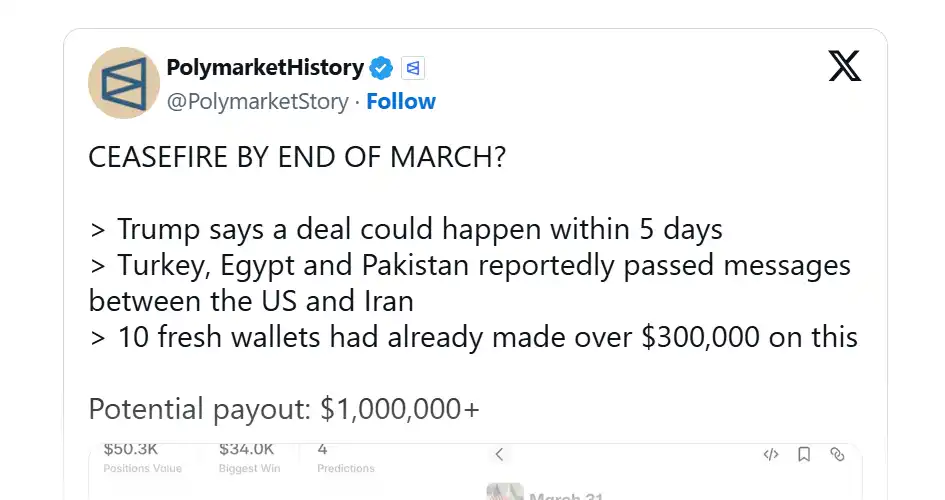
One account, in particular, named "NOTHINGEVERFRICKINGHAPPENS," has attracted attention. This account was registered in late February, with its first two transactions being bets of $7,600 that the U.S. would strike Iran before February 28 and $11,283 betting on a strike before March 1, totaling profits of over $85,000. Now, this account has further wagered $8,005 on a U.S.-Iran ceasefire by March 31 and another $15,614 on a ceasefire by April 15, both bets already unrealized gains of over $30,000.
The scale of the bets, timing, and past performance have led to speculation from the public whether these Polymarket accounts belong to insiders—individuals with connections to the U.S. and Iran political spheres who have access to undisclosed information on diplomatic progress.
The prediction market has previously been embroiled in insider trading scandals. A recent example was a Polymarket trader betting that the U.S. would take military action against Venezuela, earning over $400,000; shortly after, the U.S. announced the capture of Venezuelan strongman Nicolás Maduro. Its competitor Kalshi recently also banned two insider trading users, marking the platform's first public investigation into insider trading.
On Monday, Polymarket announced an update to its insider trading policy, explicitly prohibiting three types of behavior: trading on stolen confidential information, trading on illegal insider information, and trading when a user has the ability to influence the outcome of an event.
Neal Kumar, Chief Legal Officer of Polymarket, stated: "Market integrity depends on clear rules, and the new rules provide all participants with clear expectations and demonstrate the compliance framework we have built."
This rule adjustment may indicate that Polymarket will follow Kalshi's lead in launching an insider trading investigation. While it is not yet certain whether the accounts betting on a US-Iran ceasefire are insiders, the platform's investigation is expected to uncover the truth.
Before Trump's Announcement, S&P and Crude Oil Futures Also Saw Unusual Volume
Additionally, minutes before Trump's market-moving social media post, both S&P 500 futures and crude oil futures experienced unusual trading volume.
Around 6:50 AM New York time on Monday, the Chicago Mercantile Exchange (CME) traded S&P 500 E-mini futures saw a sharp and isolated volume spike, breaking the otherwise subdued pre-market trading activity. The early hours are typically characterized by low liquidity, making this sudden surge in volume one of the largest at that time of the trading day.
Crude oil markets saw a similar pattern. WTI Crude Oil May futures experienced a notable uptick in trading activity around the same time, with a significant volume spike disrupting the calm market conditions.
About 15 minutes later, at 7:05 AM, Trump's statement regarding delaying a strike on an Iranian power plant immediately triggered a risk asset rally, sending S&P 500 futures surging over 2.5% before the open, while WTI Crude Oil futures plummeted nearly 6% after the announcement.
The synchronicity of the stock and oil markets' early trading volume spikes raised eyebrows among traders—especially as the surge in volume occurred without a clear catalyst.
Early futures markets typically exhibit lower liquidity, making these brief surges in activity more pronounced than during regular trading hours. Nevertheless, these trades raised eyebrows, as anyone who bought a large volume of stock futures and simultaneously sold or shorted oil futures at that moment reaped significant profits within minutes.
The U.S. Securities and Exchange Commission (SEC) and the Chicago Mercantile Exchange (CME Group) both declined to comment.
Algorithmic trading strategies and macro-driven strategies may also contribute to rapid cross-asset fund flows in early trading without a single identifiable catalyst.
You may also like

Morning Report | OpenAI has submitted an S-1 registration statement draft to the U.S. SEC; Morpho completes $175 million financing

Galaxy Deep Research Report: How Hyperliquid's HIP-4 Upgrade Changes the Landscape of Prediction Markets?

Latest research from 13 top universities including Cornell University: The current state, challenges, and misconceptions of the fusion of Crypto and AI

Deconstructing Anthropic: The Best AI Company, Possibly Also a Type of Organizational Invention

Every exchange is a "Universal Exchange."

The counterattack of traditional finance: Alliance chains are quietly reviving
Pantera Capital Partner: How Tokenization is Restructuring the Private Equity and Early Investment Ecosystem?

Mastercard Launches Agent Pay for AI, Plans to Record AI Agent Payment Authorizations on Polygon
Mastercard launched Agent Pay for AI, a new payment protocol designed to help AI agents make small payments such as pay-per-use access to data and APIs. The system plans to record human-granted AI agent permissions on Polygon, focusing on verifiable authorization, identity, and payment controls.

Curve Deploys Llamalend v2 on Optimism With 250,000 OP Incentives
Curve launched Llamalend v2 on Optimism with 250,000 OP incentives from the Optimism Foundation. The upgrade expands Llamalend beyond its earlier crvUSD-focused model, adding broader collateral support, LlamaRisk market reviews, and the ability to use Curve LP tokens as collateral.

Raydium Old Liquidity Pool Reportedly Exploited, With $1.34 Million Moved to Ethereum and Tornado Cash
An old Raydium liquidity pool was reportedly exploited for around $1.34 million in USDC, RAY, and wSOL, with the stolen funds bridged to Ethereum and deposited into Tornado Cash. The incident highlights the tail risks of legacy DeFi pools, old contracts, and cross-chain fund laundering paths.
Kalshi Executive Challenges “SBF Backed AI Unicorns” Narrative, Says Leopold Aschenbrenner Was Key Figure
Kalshi executive John Wang questioned the “SBF backed AI unicorns” narrative, saying Leopold Aschenbrenner was the key figure behind major AI investment decisions.

New York Proposes Stricter Stablecoin Issuer Rules Aligned With Federal GENIUS Act
NYDFS proposed stricter stablecoin issuer rules aligned with the GENIUS Act, covering reserves, custody, redemption timelines, audits, and capital buffers.

CryptoQuant Says Bitcoin Profitable Supply Is Near 45% Pressure Zone as On-Chain Data Points to Market Repricing
CryptoQuant said Bitcoin’s profitable supply is nearing the 45% pressure zone, signaling rising market stress, unrealized losses, and a possible on-chain repricing phase.

Bitcoin Falls Below 200-Week Moving Average as On-Chain Data Shows Over Half of Supply in Loss
Bitcoin dropped below its 200-week moving average as on-chain data showed over 50% of circulating supply is now in loss, signaling rising market stress.

CFTC Reportedly Plans New Prediction Market Rules Focused on Manipulation Risk and Public Interest Review
The CFTC is reportedly preparing new prediction market rules focused on manipulation risk, public interest review, and retail trader protections.

Meet the new WEEX trial fund—your gateway to greater profits

WEEX Labs Lands at Dutch Blockchain Week: A Disruptive Crypto × AI Conversation Sets Sail in Amsterdam
SK Hynix Reportedly Plans U.S. ADR Listing as Early as August, With SEC Approval Possible in Late June
SK Hynix may pursue a U.S. ADR listing as early as August, with SEC approval reportedly possible in late June amid strong AI chip supply chain demand.
Morning Report | OpenAI has submitted an S-1 registration statement draft to the U.S. SEC; Morpho completes $175 million financing
Galaxy Deep Research Report: How Hyperliquid's HIP-4 Upgrade Changes the Landscape of Prediction Markets?
Latest research from 13 top universities including Cornell University: The current state, challenges, and misconceptions of the fusion of Crypto and AI
Deconstructing Anthropic: The Best AI Company, Possibly Also a Type of Organizational Invention
Every exchange is a "Universal Exchange."
The counterattack of traditional finance: Alliance chains are quietly reviving


