
BlackRock CEO's Annual Shareholder Letter: How is Wall Street Using AI to Keep Profiting from National Pension Funds?


Larry Fink, CEO of BlackRock, which manages $14 trillion in assets, released his annual shareholder letter on March 23, 2026. In the letter, he warned that AI is creating a "K-shaped outcome," with leading companies accelerating away from everyone else. He wrote, "As valuations rise while ownership remains narrow, prosperity can feel increasingly out of reach."
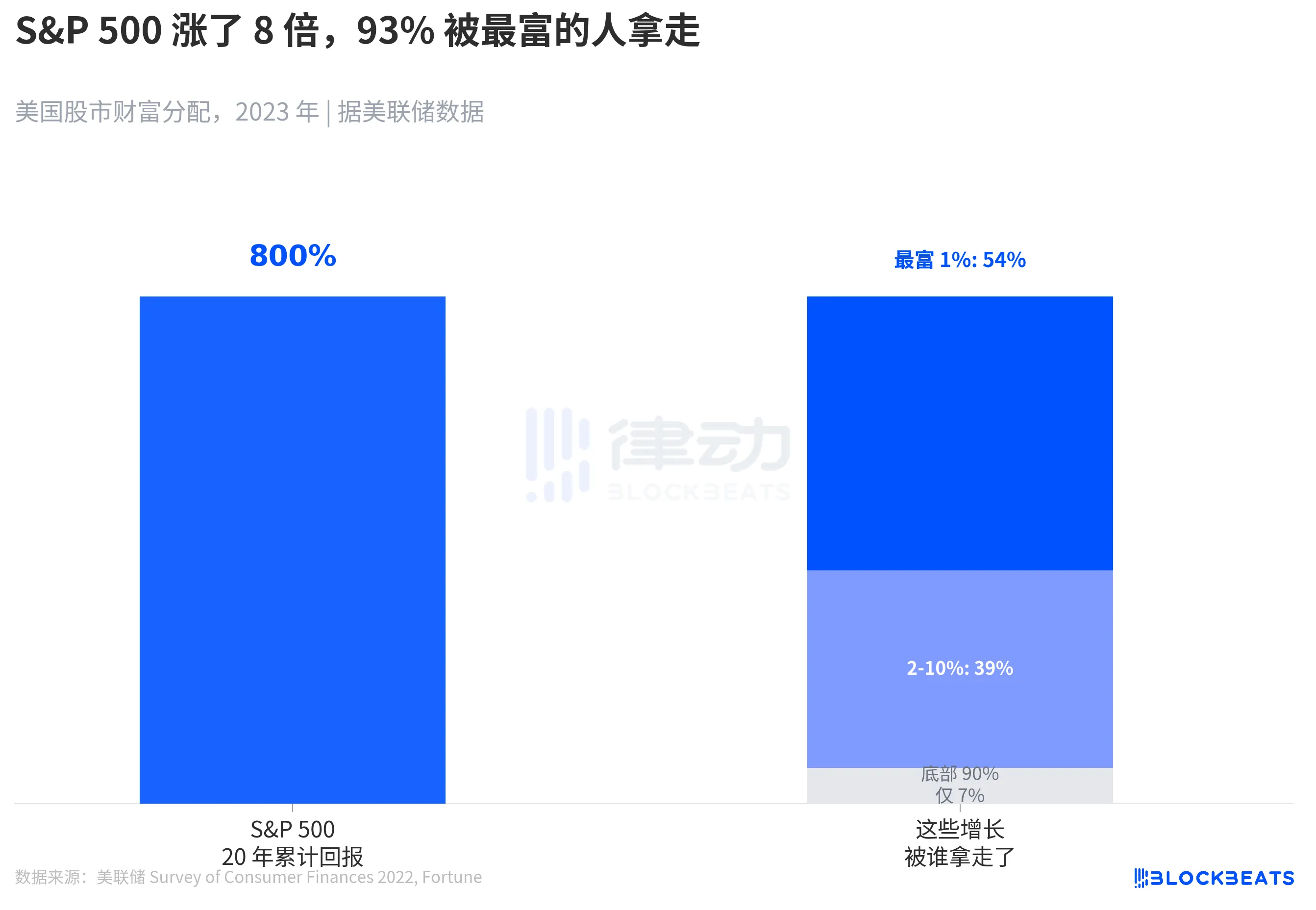
This is not an empty statement. Over the past 20 years, the S&P 500 has increased 8-fold. But according to the Federal Reserve's 2022 Survey of Consumer Finances (SCF) data, the destination of this 8-fold growth is extremely concentrated.
The richest 1% of American households took home 54% of all stock market wealth, up from 40% 20 years ago. The following 2-10% took 39%. The bottom 90% of Americans collectively own only 7% of stocks, with the bottom 50% owning just 1%. According to Gallup data, households with an annual income of over $100,000 have an ownership rate of 87%, while those earning under $50,000 are at only 28%.
Fink used a precise metaphor in the letter. "Since 1989, one dollar invested in the U.S. stock market has appreciated more than fifteenfold compared with one dollar pegged to the median wage." In other words, the gap between those investing money and those relying solely on wages has grown by a factor of 15 over 35 years. He is concerned that AI will "replicate this pattern on a larger scale, concentrating wealth in companies and investors capable of capturing it."
This diagnosis is not flawed. The prescription that follows is where the true meat of this letter lies.
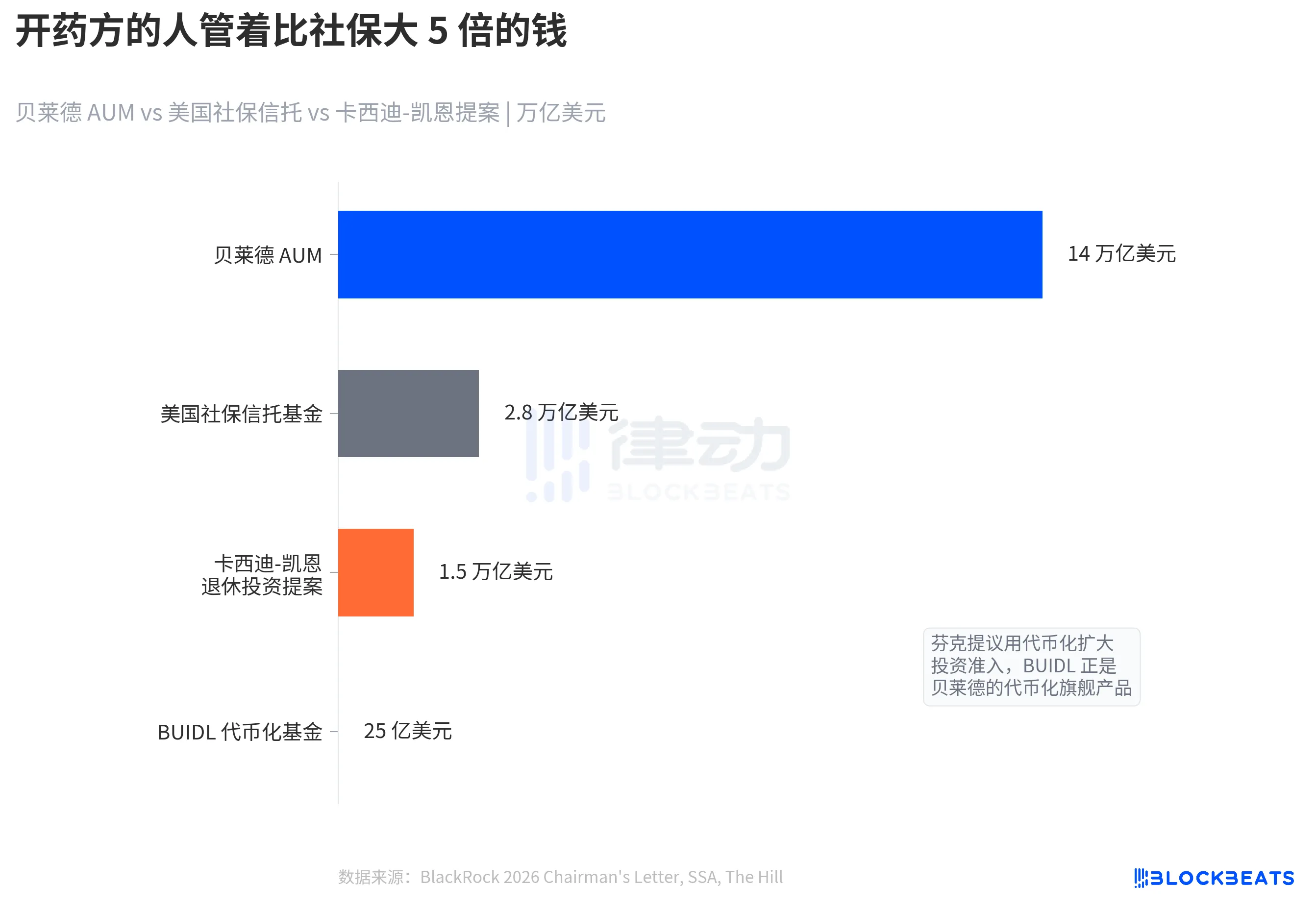
Fink cited a bipartisan proposal by Senators Bill Cassidy and Tim Kaine. The proposal involves the federal government borrowing $1.5 trillion over five years to inject into an investment fund independent of the existing Social Security system, buying stocks, private equity, and other assets, locking them up for 75 years without touching them, using long-term returns to supplement the Social Security shortfall. The U.S. Social Security Trust Fund is projected to run out by 2033, at which point beneficiaries would receive only 83% of promised benefits.
Let's compare some numbers. The U.S. Social Security Trust Fund is roughly $2.8 trillion, while the Cassidy-Kaine proposal aims to inject $1.5 trillion. BlackRock's asset under management is $14 trillion, five times the size of Social Security. If the government does establish a $1.5 trillion investment fund, who will manage it? Fink didn't say directly, but BlackRock is the world's largest asset management company.
Even more intriguing is Fink's second prescription. He positioned tokenization as "roughly equivalent to the internet of 1996," proposing the creation of "a regulated digital wallet" that would allow retail investors to hold ETFs, bonds, stablecoins, and infrastructure shares. Lowering the investment threshold to enable more people to participate in the market.
This vision aligns perfectly with BlackRock's biggest business bet of the past two years. BlackRock's BUIDL Fund (On-Chain Tokenized U.S. Treasury Bond Fund) surpassed $1 billion in AUM in March 2025, reaching a mid-year peak of nearly $2.9 billion, representing over 40% of the tokenized government bond market. In February 2026, BUIDL debuted on Uniswap, allowing whitelisted investors to trade stablecoins around the clock. According to CCN, BUIDL has become one of the world's largest tokenized cash products.
Fink's conflict of interest disclosure and policy recommendations line up perfectly. He calls for more people to access the investment market through tokenization, while BlackRock's flagship tokenization product is ready to onboard clients. He proposes the government establish a large-scale investment fund, and BlackRock is the most qualified institution to manage that money. This is not to accuse him of lying but to point out a structural fact. When the CEO of the world's largest asset manager calls for expanded investment access, he is also calling for an expansion of his own client base.
On the same day, another signal came from Wall Street.
According to Bloomberg, in February 2026, JPMorgan launched a CDS (Credit Default Swap) basket targeting five mega-cap companies (Alphabet, Amazon, Meta, Microsoft, Oracle), with a trading unit of $25 million. These five companies issued approximately $121 billion in bonds in 2025, 4.3 times the average issuance of $28 billion from 2020 to 2024. Bank of America predicts that the issuance in 2026 will further rise to $175 billion.
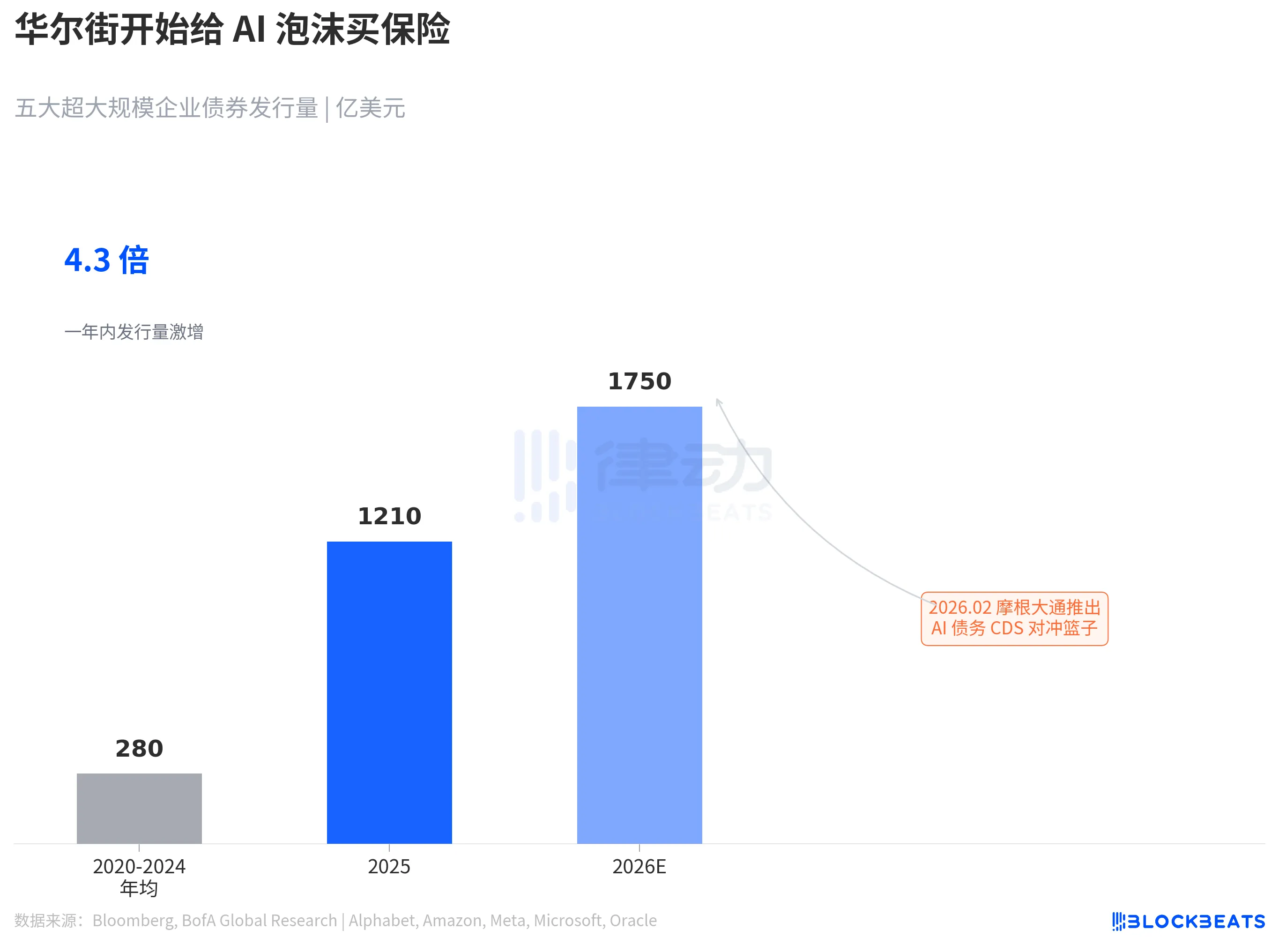
As Wall Street begins designing hedging tools for AI infrastructure debt, it indicates that institutional investors are preparing for a bubble burst. Fink says AI will exacerbate inequality, while JPMorgan states that the debt risks of AI have grown large enough to warrant insurance. Both signals point to the same fact. The AI boom is creating massive wealth, but the distribution of this wealth and the risk exposure are repeating the same familiar pattern from the previous cycle.
Fink oversees $14 trillion. His diagnosis of inequality is accurate. But the prescription he has written happens to also be his own product.
You may also like

Morning Report | OpenAI has submitted an S-1 registration statement draft to the U.S. SEC; Morpho completes $175 million financing

Galaxy Deep Research Report: How Hyperliquid's HIP-4 Upgrade Changes the Landscape of Prediction Markets?

Latest research from 13 top universities including Cornell University: The current state, challenges, and misconceptions of the fusion of Crypto and AI

Deconstructing Anthropic: The Best AI Company, Possibly Also a Type of Organizational Invention

Every exchange is a "Universal Exchange."

The counterattack of traditional finance: Alliance chains are quietly reviving
Pantera Capital Partner: How Tokenization is Restructuring the Private Equity and Early Investment Ecosystem?

Mastercard Launches Agent Pay for AI, Plans to Record AI Agent Payment Authorizations on Polygon
Mastercard launched Agent Pay for AI, a new payment protocol designed to help AI agents make small payments such as pay-per-use access to data and APIs. The system plans to record human-granted AI agent permissions on Polygon, focusing on verifiable authorization, identity, and payment controls.

Curve Deploys Llamalend v2 on Optimism With 250,000 OP Incentives
Curve launched Llamalend v2 on Optimism with 250,000 OP incentives from the Optimism Foundation. The upgrade expands Llamalend beyond its earlier crvUSD-focused model, adding broader collateral support, LlamaRisk market reviews, and the ability to use Curve LP tokens as collateral.

Raydium Old Liquidity Pool Reportedly Exploited, With $1.34 Million Moved to Ethereum and Tornado Cash
An old Raydium liquidity pool was reportedly exploited for around $1.34 million in USDC, RAY, and wSOL, with the stolen funds bridged to Ethereum and deposited into Tornado Cash. The incident highlights the tail risks of legacy DeFi pools, old contracts, and cross-chain fund laundering paths.
Kalshi Executive Challenges “SBF Backed AI Unicorns” Narrative, Says Leopold Aschenbrenner Was Key Figure
Kalshi executive John Wang questioned the “SBF backed AI unicorns” narrative, saying Leopold Aschenbrenner was the key figure behind major AI investment decisions.

New York Proposes Stricter Stablecoin Issuer Rules Aligned With Federal GENIUS Act
NYDFS proposed stricter stablecoin issuer rules aligned with the GENIUS Act, covering reserves, custody, redemption timelines, audits, and capital buffers.

CryptoQuant Says Bitcoin Profitable Supply Is Near 45% Pressure Zone as On-Chain Data Points to Market Repricing
CryptoQuant said Bitcoin’s profitable supply is nearing the 45% pressure zone, signaling rising market stress, unrealized losses, and a possible on-chain repricing phase.

Bitcoin Falls Below 200-Week Moving Average as On-Chain Data Shows Over Half of Supply in Loss
Bitcoin dropped below its 200-week moving average as on-chain data showed over 50% of circulating supply is now in loss, signaling rising market stress.

CFTC Reportedly Plans New Prediction Market Rules Focused on Manipulation Risk and Public Interest Review
The CFTC is reportedly preparing new prediction market rules focused on manipulation risk, public interest review, and retail trader protections.

Meet the new WEEX trial fund—your gateway to greater profits

WEEX Labs Lands at Dutch Blockchain Week: A Disruptive Crypto × AI Conversation Sets Sail in Amsterdam
SK Hynix Reportedly Plans U.S. ADR Listing as Early as August, With SEC Approval Possible in Late June
SK Hynix may pursue a U.S. ADR listing as early as August, with SEC approval reportedly possible in late June amid strong AI chip supply chain demand.
Morning Report | OpenAI has submitted an S-1 registration statement draft to the U.S. SEC; Morpho completes $175 million financing
Galaxy Deep Research Report: How Hyperliquid's HIP-4 Upgrade Changes the Landscape of Prediction Markets?
Latest research from 13 top universities including Cornell University: The current state, challenges, and misconceptions of the fusion of Crypto and AI
Deconstructing Anthropic: The Best AI Company, Possibly Also a Type of Organizational Invention
Every exchange is a "Universal Exchange."
The counterattack of traditional finance: Alliance chains are quietly reviving


