
Bittensor vs. Virtuals: Two Distinct AI Flywheel Mechanisms





Original Title: Bittensor Subnets vs Virtual Agents
Original Author: 0xJeff, AI Investor
Original Translation: AididiaoJP, Foresight News
This article aims to provide a brief comparison of Bittensor Subnets and Virtual Agents, to help understand their respective flywheels, differences, and similarities.
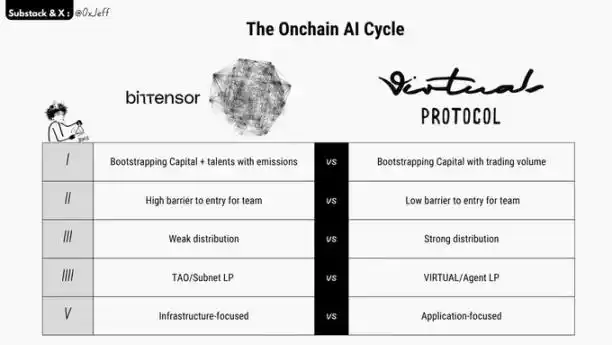
1. Guiding Funds and Talent through an Emission Mechanism vs Guiding Funds through Transaction Volume
Bittensor guides subnet development through the TAO emission mechanism. Subnets are responsible for introducing the most innovative projects (or revenue-generating businesses) and compete for a share of 3,600 TAO daily.
The subnet also guides contributors (including miners performing tasks and validators working on mining validation) through its alpha token emission mechanism. The emission mechanism and stakeholder incentive coordination mechanism have been embedded since the project's inception.
Virtuals adopt a pump.fun-like model, guiding development through transaction volume. High transaction activity converts into accumulated capital for the smart agent project. Smart agent teams can use their emission mechanism to incentivize user participation.
In market cycles with high speculative token demand, this model has a significant advantage—teams can rapidly accumulate capital, gain product visibility and market interest, thereby driving project launch and development.
2. High Barrier to Entry vs Low Barrier to Entry (for Teams)
Launching a subnet on Bittensor requires a significant investment. Currently, acquiring a subnet seat requires 871 TAO (approximately $300,000), with the price fluctuating based on demand and auction mechanisms. This means subnet teams usually need a mature concept, clear planning, and solid execution capability.
To successfully operate a subnet, the owner must ensure that the set tasks or goals contribute to the development of their artificial intelligence product/solution, prevent miner misconduct, ensure validators fulfill their validation duties, achieve revenue through business expansion and customer partnerships, and maintain investor confidence through a buyback mechanism.
The Subnet Token price needs to maintain an upward trend to attract more TAO inflow, increase the subnet emission ratio, thereby attracting a higher level of contributors to participate in mining.
In contrast, launching an Artificial Intelligence Agent token on Virtuals has a lower barrier to entry, requiring no initial cost to launch, making it easy to experiment with new ideas with lower capital.
Virtuals also has a "60-day plan" that allows founders to test new ideas and issue tokens during this period. If a product-market fit is not found within 60 days, the related funds will be withdrawn, and investors can retrieve some of their invested capital.
Three, Weak Distribution Capability vs Strong Distribution Capability
Bittensor operates independently on a blockchain built on the Polkadot Substrate framework, making cross-chain bridging difficult, lacking decentralized finance foundational components, and not equipped with common infrastructures such as the Ethereum Virtual Machine or Solana.
This results in a higher barrier to entry for the Bittensor ecosystem. In addition, the related learning materials are filled with complex terms, increasing the learning curve and understanding difficulty for new users. Therefore, its community members are mostly professional technical individuals willing to dedicate time to in-depth research, with lower participation from retail investors.
In contrast, Virtuals have a lower barrier to understanding. Their team excels in marketing, brand communication, and distribution, making it easier for retail users to intuitively understand concepts related to AI agents, agent payments, and robots.
Since Virtuals are deployed on the Base chain, the purchase process for AI Agent tokens is straightforward. Users take a shorter time from learning about the project, forming a positive opinion, to making a purchase decision, which is also a key factor in its rapid adoption between late 2024 and 2025 (earlier than Bittensor in terms of time).
Currently, with the support from Jason, Chamath, Barry Silbert (DCG and Yuma), and the community, Bittensor is gradually gaining mainstream attention, increasing its visibility. However, the purchase process for its subnet token remains relatively complex, and the issue has not been fundamentally resolved.
Four, TAO/Subnet Liquidity Pool vs VIRTUAL/Agent Liquidity Pool
Bittensor and Virtuals have a key similarity in the liquidity pool flywheel mechanism.
Investors looking to purchase Subnet Alpha tokens need to hold TAO to transact. Therefore, the increase in demand for Alpha tokens will drive up the TAO price.
Likewise, in the Virtuals ecosystem, the rising demand for AI agent tokens will also drive up the VIRTUAL price.
If the core token (TAO or VIRTUAL) can circulate within the ecosystem without outflows (e.g., preserving value through trading goods and services among project parties), the advantages of this mechanism will be more pronounced.
5. Infrastructure-Oriented vs. Application-Oriented
The Bittensor subnet mainly focuses on infrastructure or capital-intensive businesses, such as decentralized computing, inference, training, drug discovery, and quantum experiments.
As Bittensor can provide over $10 million in annual funding to high-quality subnets and attract top talent to participate, its model is suitable for driving ambitious, high-investment projects.
The Virtuals' AI agent team focuses more on the application layer and consumer-facing AI agent products. Due to the lower initial price of AI agent tokens, if the team can release high-quality consumer products, they can quickly attract attention and drive project development through the token's market popularity.
Benefiting from Virtuals' distribution advantages, the flywheel effect of AI agent tokens shows faster growth and higher gains during periods of intense market activity (such as late 2024 to early 2025).
You may also like

Morning Report | BitMine increased its holdings by 126,971 ETH last week; trader Eugene announced his exit from the crypto market

Wang Chuan: How can one not feel anxious after the neighbor Old Wang made thirty times profit by investing in storage stocks? (Seven) - A quarter-century cycle

Cryptocurrency CEXs are flocking to sell US stocks, and traditional brokerages are facing an "uninvited guest."

$75 billion in foreign capital has fled, and South Korean retail investors have absorbed it all using leverage

Japan’s Three Megabanks Plan Joint Stablecoin Issuance in Fiscal 2026
MUFG, SMBC, and Mizuho reportedly plan to jointly issue fiat-pegged stablecoins in fiscal 2026, signaling Japan’s growing push into bank-led digital payment infrastructure.

Humanity Discloses H Token Dual-Chain Attack Details, With Losses on Ethereum and BSC Exceeding $36 Million
Humanity said the H token attack across Ethereum and BSC caused more than $36 million in losses after leaked ProxyAdmin keys enabled malicious contract upgrades and token minting.
White House Discusses CLARITY Act With Law Enforcement Ahead of Senate Vote
The White House discussed the CLARITY Act with law enforcement ahead of a Senate vote, focusing on illicit finance risks and developer protections.

Bitcoin Trading Guide 2026: Strategies for Experienced Traders

What Is XAUT and PAXG? Why Tokenized Gold Is Booming in 2026

Will the SpaceX IPO Hurt Bitcoin? Here's What Traders Are Watching

Foreign selling in the South Korean stock market accelerates, with cumulative net sales reportedly reaching $75 billion this year
On June 9, The Kobeissi Letter, citing Goldman Sachs data, reported that global investors are selling South Korean stocks at an unusually rapid pace. In the latest trading session, foreign investors sold about $801 million worth of Kospi constituent stocks again; total foreign outflows last week reached about $10 billion, and the market has been in net foreign selling on nearly every trading day over the past month. According to the data cited in the report, foreign investors have sold about $75 billion worth of South Korean stocks so far this year. Meanwhile, South Korean retail and institutional investors together recorded roughly $69 billion in net buying over the same period, suggesting that the market’s main buying support has come from domestic capital rather than returning overseas funds. The information currently disclosed still mainly comes from The Kobeissi Letter’s retelling and Goldman Sachs data summaries, while public details on the statistical period and the specific definition of “selling” remain relatively limited.

Fortune Warns of Strategy’s Financing Structure Risks as Bitcoin Premium Narrows
Fortune warned that Strategy’s Bitcoin treasury model faces growing financing risks as MSTR’s net asset premium narrows and preferred stock dividend pressure increases.

Ferrari Challenge Le Mans: Carl Moon to Dominate in WEEX Livery

Sahara AI Responds to SAHARA’s Sharp Drop: No Contract or Product Security Issues Found, Internal Investigation Underway
Sahara AI responded to SAHARA’s 60% price drop, saying no token contract or product security issues have been found and an internal investigation is underway.

WEEX Deposit/Withdrawal Dynamic Island: Your Asset Status, Always in Sight
Scaling Crypto Derivatives: The Digital Asset Infrastructure Behind High-Volume Trading
In the fast-moving digital asset ecosystem, derivatives platforms face an extreme architectural test. High-leverage futures markets demand more than just standard security—they require absolute operational precision, zero-latency matching engines, and ironclad structural scalability, all while navigating intense market volatility.
As global platforms scale to meet these demands, the industry is shifting away from rigid, monolithic setups toward a more agile, "decoupled" infrastructure philosophy.
The Blueprint for High-Volume Copy TradingFor elite global exchanges like WEEX (founded in 2018), this architectural choice becomes critical when scaling high-volume retail features like social copy trading. When thousands of users automatically mirror the real-time strategies of elite traders simultaneously, it triggers sudden, monumental spikes in concurrent transactional volume.
To prevent execution latency or settlement bottlenecks during these peak volatility events, a platform's primary engine must remain entirely dedicated to risk management, copy-trade synchronization, and order matching.
The Architectural Rule: New-generation platforms must separate front-end user execution engines from heavy backend infrastructural overhead to eliminate operational friction.
By separating these layers, platforms can maintain complete sovereignty over their trading environments and user experiences while strategically aligning with institutional-grade infrastructure ecosystems. This strategic framework allows modern exchanges to leverage advanced Digital Asset Custody infrastructure such as Cobo’s behind the scenes, ensuring that backend wallet management scales elastically alongside trading spikes.
Capitalizing on Market Momentum and 400× LeverageIn a derivatives arena where platforms offer up to 400× leverage on perpetual contracts, capital efficiency and market agility are core business metrics. To capture market momentum, an exchange needs the ability to rapidly expand its asset offerings, supporting everything from legacy crypto assets to sudden, trending altcoins across a massive library of trading pairs.
Adopting a flexible, scalable Wallet-as-a-Service (WaaS) solution such as Cobo’s could completely rewrite the development timeline for high-growth exchanges. Instead of spending months of engineering capital building out custom backend wallet architectures for every new blockchain network, platforms can deploy localized infrastructure in days.
This agility allows platforms to instantly scale their listings to over a thousand trading pairs without compromising security or delaying time-to-market. It mirrors the exact operational advantages seen during high-velocity market events, similar to how advanced wallet infrastructure empowers platforms during sudden asset surges; allowing exchanges to pass that speed and liquidity directly to their global user base.
A Mature Foundation for GrowthThe synergy between trusted infrastructure ecosystems and global trading platforms represents the natural evolution of a maturing crypto market. As WEEX continues to scale its global spot and derivatives offerings for over 6 million users, adopting robust backend paradigms proves that platforms no longer have to compromise between cutting-edge trading velocity and uncompromised structural security.

Get Paid to Onboard? Try WEEX’s New Homepage with Rewards for Registration, Deposit & Trade
WEEX Custom Layout: Build Your Perfect Trading Workspace in Seconds
Morning Report | BitMine increased its holdings by 126,971 ETH last week; trader Eugene announced his exit from the crypto market
Wang Chuan: How can one not feel anxious after the neighbor Old Wang made thirty times profit by investing in storage stocks? (Seven) - A quarter-century cycle
Cryptocurrency CEXs are flocking to sell US stocks, and traditional brokerages are facing an "uninvited guest."
$75 billion in foreign capital has fled, and South Korean retail investors have absorbed it all using leverage
Japan’s Three Megabanks Plan Joint Stablecoin Issuance in Fiscal 2026
MUFG, SMBC, and Mizuho reportedly plan to jointly issue fiat-pegged stablecoins in fiscal 2026, signaling Japan’s growing push into bank-led digital payment infrastructure.
Humanity Discloses H Token Dual-Chain Attack Details, With Losses on Ethereum and BSC Exceeding $36 Million
Humanity said the H token attack across Ethereum and BSC caused more than $36 million in losses after leaked ProxyAdmin keys enabled malicious contract upgrades and token minting.


