
Besides Resolv Hack, This DeFi Vulnerability Type Has Occurred Four Times




Original Title: DeFi Has Seen Resolv's $25M USR Exploit Many Times Before
Original Author: Camila Russo, The Defiant
Original Translation: DeepFlow Tech
On a quiet Sunday morning, someone turned $100,000 into $25 million in about 17 minutes.
The target was the yield-bearing stablecoin protocol Resolv. Before Resolv paused the contract, its USD-pegged stablecoin USR had plummeted to a few cents. As of the time of writing, USR remains severely off-peg, trading around $0.25, with a drop of over 70% this week.
The impact wave goes far beyond Resolv itself. Fluid/Instadapp absorbed over $10 million in bad debt in a single day, experiencing over $300 million in net outflows on the same day, marking its largest daily outflow in history. 15 Morpho vaults were affected. Euler, Venus, Lista DAO, and Inverse Finance all successively paused USR-related markets.
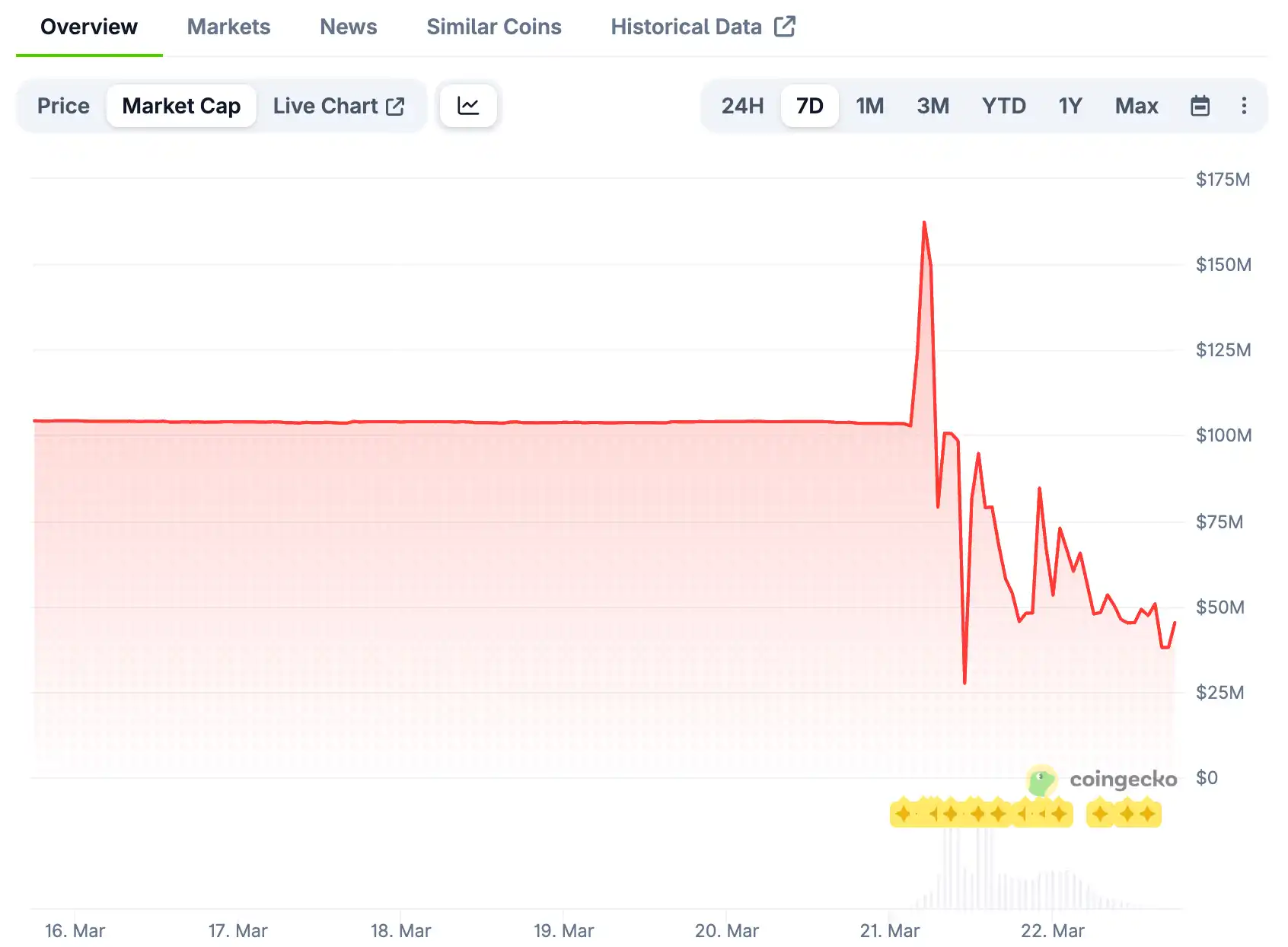
The mechanism that led to the spread of losses from this vulnerability—pricing the off-peg stablecoin at $1 in the lending market—is not a novelty. Over the past 14 months, this situation has occurred at least four times.
How the Exploit Worked
The minting of USR follows a two-step off-chain process: Users deposit USDC through the `requestSwap` function, and a privileged off-chain signing key `SERVICE_ROLE` finalizes the issuance of the USR amount through `completeSwap`.
The contract has a minimum output restriction but no upper limit. Whatever the key holder signs, the contract executes.
The attacker gained access to this key through Resolv's AWS Key Management Service. They submitted two USDC deposits totaling around $100,000 to $200,000 and then utilized the stolen key to mint 80 million USR as a reward. On-chain data shows two transactions of 50 million USR and 30 million USR, both minted within minutes.
「The Resolv USR vulnerability is not a bug - it's a feature working as intended. That's the problem.」 On-chain analyst Vadim (@zacodil) stated.
The SERVICE_ROLE is a regular external account address, not a multisig. The admin key has multisig protection, but the minting key does not.
「Resolv went through 18 audits,」 Vadim said, 「and one of the findings was directly named 'missing cap.'」
The attacker methodically exited: first converting minted USR to wstUSR (a wrapped staking version) to soften the market impact, then swapping it for ETH through Curve, Uniswap, and KyberSwap. The attacker's wallet holds around 11,400 ETH (about $24 million). The system's ETH and BTC collateral pools remain intact amid the stablecoin crash.
How the Contagion Spread
The Resolv vulnerability is actually the overlap of two events. The first being the minting bug and the second the failure of the cascade lending market.
When USR and wstUSR collapsed, every lending market that accepted them as collateral faced the same issue: their oracle still priced wstUSR near $1.
Risk analysis firm Chaos Labs founder Omer Goldberg documented this mechanism. His key finding was: 「The oracle is hardcoded, so it was never repriced. wstUSR was marked at $1.13, while its secondary market trading price was around $0.63.」
Traders bought wstUSR at a low price on the open market, then used the oracle's $1.13 price on Morpho or Fluid to collateralize it and borrowed USDC before exiting.
At Fluid, the team raised short-term loans to cover 100% of the default and pledged to compensate every user in full. At Morpho, co-founder Paul Frambot stated approximately 15 treasuries hold significant exposure, all part of a high-risk, long-tail collateral strategy.
Renowned curator Gauntlet has stated, "Several high-yield vaults have limited exposure."
However, D2 Finance directly refuted this claim, releasing on-chain data showing that Gauntlet's flagship "USDC Core Vault" allocated $4.95 million to the wstUSR/USDC market. Goldberg then stated that Gauntlet's vault holds 98% of the lending-side liquidity in that market.
Responding in writing to The Defiant, Frambot stated, "We've been researching how to present various risks more comprehensively. However, we don't believe the core issue here is a lack of labeling."
Frambot added, "Morpho is oracle agnostic, meaning it allows curators to choose any oracle they deem most suitable for a specific market. Morpho is an open, permissionless infrastructure designed to outsource risk management to curators."
"It is difficult to enforce an objectively 'correct' threshold in all scenarios," Frambot said. "Imposing constraints at the protocol level also carries the risk of hindering the implementation of legitimate strategies."
While the underlying protocol leaves risk management to the curator, some industry insiders believe that curators have not fulfilled their duties.
"I believe there is a flaw in the curator industry's design, as there is no genuine curation taking place," Marc Zeller stated on X.
As of the time of writing, Resolv, Gauntlet, and Fluid have not responded to The Defiant's request for comment.
A Recurring Pattern of Failure
This is not a new type of attack. In January 2025, Usual Protocol's USD0++ was hard-coded to $1 by curator MEV Capital in the Morpho Vault.
Usual then suddenly adjusted the redemption floor to $0.87 without any warning, leaving lenders locked in the MEV Capital Vault, which saw its utilization surge to 100%.
In November 2025, Stream Finance's xUSD collapsed, as the curator had routed USDC deposits into a leverage loop backed by that synthetic stablecoin. When its oracle refused to update, assets worth an estimated $2.85 billion to $7 billion on Morpho, Euler, and Silo faced risk.
In October and November 2025, Moonwell experienced two consecutive oracle failures, resulting in over $5 million in defaults.
What Does This Mean for the Curator Model
Morpho's architecture outsources all risk decisions to a third-party "curator," who builds the vault, selects collateral, sets loan-to-value ratios, and chooses oracles. This theoretical framework posits that professional entities possess deeper expertise, competition leads to better risk management, and the protocol is responsible for rule execution.
However, curators rely on generated yields to earn fees, creating an incentive for higher-risk, higher-yield collateral (such as yield-bearing stablecoins). The issue arises when these stablecoins lose their peg, with depositors bearing the brunt of the loss instead of the curator.
In the Resolv incident, some curators' automated bots continued to deposit funds into the affected vault hours after the exploit, exacerbating the loss.
The reason for using hard-coded oracles for yield-bearing stablecoins is to prevent unnecessary liquidations triggered by short-term fluctuations. However, this protection is only effective when the stablecoin remains stable.
Chainalysis, a blockchain analysis firm, stated in a post-mortem analysis that real-time on-chain monitoring capabilities are essential.
"The on-chain smart contract execution worked perfectly fine. The issue clearly stemmed from broader system design and off-chain infrastructure." The analysis firm stated.
You may also like

Curve Deploys Llamalend v2 on Optimism With 250,000 OP Incentives
Curve launched Llamalend v2 on Optimism with 250,000 OP incentives from the Optimism Foundation. The upgrade expands Llamalend beyond its earlier crvUSD-focused model, adding broader collateral support, LlamaRisk market reviews, and the ability to use Curve LP tokens as collateral.

Raydium Old Liquidity Pool Reportedly Exploited, With $1.34 Million Moved to Ethereum and Tornado Cash
An old Raydium liquidity pool was reportedly exploited for around $1.34 million in USDC, RAY, and wSOL, with the stolen funds bridged to Ethereum and deposited into Tornado Cash. The incident highlights the tail risks of legacy DeFi pools, old contracts, and cross-chain fund laundering paths.

Kalshi Executive Challenges “SBF Backed AI Unicorns” Narrative, Says Leopold Aschenbrenner Was Key Figure
Kalshi executive John Wang questioned the “SBF backed AI unicorns” narrative, saying Leopold Aschenbrenner was the key figure behind major AI investment decisions.

Pantera Capital Partner: How Tokenization is Restructuring the Private Equity and Early Investment Ecosystem?

New York Proposes Stricter Stablecoin Issuer Rules Aligned With Federal GENIUS Act
NYDFS proposed stricter stablecoin issuer rules aligned with the GENIUS Act, covering reserves, custody, redemption timelines, audits, and capital buffers.
Every exchange is a "Universal Exchange."

The counterattack of traditional finance: Alliance chains are quietly reviving

CryptoQuant Says Bitcoin Profitable Supply Is Near 45% Pressure Zone as On-Chain Data Points to Market Repricing
CryptoQuant said Bitcoin’s profitable supply is nearing the 45% pressure zone, signaling rising market stress, unrealized losses, and a possible on-chain repricing phase.

Bitcoin Falls Below 200-Week Moving Average as On-Chain Data Shows Over Half of Supply in Loss
Bitcoin dropped below its 200-week moving average as on-chain data showed over 50% of circulating supply is now in loss, signaling rising market stress.

CFTC Reportedly Plans New Prediction Market Rules Focused on Manipulation Risk and Public Interest Review
The CFTC is reportedly preparing new prediction market rules focused on manipulation risk, public interest review, and retail trader protections.

Meet the new WEEX trial fund—your gateway to greater profits

WEEX Labs Lands at Dutch Blockchain Week: A Disruptive Crypto × AI Conversation Sets Sail in Amsterdam

SK Hynix Reportedly Plans U.S. ADR Listing as Early as August, With SEC Approval Possible in Late June
SK Hynix may pursue a U.S. ADR listing as early as August, with SEC approval reportedly possible in late June amid strong AI chip supply chain demand.

SpaceX vs Tesla vs xAI: Which Elon Musk Trade Has the Biggest Upside in 2026?
OpenAI Reveals It Has Confidentially Submitted an S-1 to the SEC, Keeping the Door Open for a Future IPO
On June 9, according to an OpenAI announcement, the company recently confidentially submitted a draft S-1 registration statement to the U.S. Securities and Exchange Commission (SEC), beginning the preliminary compliance process for a potential initial public offering. OpenAI said it chose to disclose this proactively because it expected the news might leak; however, the company has not yet set a specific listing timeline, and related arrangements may still take some time.
Latest research from 13 top universities including Cornell University: The current state, challenges, and misconceptions of the fusion of Crypto and AI
Deconstructing Anthropic: The Best AI Company, Possibly Also a Type of Organizational Invention
Apollo and Blackstone Reportedly Back $35 Billion Anthropic Chip Financing as Deal Details Remain Unclear
On June 9, according to currently available news alerts, Apollo and Blackstone Group participated in a $35 billion financing for an Anthropic “chip project.” Based on the original wording of the report, the funding has already been raised, but public information remains limited. The financing structure, use of proceeds, project entity, and whether Apollo and Blackstone participated through equity, debt, or project financing have not yet been disclosed.
Curve Deploys Llamalend v2 on Optimism With 250,000 OP Incentives
Curve launched Llamalend v2 on Optimism with 250,000 OP incentives from the Optimism Foundation. The upgrade expands Llamalend beyond its earlier crvUSD-focused model, adding broader collateral support, LlamaRisk market reviews, and the ability to use Curve LP tokens as collateral.
Raydium Old Liquidity Pool Reportedly Exploited, With $1.34 Million Moved to Ethereum and Tornado Cash
An old Raydium liquidity pool was reportedly exploited for around $1.34 million in USDC, RAY, and wSOL, with the stolen funds bridged to Ethereum and deposited into Tornado Cash. The incident highlights the tail risks of legacy DeFi pools, old contracts, and cross-chain fund laundering paths.
Kalshi Executive Challenges “SBF Backed AI Unicorns” Narrative, Says Leopold Aschenbrenner Was Key Figure
Kalshi executive John Wang questioned the “SBF backed AI unicorns” narrative, saying Leopold Aschenbrenner was the key figure behind major AI investment decisions.
Pantera Capital Partner: How Tokenization is Restructuring the Private Equity and Early Investment Ecosystem?
New York Proposes Stricter Stablecoin Issuer Rules Aligned With Federal GENIUS Act
NYDFS proposed stricter stablecoin issuer rules aligned with the GENIUS Act, covering reserves, custody, redemption timelines, audits, and capital buffers.
Every exchange is a "Universal Exchange."


