
22x Subsidy to 1 USD Revenue: How Long Can the TAO Growth Myth Last?

Original Title: The Bear Case for Bittensor (TAO)
Original Source: Pine Analytics
Original Translation: Saoirse, Foresight News
TAO is currently priced at around $275, with a market cap of $26 billion and a fully diluted valuation of $58 billion. The project has received endorsement from Grayscale Investments (a New York Stock Exchange ETF listing application was submitted in December 2025) and has also been publicly praised by NVIDIA CEO Jensen Huang. Additionally, the token supply narrative is very appealing: with a total supply cap of 21 million coins and a Bitcoin-like halving mechanism. Following the first halving in December 2025, the daily issuance decreased from 7200 coins to 3600 coins. Within a year, the number of subnets increased from 32 to 128, and Templar's Covenant-72B training has demonstrated that decentralized compute power can train large language models competitively.
This report does not deny the above facts. What we aim to explore is: whether the network's economic model can generate real external revenue to support the current valuation scale, and how competitive it is when facing centralized service providers and self-hosted compute power.
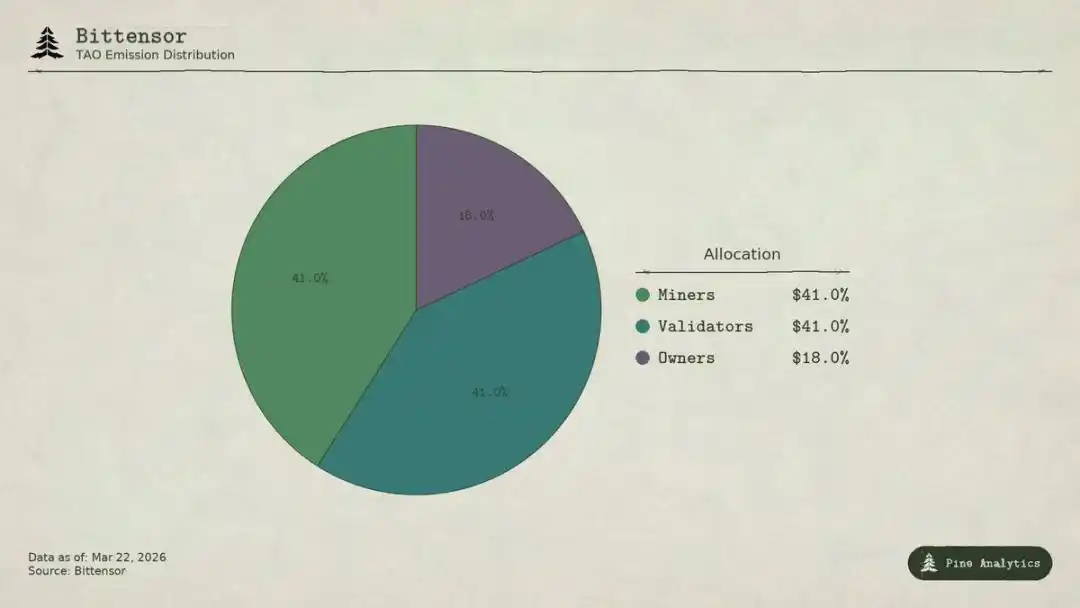
Bittensor (TAO) Token Issuance Allocation
How Network Value Flows
Bittensor has four types of participants:
· Subnet owners who build a professional AI marketplace and receive 18% of the TAO issuance reward for the subnet;
· Miners who perform AI tasks (inference, training, data processing) receive 41%, totaling approximately 1476 TAO per day, with an annualized value of around $148 million;
· Validators score the output of miners and receive 41%;
· Stakers who deposit TAO into the subnet liquidity pool in exchange for subnet-specific tokens.
In the Taoflow model, a subnet's reward share is determined by the net inflow of staked TAO, with no reward for negative net flows. The top ten subnets control around 56% of the total network issuance.
TAO is a Universal Token: Mining registration, validator staking, subnet token purchase, and service payments all require the use of TAO. In theory, subnet activity will bring structural demand to the base layer token.
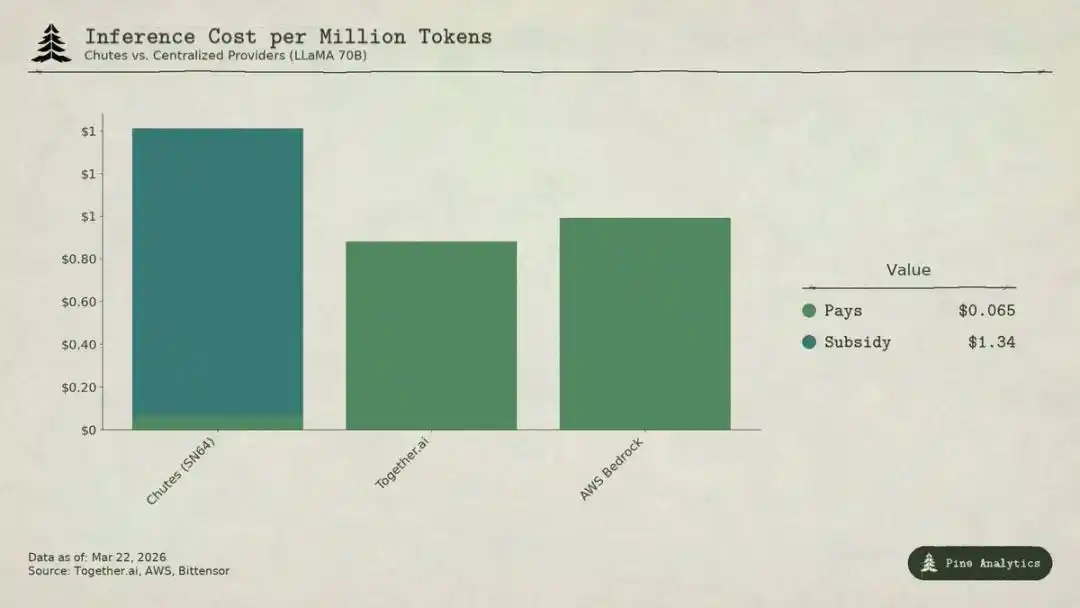
Comparison Analysis between Bittensor Subnet Chutes (SN64) and Centralized Service Provider LLaMA 70B Model Inference Costs
Current Demand-Side Status
Transparent Supply vs. Opaque Demand
Bittensor's supply side is highly transparent: 3600 TAO distributed daily according to a programmatic schedule, halving rule hard-coded, staking rate (around 70%), allocation ratios, and liquidity data all on-chain.
However, the demand side is completely opaque. There is no unified dashboard to track external income per subnet, and the actual usage of AI services (inference, computation, training) occurs off-chain and is not recorded on the blockchain. Investors can only speculate on demand through indirect indicators such as staking flow, subnet token price, and project-reported data. This opacity is structural, not a temporary phenomenon. The blockchain only records token transfers, not API calls.
Below is the most comprehensive demand-side overview as of March 2026.
Chutes (SN64): Subsidized Low Price
Chutes hold 14.4% of the total network issuance, the highest among all subnets. Developed by Rayon Labs, it offers open-source model serving without servers at a price 85% lower than AWS and 10%-50% lower than Together AI. Its usage data outshines all others in the ecosystem: over 400k users (over 100k API users), daily request volume surpassing 5 million, cumulative processing of 9.1 trillion tokens, and three-day average token generation soaring from 6.6 billion to 101 billion. It is also a top inference provider on OpenRouter, with some models outperforming centralized competitors.
However, this low price does not stem from operational efficiency but from subsidies.
Calculated on the 14.4% share, Chutes receive approximately 518 TAO daily, with an annualized value of around $52 million. Yet its external annual revenue is only about $1.3-2.4 million (the higher figure is self-reported by the team and not independently audited). The protocol's subsidy ratio to this subnet is about 22:1 to 40:1. For every $1 paid by users, the network must release 22-40 dollars' worth of TAO through inflation to subsidize.
If subsidies are removed, the cost price, reverse-calculated based on its daily processing volume of approximately 1.01 trillion tokens, is about $1.41 per million tokens. Whereas the current centralized market prices are:
· Together.ai's LLaMA 3.3 70B Turbo around $0.88 per million tokens;
· DeepSeek V3 around $0.40–0.80;
· Small-scale models going as low as $0.18.
This means that post-subsidy removal, Chutes' price will be 1.6–3.5 times higher than the centralized solutions. The so-called 85% cost advantage is completely reversed, where the low price is the result of TAO holders footing the bill through inflation, not the structural efficiency brought by decentralization.
With the upcoming halving (expected by late 2026 or 2027), either prices will double, miners will exit, or the subsidy-revenue gap will widen further.
Some draw parallels with early-days internet subsidy for user acquisition, but Uber, DoorDash, AWS built conversion costs during the subsidy period: proprietary platforms, driver networks, enterprise ecosystems. The Bittensor subnet has no barriers: open-source models, standardized interfaces, allowing users to switch service providers at zero cost. Once subsidies recede, there is no lock-in mechanism to retain users.
Rayon Labs also operates SN56 and SN19, collectively controlling approximately 23.7% of the total network issuance, with undisclosed external revenue. A single team nearly controls a quarter of the network's incentive distribution.
Targon, Templar, and Other Subnets
Targon (SN4) is the highest-income subnet, operated by Manifold Labs, providing confidential GPU compute services to enterprises, with an estimated annual revenue of around $10.4 million, corresponding to a valuation of $48 million, a market-to-sales ratio of about 4.6 times, representing the most solid valuation in the ecosystem. However, the $10.4 million is only a projected figure cited in several reports and not audited numbers.
Templar (SN3) completed the Covenant-72B training, with a market value of $98 million, but zero external revenue. Training APIs and enterprise sales efforts are still ongoing, with no paid products launched yet.
The remaining 120+ subnets either have no publicly disclosed revenue or are still in the early stages of product development, heavily relying on token issuance subsidies for survival.
Overview
The total verifiable demand-side annual revenue of the network is only about $3-15 million. The annual subsidy for just one subnet, Chutes (about $52 million), exceeds the upper limit of the entire network's external revenue.
Based on a $2.6 billion market valuation, its revenue multiple is approximately 175-200x; based on a $5.8 billion fully diluted valuation, it is close to 400x. In recent years, centralized AI compute companies have been valued at only 15-25x forward revenue, and high-growth SaaS companies rarely sustain valuations above 50x long term. Bittensor's valuation multiple is 4-10x of the industry's aggressive target.
The significant disparity between valuation and fundamental demand highlights that the market almost entirely prices TAO based on supply-side scarcity (halving, staking lockup), institutional catalysts (Grayscale ETF, anticipated listing), and AI sector sentiment, rather than real economic output. While these are indeed price-driving factors, they are entirely separate from the logic of "Bittensor creating sustainable value as an AI service network."
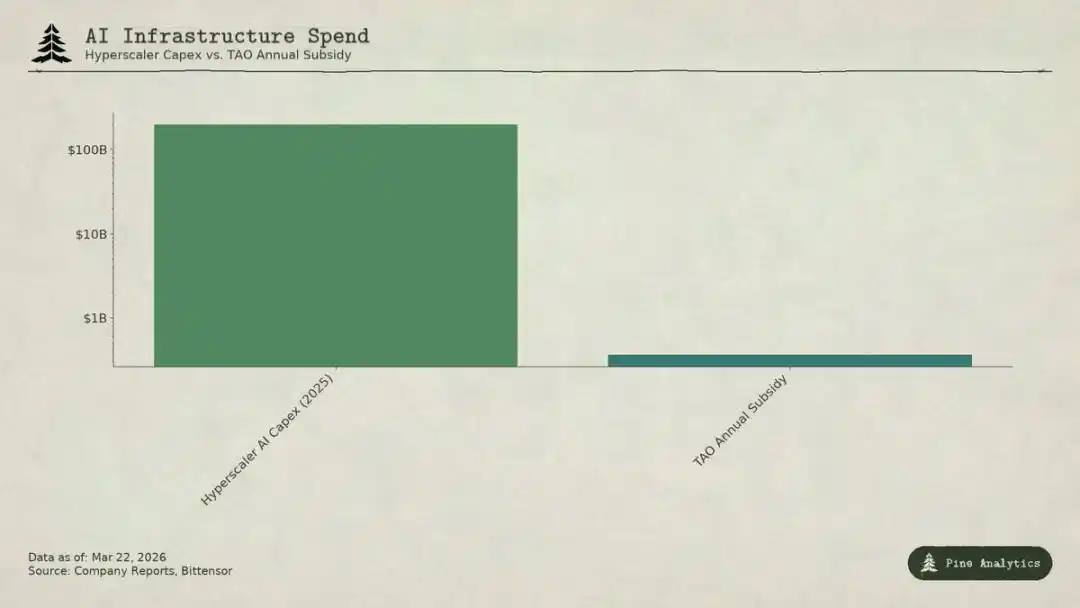
Comparison of AI Capital Expenditure of Hyperscale Cloud Providers with Bittensor (TAO) Annual Subsidy Scale
Pricing Predicament: Caught in the Middle
The subnet faces a two-pronged squeeze:
· Upward Pressure: Self-hosting Cap
All models on the platform are open-source, with weights public, running a 70B model on a single H100 costing only $40-50 in total daily costs, and tools like vLLM, Ollama making local deployment extremely simple. NVIDIA's next-gen chip will significantly reduce inference costs. Institutionally self-hosted deployments with sufficient volume will be even cheaper.
· Downward Pressure: Cloud Giants Squeeze
By 2025, AI capital spending by Microsoft, Google, Amazon, Meta exceeds $200 billion, with hardware preferential quotas, dedicated data centers, enterprise customer relations, and the ability to subsidize AI with cash flows from other businesses. Bittensor's annual incentive budget (approximately $360 million) is less than Microsoft's weekly AI infrastructure investment. Professional service providers also subsidize low-cost competition on open-source models using VC funds.
Subnet pricing is compressed into an extremely narrow range and must also bear the unique costs of decentralization: token friction, validation node overhead, subnet owner revenue share, network latency, etc.
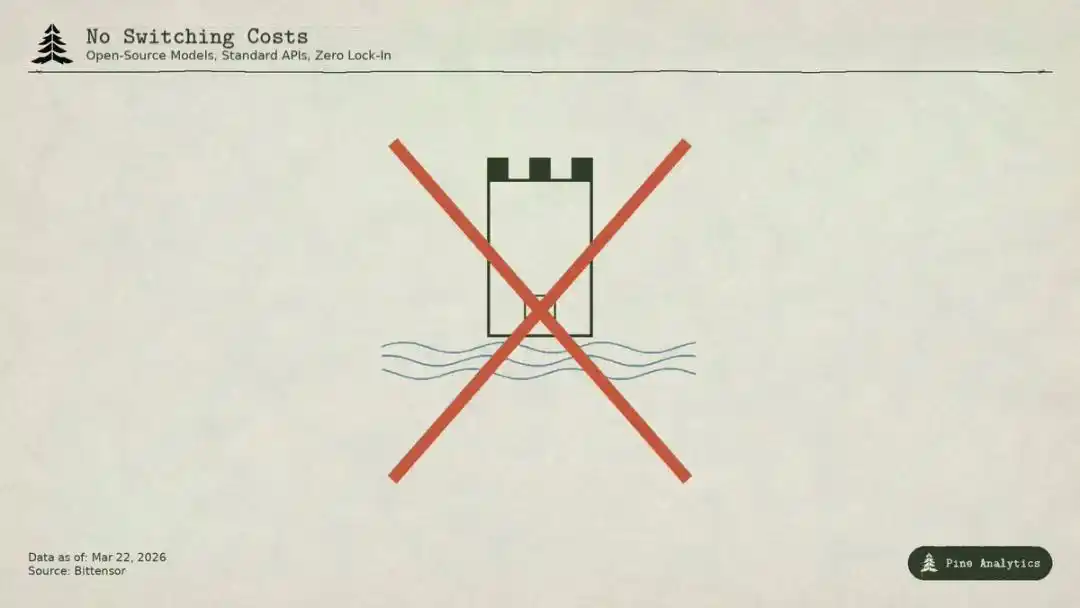
Mote Problem
Even if a subnet provides valuable services, the underlying model and approach are inherently open: Covenant-72B adopts the Apache license, and the technical paper is publicly available. Any competitor can directly replicate the TAO ecosystem without participating.
Traditional moats (proprietary technology, network effects, switching costs, brand) do not apply:
· Technology is open-source;
· Network effects belong to TAO, not to individual subnets;
· Model weights are consistent, and user switching costs are zero.
The community believes that the incentive mechanism is the moat, but this relies on continuous large-scale token issuance, and each halving will continue to shrink the incentive budget.
What Is TAO Trading Exactly
With a market capitalization of $2.6 billion, TAO's price does not reflect fundamental demand. An annual revenue of 3–15 million cannot be sustained in any traditional framework. The market trades: Bitcoin-like scarcity, Grayscale ETF expectations, AI sector rotation, and the long-term option value of decentralized AI. These are all reasonable speculative factors but are entirely driven by the supply side and market sentiment.
If you hold TAO based on scarcity and narrative, you may still profit even if demand weakens; but if you believe Bittensor will become a truly scalable AI service network, currently there is no evidence, and it faces insurmountable structural resistance. Investors should clearly differentiate their investment logic.
You may also like

Pantera Capital Partner: How Tokenization is Restructuring the Private Equity and Early Investment Ecosystem?

New York Proposes Stricter Stablecoin Issuer Rules Aligned With Federal GENIUS Act
NYDFS proposed stricter stablecoin issuer rules aligned with the GENIUS Act, covering reserves, custody, redemption timelines, audits, and capital buffers.
Every exchange is a "Universal Exchange."

The counterattack of traditional finance: Alliance chains are quietly reviving

CryptoQuant Says Bitcoin Profitable Supply Is Near 45% Pressure Zone as On-Chain Data Points to Market Repricing
CryptoQuant said Bitcoin’s profitable supply is nearing the 45% pressure zone, signaling rising market stress, unrealized losses, and a possible on-chain repricing phase.

Bitcoin Falls Below 200-Week Moving Average as On-Chain Data Shows Over Half of Supply in Loss
Bitcoin dropped below its 200-week moving average as on-chain data showed over 50% of circulating supply is now in loss, signaling rising market stress.

CFTC Reportedly Plans New Prediction Market Rules Focused on Manipulation Risk and Public Interest Review
The CFTC is reportedly preparing new prediction market rules focused on manipulation risk, public interest review, and retail trader protections.

Meet the new WEEX trial fund—your gateway to greater profits

WEEX Labs Lands at Dutch Blockchain Week: A Disruptive Crypto × AI Conversation Sets Sail in Amsterdam

SK Hynix Reportedly Plans U.S. ADR Listing as Early as August, With SEC Approval Possible in Late June
SK Hynix may pursue a U.S. ADR listing as early as August, with SEC approval reportedly possible in late June amid strong AI chip supply chain demand.

SpaceX vs Tesla vs xAI: Which Elon Musk Trade Has the Biggest Upside in 2026?
OpenAI Reveals It Has Confidentially Submitted an S-1 to the SEC, Keeping the Door Open for a Future IPO
On June 9, according to an OpenAI announcement, the company recently confidentially submitted a draft S-1 registration statement to the U.S. Securities and Exchange Commission (SEC), beginning the preliminary compliance process for a potential initial public offering. OpenAI said it chose to disclose this proactively because it expected the news might leak; however, the company has not yet set a specific listing timeline, and related arrangements may still take some time.

Latest research from 13 top universities including Cornell University: The current state, challenges, and misconceptions of the fusion of Crypto and AI
Deconstructing Anthropic: The Best AI Company, Possibly Also a Type of Organizational Invention
Apollo and Blackstone Reportedly Back $35 Billion Anthropic Chip Financing as Deal Details Remain Unclear
On June 9, according to currently available news alerts, Apollo and Blackstone Group participated in a $35 billion financing for an Anthropic “chip project.” Based on the original wording of the report, the funding has already been raised, but public information remains limited. The financing structure, use of proceeds, project entity, and whether Apollo and Blackstone participated through equity, debt, or project financing have not yet been disclosed.

Humanity Protocol Security Incident Escalates: More Than $31 Million Stolen From Related Addresses as Attacker Continues Selling H for ETH
On June 9, according to monitoring by Onchain Lens, more than $31 million has been stolen from addresses linked to Humanity Protocol, and the attack is still ongoing, with the hacker continuously swapping H tokens for ETH. Project founder Terence Kwok later confirmed the security incident on X, saying the issue involved a private key leak.

Bloomberg: As Bitcoin Weakens, Stablecoins and RWA Continue to Drive Expansion in Crypto Businesses
In June, Bloomberg reported that despite Bitcoin falling below $60,000 last week, wiping out about $235 billion in market value within seven days, and dropping close to 50% from last year’s peak, some core businesses in the crypto industry are still expanding, mainly in stablecoins, real-world asset tokenization (RWA), payments, and infrastructure. The report also noted that overall altcoin activity has contracted significantly: altcoin market capitalization has fallen from a peak of about $431 billion in November 2021 to around $170 billion, and among the tens of millions of tokens issued in recent years, fewer than 1,700 still maintain meaningful trading activity.

Galaxy Deep Research Report: How Hyperliquid's HIP-4 Upgrade Changes the Landscape of Prediction Markets?
Pantera Capital Partner: How Tokenization is Restructuring the Private Equity and Early Investment Ecosystem?
New York Proposes Stricter Stablecoin Issuer Rules Aligned With Federal GENIUS Act
NYDFS proposed stricter stablecoin issuer rules aligned with the GENIUS Act, covering reserves, custody, redemption timelines, audits, and capital buffers.
Every exchange is a "Universal Exchange."
The counterattack of traditional finance: Alliance chains are quietly reviving
CryptoQuant Says Bitcoin Profitable Supply Is Near 45% Pressure Zone as On-Chain Data Points to Market Repricing
CryptoQuant said Bitcoin’s profitable supply is nearing the 45% pressure zone, signaling rising market stress, unrealized losses, and a possible on-chain repricing phase.
Bitcoin Falls Below 200-Week Moving Average as On-Chain Data Shows Over Half of Supply in Loss
Bitcoin dropped below its 200-week moving average as on-chain data showed over 50% of circulating supply is now in loss, signaling rising market stress.


